

Have you ever stopped mid-sentence and asked yourself, “Should I say ‘there is no’ or ‘there are no’ here?” You’re not alone. This is one of the most common grammar dilemmas in the English language and it trips up native speakers just as often as learners.
The good news? Once you understand the logic behind these two phrases, the confusion disappears for good. This guide breaks down the difference between there is no and there are no, covers every edge case from uncountable nouns to tricky words like data and news and gives you dozens of real-world examples to make the rule stick.
By the end of this article, you’ll know exactly which phrase to reach for, every single time.
What Is the Difference Between “There Is No” and “There Are No”?
The core rule is simple:
- “There is no” is used with singular countable nouns and uncountable nouns
- “There are no” is used with plural countable nouns
Both phrases express the absence of something that something does not exist, is not available, or is not present. The only thing that changes is the noun that follows.
| Phrase | Noun Type | Example |
| There is no | Singular countable noun | There is no chair in the room. |
| There is no | Uncountable noun | There is no water in the glass. |
| There are no | Plural countable noun | There are no chairs in the room. |
This single table captures 90% of what you need to know. The remaining 10%? We’ll get to that including special cases like collective nouns, gerunds, quantifiers, and tricky words that look plural but aren’t.
Understanding the Grammar Foundation: Singular vs. Plural Nouns
Before going further, it helps to revisit the grammar building blocks that make this rule work.
What Are Countable Nouns?
Countable nouns are people, places, things, or ideas that can be counted individually. They have both a singular and a plural form.
Examples of countable nouns:
- Book → Books
- Chair → Chairs
- Reason → Reasons
- Mistake → Mistakes
- Dog → Dogs
Because countable nouns can be singular or plural, the verb changes accordingly:
- There is no book on the shelf. (singular)
- There are books on the shelf. (plural)
What Are Uncountable Nouns?
Uncountable nouns also called mass nouns refer to things that cannot be counted as individual units. They represent substances, concepts, or abstract ideas that are treated as a whole. Crucially, they are always grammatically singular, even when they refer to a large quantity.
Common examples of uncountable nouns:
| Category | Examples |
| Liquids & substances | water, milk, oil, air, sand |
| Abstract concepts | information, knowledge, advice, happiness, hope |
| Materials | wood, iron, cotton, paper |
| Food types | rice, bread, butter, pasta |
| Academic fields | music, chemistry, literature |
| Natural phenomena | weather, thunder, gravity |
Because uncountable nouns are always singular, they always pair with “there is no” never “there are no.”
- ✅ There is no information available.
- ❌ There are no information available.
- ✅ There is no furniture in the apartment.
- ❌ There are no furniture in the apartment.
“There Is No” Complete Usage Guide
Rule 1: Use with Singular Countable Nouns
When you’re talking about the absence of one specific thing, “there is no” is your phrase.
Examples:
- There is no bus stop near my house.
- There is no ticket left for the show.
- There is no teacher in the classroom right now.
- There is no good reason to skip breakfast.
- There is no phone on the desk.
Notice how each sentence refers to exactly one of something. If you’re tempted to say a or one before the noun, “there is no” is almost certainly the right choice.
Rule 2: Use with Uncountable Nouns
This is where many writers slip up. Uncountable nouns feel large and abundant water, money, information, traffic so people instinctively reach for the plural form. Resist that instinct.
Examples:
- There is no time left before the deadline.
- There is no money in the account.
- There is no evidence to support that claim.
- There is no electricity in this part of town.
- There is no traffic on the highway tonight.
- There is no progress without effort.
- There is no shortage of talent in the team.
Rule 3: Use with Gerunds and Infinitives (Idiomatic Expressions)
One fascinating pattern in English is that most idiomatic expressions use “there is no” rather than “there are .” Why? Because these phrases deal with abstract, uncountable concepts actions, states, or impossibilities rather than physical objects you can count.
Classic idioms and expressions using “there is no”:
- There is no turning back.
- There is no place like home.
- There is no doubt about it.
- There is no point in arguing.
- There is no accounting for taste.
- There is no getting around the problem.
In all of these, the word following “there is no” is either a gerund (-ing form) or an abstract noun both of which are grammatically uncountable.
“There Are No” Complete Usage Guide
Rule: Use with Plural Countable Nouns
“There are ” appears whenever the noun that follows is plural meaning it refers to more than one of something that can be individually counted.
Examples:
- There are seats available on this flight.
- There are students in the library today.
- There are mistakes in your report.
- There are buses running after midnight.
- There are clouds in the sky this morning.
- There are good movies at the cinema this weekend.
- There are rules against wearing casual clothes on Friday.
The test is simple: can the noun be counted individually? Can it take an -s or -es ending? If yes, and there are multiple of them, you want “there are .”
Side-by-Side Comparison: “There Is No” vs “There Are No”
Sometimes the clearest way to see the difference is to look at both phrases in direct contrast, using the same noun in its singular and plural forms.
| “There Is No” (Singular/Uncountable) | “There Are No” (Plural) |
| There is no dog in the park. | There are no dogs in the park. |
| There is no reason to panic. | There are no reasons to panic. |
| There is no option left. | There are no options left. |
| There is no mistake in this draft. | There are no mistakes in this draft. |
| There is no student absent today. | There are no students absent today. |
| There is no flight to Paris tonight. | There are no flights to Paris tonight. |
| There is no parking space available. | There are no parking spaces available. |
| There is no solution to this problem. | There are no solutions to this problem. |
Notice how the meaning in each row is nearly identical the only shift is whether you’re speaking about one thing or many things.
Tricky Cases and Special Scenarios
This is where English earns its reputation for complexity. Let’s look at the words and situations that create the most confusion.
1. “There Is No” with Words That Look Plural
Some words end in -s and appear plural but are grammatically singular and uncountable. Always use “there is no” with these.
| Word | Correct Usage |
| news | There is no news about the storm. |
| mathematics | There is no mathematics exam today. |
| physics | There is no physics class this week. |
| economics | There is no economics lecture on Friday. |
2. “Data” Singular or Plural?
This one sparks genuine debate. Technically, data is the Latin plural of datum. In formal academic and scientific writing, many style guides still treat it as plural:
- There are data to support this hypothesis. (formal/academic)
However, in everyday modern English, data is widely treated as an uncountable singular noun:
- There is no data to support this hypothesis. (standard modern usage)
Both are accepted, but choose based on your audience and context. Academic writing: plural. Business writing and everyday speech: singular.
3. Collective Nouns
Collective nouns like team, staff, committee, and family refer to a group but are typically treated as singular in American English.
- There is no team willing to take on the project.
- There is no committee reviewing the proposal at this time.
In British English, collective nouns sometimes take plural agreement, so you may occasionally see:
- There are no staff available this afternoon. (British English)
4. Quantifiers Before Uncountable Nouns
Here’s a twist that catches many writers off guard. When a quantifier (like number, amount, or series) precedes an uncountable noun, the verb agreement depends on the quantifier not the uncountable noun itself.
- There are amounts of caffeine that can replace proper sleep.
- There are types of evidence strong enough to change his mind.
In these sentences, amounts and types are the plural countable nouns driving the plural verb. The uncountable nouns (caffeine, evidence) become secondary.
5. “There Is No” vs “There Are No” with Percentages and Statistics
When referring to a singular percentage or proportion, use “there is no”:
- There is no 100% guarantee in this field.
When referring to multiple statistics or percentages as a collection:
- There are reliable statistics on this topic.
Common Mistakes to Avoid

Even fluent English speakers make predictable errors with these phrases. Here are the most frequent slip-ups:
Mistake 1: Using “There Are No” with Uncountable Nouns
❌ There are information on the website. ✅ There is no information on the website.
❌ There are evidence of wrongdoing. ✅ There is no evidence of wrongdoing.
❌ There are furniture included in the rent. ✅ There is no furniture included in the rent.
Mistake 2: Using “There Is No” with Plural Countable Nouns
❌ There is no chairs in the waiting room. ✅ There are no chairs in the waiting room.
❌ There is no tickets available. ✅ There are no tickets available.
Mistake 3: Using “There’s” Before Plural Nouns in Writing
In casual spoken English, people often say “There’s no chairs” or “There’s no tickets.” This sounds natural in conversation, but it is grammatically incorrect and should be avoided in all formal writing, emails, reports, and academic work.
❌ There’s no options left. (written English) ✅ There are no options left. (written English) ✓ There’s no options left. (informal speech only acceptable but technically incorrect)
Real-World Examples Across Different Contexts
Grammar rules are only truly useful when you can see them working in situations you actually encounter. Here’s how these phrases appear across everyday contexts.
In Business and Professional Writing
- There is no deadline extension possible at this stage.
- There are no vacancies in the marketing department.
- There is no budget allocated for this quarter.
- There are no outstanding invoices on your account.
In Academic Writing
- There is no conclusive evidence to support this theory.
- There are peer-reviewed studies confirming this result.
- There is no consensus among researchers on this point.
- There are no significant differences between the two groups.
In Everyday Conversation
- There is no milk left in the fridge.
- There are no good seats left at the theater.
- There is no WiFi in this area.
- There are no eggs in the carton.
In Formal Letters and Emails
- There is no record of your previous correspondence in our system.
- There are no available appointments this week, but we can schedule for next Monday.
- There is no obligation to respond immediately.
Click Here To Read Also Appreciative of vs Appreciative for
Quick Reference: How to Choose the Right Phrase
Use this decision flow every time you’re unsure which phrase fits:
- Identify the noun after “there ___ no.”
- Ask: Can I count it? Can I say one, two, three of it?
- If no → it’s uncountable → use “there is no”
- If yes: Is it singular (one) or plural (more than one)?
- Singular → use “there is no”
- Plural → use “there are no”
| Noun Type | Verb | Phrase |
| Singular countable (one thing) | is | There is no book |
| Uncountable (can’t be counted) | is | There is no water |
| Plural countable (multiple things) | are | There are no books |
“There’s No” The Contraction
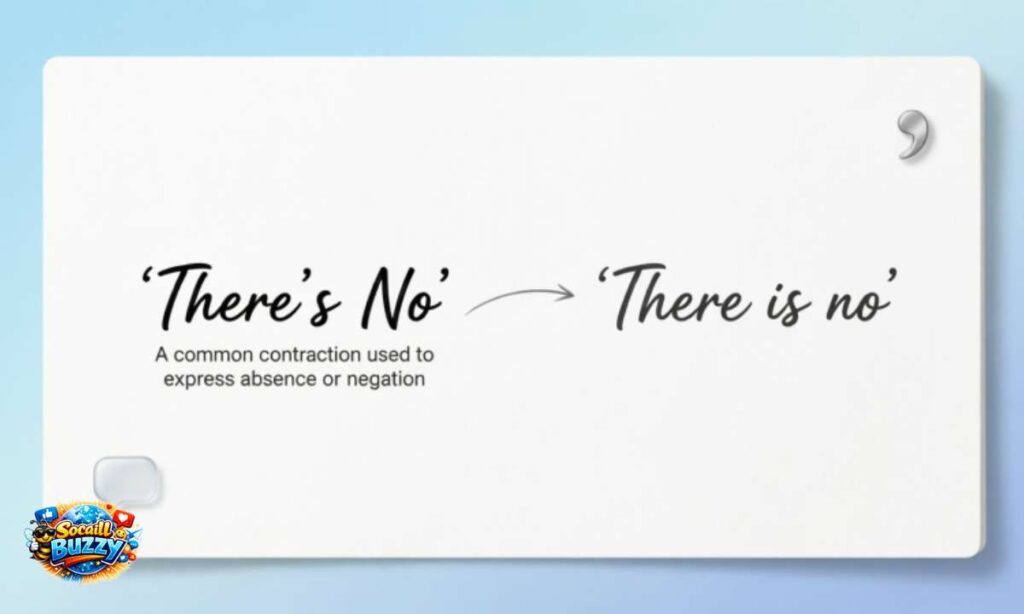
“There’s” is simply a contraction of “there is.” That means “there’s no” follows the exact same rules as “there is no” it’s used with singular countable or uncountable nouns.
- There’s no time to waste. ✅ (uncountable noun)
- There’s no doctor available right now. ✅ (singular countable noun)
- There’s no reason to worry. ✅ (singular countable noun)
In formal writing, expand the contraction to “there is no” for a more professional tone. In speech and informal writing, “there’s no” is perfectly natural.
Important: Do not use “there’s” before a plural noun in written English:
- ❌ There’s no problems with the plan. (written)
- ✅ There are no problems with the plan. (written)
- ✓ There’s no problems with the plan. (informal spoken only)
LSI Keywords and Related Grammar Concepts
Understanding “there is no” vs “there are no” connects naturally to several related grammar areas:
- Subject-verb agreement the fundamental principle behind this distinction
- Existential sentences sentences beginning with “there” that indicate existence or absence
- Noun countability the difference between count and non-count (mass) nouns
- Determiners words like no, some, any that precede nouns
- Negative sentences expressing absence or non-existence in English
- Article usage when to use a/an vs no vs nothing before a noun
Mastering this topic makes all of these related areas significantly clearer.
Conclusion: The Rule That Never Changes
Whether you’re writing a business email, an academic essay, or a casual message to a friend, the rule stays the same:
- “There is no” = singular or uncountable noun
- “There are no” = plural countable noun
The key is learning to quickly identify what type of noun you’re dealing with. Ask yourself: Can I count it? Is it one thing or many? That single question will almost always give you the answer.
With enough practice and the examples in this guide you won’t need to pause anymore. The right phrase will come naturally, every time.
Frequently Asked Questions (FAQs)
Q1: Is “there is no” or “there are no” correct?
Both are correct which one to use depends on whether the noun that follows is singular/uncountable (“there is no”) or plural (“there are no”).
Q2: Can I say “there are no information”?
No. Information is an uncountable noun, so the correct form is “there is no information.”
Q3: Is “there’s no” the same as “there is no”?
Yes “there’s” is simply the contracted form of “there is” and follows the same grammar rules.
Q4: Can I say “there are no news”?
No. News is uncountable despite its -s ending, so you must say “there is no news.”
Q5: Which is more common “there is no” or “there are no”?
“There is no” is generally more common because it covers both singular and uncountable nouns, and most idiomatic expressions use it.
Q6: Can I say “there are no reason”?
No. Reason is singular here, so say “there is no reason” or use the plural: “there are no reasons.”
Q7: What about “there is no data” vs “there are no data”?
Both are used. Academic writing often treats data as plural (“there are no data”), while everyday writing treats it as singular (“there is no data”). Choose based on your style guide and audience.
Q8: Is “there’s no problems” grammatically correct?
In formal written English, no it should be “there are no problems.” In informal speech, it’s widely heard but still technically incorrect.
Q9: Do idioms use “there is no” or “there are no”?
Almost all common idioms use “there is no” e.g., “there is no turning back,” “there is no place like home” because they involve abstract, uncountable ideas.
Q10: How do I quickly decide which phrase to use?
Identify the noun, check if it’s countable and plural → use “there are no.” If it’s singular or uncountable → use “there is no.” That’s the complete rule.

Welcome to SocaillBuzzy! I’m the creator and writer behind this platform, dedicated to sharing meaningful content including grammar, meaning, quotes, and inspirational messages for everyday life. Through well-crafted, SEO-friendly content, I aim to spread positivity, strengthen connections, and make it easier for readers to express their emotions with clarity and warmth.



uompmkrsymvzvsmvmggdnrekzemysi
ppksoqsgdqdmtrskylfyrqxdfpgnrm