Ever paused mid-sentence while writing a birthday card or a farewell email, wondering whether to write “I wish you all the best” or “Wishing you all the best”? You are not alone. This small grammatical choice trips up native speakers and English learners alike and the wrong pick can make a warm message feel oddly stiff, or a professional letter sound too casual.
In this complete guide, you will learn exactly how “wish you” and “wishing you” differ, when to use each phrase, and how to match the right expression to the right context whether you are writing a holiday card, a professional email, or a heartfelt farewell note. Let us settle this once and for all.
What Does “Wish You” Mean? (Grammar & Usage Explained)
“Wish you” is a verb phrase built around the base form of the verb wish. In standard English grammar, wish functions as a transitive verb meaning it needs both a subject (the one doing the wishing) and an object (the person receiving the wish) to form a complete, grammatically correct sentence.
Basic Structure of “Wish You”
The standard pattern looks like this:
Subject + wish/wishes + object + complement
Examples:
- I wish you a happy birthday.
- We wishing you all the best in your new role.
- She wishes you good health and success.
- They wishing you a safe journey home.
Notice something important: every sentence above has a clear subject (I, We, She, They). Without that subject, “wishing you a happy birthday” becomes grammatically incomplete. In formal writing business letters, official speeches, structured emails that subject must always be present.
When “Wish You” Sounds Right
“Wish you” fits naturally in:
- Formal correspondence: “On behalf of our team, I wish you a successful transition.”
- Structured toasts or speeches: “We wish you a lifetime of happiness and good fortune.”
- Traditional holiday greetings with a named sender: “The board wishes you a prosperous New Year.”
- Direct, sincere statements of intent: “I wishing you nothing but the best.”
The tone of “wishing you” (with its subject intact) leans formal, authoritative, and structured. It signals that someone is deliberately, consciously expressing a wish there is weight behind the words.
What Does “Wishing You” Mean? (Grammar & Usage Explained)
“Wishing you” is a participial phrase specifically, a present participle construction. Unlike “wishing you,” it does not require a subject to function as a natural greeting. It stands on its own, opening a sentence or message with warmth and immediacy.
Think of “wishing you” as a sentence fragment that English-speaking culture has fully embraced as a complete expression. Greeting card writers, email marketers, and everyday communicators have used it so widely that it now reads as entirely natural in informal and semi-formal contexts.
Basic Structure of “Wishing You”
Wishing you + noun phrase / adjective complement
Examples:
- Wishing you a wonderful day ahead.
- Wishing you all the joy this season brings.
- Wishing you success in your new chapter.
- Wishing you health, happiness, and prosperity.
No subject is needed. The phrase implies “I am wishing you…” or “We are wishing you…” the subject is understood from context.
When “Wishing You” Sounds Right
“Wishing you” works beautifully in:
- Greeting cards (birthday, holiday, anniversary): “Wishing you a day as wonderful as you are.”
- Casual email sign-offs: “Wishing you a great weekend!”
- Social media captions and posts: “Wishing you all the happiness in the world on your special day.”
- Mass communications and newsletters: “Wishing you a joyful holiday season from all of us.”
- Informal farewell messages: “Wishing you the very best in your next adventure.”
The tone of “wishing you” is warm, conversational, and emotionally resonant. It does not demand formality, it invites connection.
Wish You vs Wishing You: Key Differences at a Glance
| Feature | Wish You | Wishing You |
| Grammar Type | Verb phrase (complete verb) | Participial phrase (fragment) |
| Requires Subject? | Yes (I, We, She, They…) | No stands alone naturally |
| Formality Level | Formal to semi-formal | Informal to semi-formal |
| Best Used In | Professional letters, speeches | Greeting cards, casual messages |
| Tone | Direct, structured, serious | Warm, personal, conversational |
| Example | “I wish you great success.” | “Wishing you great success!” |
| Common Contexts | Business emails, formal toasts | Birthday cards, social media, email closings |
| Can Start a Message Alone? | No (needs a subject) | Yes very naturally |
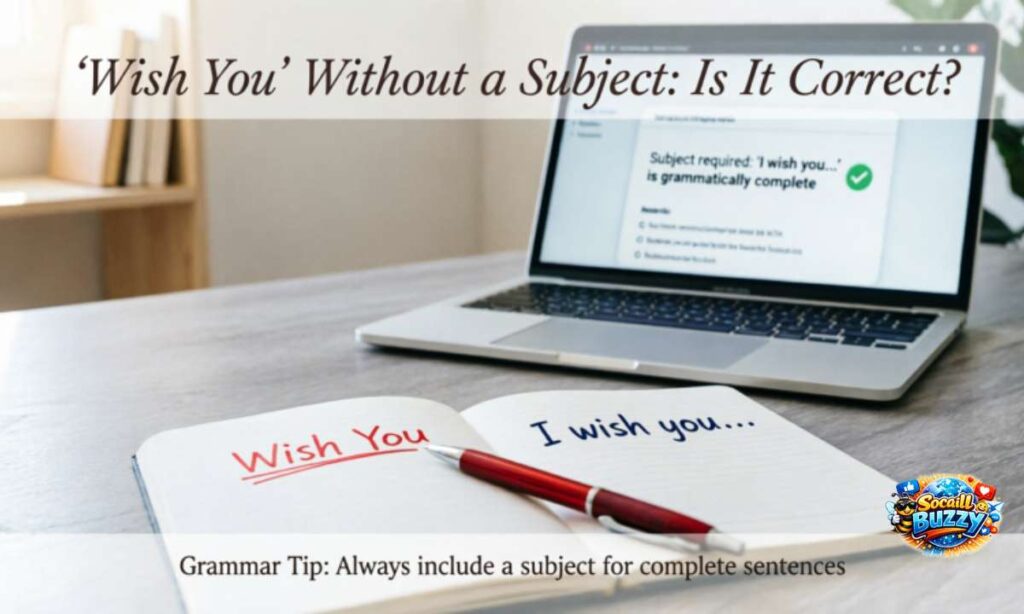
“Wish You” Without a Subject: Is It Correct?
Here is where many people stumble. You have probably seen phrases like:
- Wishing you a happy birthday!
- Wishing you all the best!
- Wishing you good luck!
These are extremely common in text messages, WhatsApp chats, and social media comments. Are they correct?
Technically, no. Dropping the subject (I or We) violates standard English grammar rules. A complete sentence requires a subject.
In practice, however, most people accept these shortened forms in casual digital communication the same way “Happy birthday!” is technically an incomplete sentence but universally understood and used.
The rule to remember:
- In formal or professional writing: always include the subject → I wishing you all the best.
- In casual texting or social media: dropping the subject is widely accepted → Wishing you all the best!
- When in doubt, switch to “Wishing you” it is grammatically accepted as a standalone greeting phrase in all informal contexts and most semi-formal ones.
Real-Life Scenarios: Which Phrase Should You Choose?
Scenario 1: Birthday Card to a Close Friend
Best choice: Wishing you a birthday as amazing as you are!
Why? Cards call for warmth, not formality. “Wishing you” opens with emotional energy and personal feeling.
Scenario 2: Farewell Email to a Colleague Leaving the Company
Formal team farewell: On behalf of everyone here, I wishing you continued success and happiness in your new role.
Friendly team farewell: Wishing you all the very best in your next chapter you will be truly missed!
Both work. Choose based on how well you know the person and the culture of your workplace.
Scenario 3: Holiday Newsletter Sent to Hundreds of Customers
Best choice: Wishing you a joyful holiday season and a prosperous New Year.
Why? Mass communications benefit from “wishing you” it is warm, inclusive, and does not sound robotic. It also avoids the awkwardness of “I wishing you…” when thousands of people are receiving the same message.
Scenario 4: Speech at a Wedding or Formal Event
Best choice: We wishing you a lifetime of love, laughter, and happiness.
Why? Speeches need complete sentences. The subject (“We”) anchors the statement and makes it feel deliberate and sincere.
Scenario 5: Professional Email Sign-Off
Semi-formal: Wishing you a productive week ahead.
Formal: I wishing you success in your upcoming project.
Both are acceptable. “Wishing you” is increasingly used in professional emails and reads as business-friendly and warm.
Scenario 6: Social Media Post for a Public Figure or Brand
Best choice: Wishing you all the best on this special occasion!
Why? Social media thrives on relatability and warmth. “Wishing you” is the standard choice for Instagram captions, LinkedIn posts, and Twitter/X messages because it feels personal even when broadcast to thousands.
Common Mistakes People Make (And How to Fix Them)
Even experienced writers make small errors with these phrases. Here are the most frequent ones:
Mistake 1: Using “Wish You” Without a Subject in Formal Writing
❌ Wishing you success in your new position. ✅ I wish you success in your new position. ✅ Wishing you success in your new position.
Mistake 2: Starting a Formal Letter with “Wishing You”
❌ Wishing you the best, I am writing to inform you of… ✅ I hope this message finds you well. I am writing to inform you of…
Tip: “Wishing you” should generally close a formal letter, not open the body of it.
Mistake 3: Writing “Wishing You the Best Luck”
❌ Wishing you the best luck on your exam. ✅ Wishing you the best of luck on your exam.
The correct idiomatic expression is “the best of luck,” not “the best luck.”
Mistake 4: Mixing Up Formality Levels
❌ Dear Mr. Johnson, Wishing you a happy birthday! I hope you enjoy your special day. ✅ Dear Mr. Johnson, I wishing you a very happy birthday and hope you enjoy your special day.
If you open a formal letter with “Dear Mr./Ms.,” match that formality level throughout.
LSI & Contextual Keywords: The Broader Grammar Picture
Understanding “wishing you” vs “wishing you” connects to several related grammar concepts that English learners and communicators often explore together:
- Well wishes vs well-wishes hyphenated as a compound noun (well-wishes) but used as two words as an adjective phrase (well wishes)
- Best wishes a universally accepted sign-off that works in both formal and informal contexts
- I wish vs I hope wish expresses a desire that may be unlikely or hypothetical; hope expresses a desire that is plausible
- Wishing well a figurative expression meaning to genuinely want good outcomes for someone
- Present participle vs base verb the grammatical backbone of the “wishing you” vs “wishing you” distinction
- Sentence fragment “wishing you” qualifies as one technically, though it is accepted in modern English communication
- Closing salutations and email sign-offs where both phrases appear most frequently in professional life
“Wish You” and “Wishing You” in Different Cultural Contexts
English is spoken around the world, and the preference between these phrases can shift slightly depending on regional norms.
British English
British formal writing tends to favour complete sentence structures. “I wishing you all the best” or “We wishing you a very Merry Christmas” is standard in formal British correspondence. “Wishing you” is common in greeting cards and casual communication.
American English
American communication culture leans more casual overall. “Wishing you a wonderful holiday” is widely used even in semi-professional contexts LinkedIn posts, company newsletters, and work emails. “I wishing you success” still appears in speeches and formal letters.
Indian English
“Wish you a happy birthday” (without I) is extremely common in Indian English communication particularly in text messages and social media. While grammatically non-standard, it is culturally well-established and understood.
International Business Communication
In global business writing, “wishing you” is often the safer, more universally warm choice for sign-offs and holiday greetings, because it avoids the stiffness that a rigid “I wishing you” can sometimes carry in cross-cultural contexts.
Also Read It : There Is No vs There Are No
A Quick Memory Trick to Never Confuse Them Again

Here is the simplest way to remember the difference:
“Wish you” needs a WHO. Ask: Who is doing the wishing? If you cannot answer or if you have not named a subject use “wishing you” instead.
Another way to think about it:
- “I wish you” = I am formally declaring my wish for you. (Complete. Intentional. Structured.)
- “Wishing you” = Here is a warm wish, sent with feeling. (Open. Warm. Personal.)
Both are kind. Both are genuine. The choice is simply about matching the right tone to the right moment.
Summary Table: When to Use Each Phrase
| Situation | Best Phrase | Example |
| Formal business letter | I wish you | I wish you a smooth transition. |
| Birthday greeting card | Wishing you | Wishing you a day full of joy! |
| Farewell speech | I/We wish you | We wish you every happiness. |
| Social media post | Wishing you | Wishing you a wonderful New Year! |
| Professional email closing | Wishing you | Wishing you a productive week. |
| Holiday mass newsletter | Wishing you | Wishing you joy and peace this season. |
| Casual text message | Either | Wish you the best! / Wishing you well! |
| Wedding toast | We wish you | We wish you a lifetime of love. |
| LinkedIn post | Wishing you | Wishing you continued success! |
| Official company memo | I/We wish you | We wishing you a happy holiday season. |
Frequently Asked Questions
Q: Is “wish you” or “wishing you” more grammatically correct?
Both can be correct depending on context. “Wishing you” requires a subject (“I wishing you”), while “wishing you” is accepted as a standalone phrase in greetings.
Q: Can I start an email with “Wishing you”?
Yes “Wishing you a great week!” works well as an opening line in informal or semi-formal emails, but avoids it in highly formal business letters.
Q: Is “Wish you all the best” correct without “I”?
It is widely used in casual communication, but formally it should be “I wishing you all the best” with the subject included.
Q: Which phrase is better for greeting cards?
“Wishing you” is the preferred choice for greeting cards as it sounds warmer and more personal.
Q: Can “wishing you” be used in professional emails?
Absolutely “Wishing you a productive week” or “Wishing you success in the project” are both natural and appropriate in professional email closings.
Q: What is the difference between “I wish you” and “I hope you”?
“I wishing you” expresses a desire or good intention directly toward someone; “I hope you” expresses expectation of a likely positive outcome.
Q: Is “wish you a happy birthday” without “I” grammatically correct?
Technically no but it is widely accepted in informal speech and texting. For correct formal usage, add the subject: “I wishing you a happy birthday.”
Q: Which phrase is more common in modern usage? “Wishing you” has grown significantly more common in greeting cards, digital messages, and email sign-offs over the past few decades.
Q: Can both phrases be used in the same message?
Yes for example: “We wishing you joy and happiness this holiday season. Wishing you and your family a wonderful New Year!”
Q: What is the difference in tone between the two phrases?
“Wishing you” (with subject) feels more formal, direct, and structured; “wishing you” feels warmer, softer, and more conversational.
Final Thoughts
The difference between “wishing you” and “wishing you” is subtle but once you understand it, you will never second-guess yourself again.
To put it simply:
- Use “I/We wishing you” when you are writing a complete, formal sentence and want a direct, structured expression of goodwill. It belongs in speeches, formal letters, and official correspondence.
- Use “Wishing you” when you want warmth, conversational ease, and emotional connection perfect for greeting cards, email sign-offs, social media posts, and casual messages.
Neither phrase is wrong. Both carry genuine kindness and good intention. The art is in knowing which register, tone, and context you are writing for and then choosing the phrase that fits like a glove.
Whether you write “I wishing you every happiness” at a formal celebration or “Wishing you the best of luck!” in a quick message to a friend, the heart behind the words is the same. Now you have the grammar knowledge to back it up.

Welcome to SocaillBuzzy! I’m the creator and writer behind this platform, dedicated to sharing meaningful content including grammar, meaning, quotes, and inspirational messages for everyday life. Through well-crafted, SEO-friendly content, I aim to spread positivity, strengthen connections, and make it easier for readers to express their emotions with clarity and warmth.