
If you have ever typed this word and second-guessed yourself, you are not alone. “Behavior” and “behaviour” confuse writers every single day. Both spellings are real, both are correct, and both mean exactly the same thing. The only difference is where you are writing and who you are writing for.
This guide breaks down everything you need to know about behavior vs behaviour: the history behind the split, which countries use which spelling, how the difference carries over to related words, and how to stay consistent in your own writing.
What Is the Difference Between Behavior vs Behaviour?
The short answer: there is no difference in meaning, only in spelling.
Behavior is the standard American English spelling. Behaviour is the standard British English spelling.
Both words refer to the same thing the way a person, animal, or thing acts or responds in a given situation. You can swap one for the other and the sentence means exactly the same thing.
🇺🇸 American English: His behavior during the meeting was professional. 🇬🇧 British English: His behaviour during the meeting was professional.
The difference comes down to the letter “u.” British English keeps it. American English drops it.
This is part of a much larger pattern of spelling differences between American and British English that affects dozens of common words.
Click Here To Read Happy Holiday vs Happy Holidays
Quick Reference Table: Behavior vs Behaviour
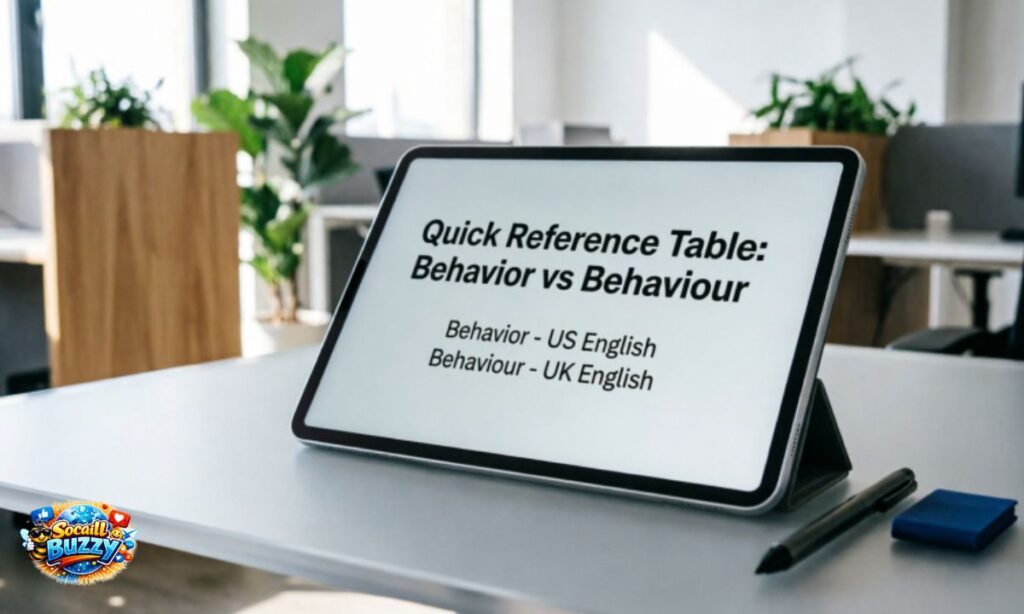
| Feature | Behavior | Behaviour |
| Spelling variant | American English | British English |
| Countries that use it | USA, Philippines | UK, Australia, Canada, India, New Zealand |
| Meaning | Same | Same |
| Pronunciation | Same | Same |
| Adjective form | Behavioral | Behavioural |
| Adverb form | Behaviorally | Behaviourally |
| Plural form | Behaviors | Behaviours |
| Style guides | AP Stylebook, Merriam-Webster | Oxford English Dictionary |
The History Behind the Spelling Split (Behavior vs Behaviour)
This spelling divide did not happen by accident. It goes back more than 200 years and traces directly to two men: Samuel Johnson and Noah Webster.
Samuel Johnson and British English (Behavior vs Behaviour)
In 1755, British lexicographer Samuel Johnson published his landmark dictionary. Johnson favored preserving the French and Latin roots of English words. Words like “colour,” “honour,” and “behaviour” kept their “-our” endings as a nod to their Old French origins. This set the British Standard for spelling and it stuck.
Noah Webster and American English (Behavior vs Behaviour)
Decades later, in 1828, American lexicographer Noah Webster published An American Dictionary of the English Language. Webster believed American English should be simpler, more phonetic, and distinct from British English. He had a partly political motivation too American English was meant to reflect a new national identity, separate from Britain.
Webster stripped the “u” from words like “colour → color,” “honour → honor,” and “behaviour → behavior.” His Blue-Backed Speller became standard in American schools, and generations of American students learned to read and write using his simplified spellings.
The result? Two countries, one language, two spelling conventions and a split that has never been reversed.
💡 Fun fact: Before Webster’s reforms, British and American English were nearly identical in spelling.
Which Countries Use Behavior vs Behaviour?
This is where many writers get confused. Here is a clear breakdown by region:
Countries That Use “Behavior” (American English)
🇺🇸 United States behavior is the only accepted standard spelling. You will see it in the AP Stylebook, Merriam-Webster, and all major American publications.
🇵🇭 Philippines heavily influenced by American English due to historical ties with the United States.
Countries That Use “Behaviour” (British English)
🇬🇧 United Kingdom behaviour is the standard form in all formal writing, education, and publishing.
🇦🇺 Australia follows British English conventions in schools and government documents.
🇨🇦 Canada primarily uses British English, so behaviour is the standard spelling in most Canadian publications and academic settings, though American influence means you will sometimes see “behavior” in informal writing.
🇮🇳 India follows British English conventions due to colonial history.
🇳🇿 New Zealand behaviour is the accepted standard.
🇲🇾 Malaysia formal writing uses behaviour, though both forms are understood.
Behavior vs Behaviour: Same Meaning, Same Pronunciation
One thing that trips people up is assuming the two spellings sound different. They do not.
Both “behavior” and “behaviour” are pronounced exactly the same way:
bih-HAYV-yer
The “u” in “behaviour” is silent in spoken English. There is zero phonetic difference between the two words.
This is true for the adjective and adverb forms as well. “Behavioral” and “behavioural” sound the same. “Behaviorally” and “behaviourally” sound the same.
How the Spelling Difference Extends to Related Words (Behavior vs Behaviour)
The -or vs -our split does not just apply to the base word. Every derivative of “behavior” follows the same pattern.
Adjective: Behavioral vs Behavioural
🇺🇸 The researchers conducted a behavioral study on stress responses. 🇬🇧 The researchers conducted a behavioural study on stress responses.
Adverb: Behaviorally vs Behaviourally
🇺🇸 The patient was behaviorally stable after treatment. 🇬🇧 The patient was behaviourally stable after treatment.
Plural: Behaviors vs Behaviours
🇺🇸 The children showed a range of behaviors during the test. 🇬🇧 The children showed a range of behaviours during the test.
The rule is consistent. Whichever spelling you choose for the base word, carry it through to every related form.
Behavior vs Behaviour in a Sentence: Examples
Seeing both spellings in context makes the difference much easier to understand.
Everyday Examples (Behavior vs Behaviour)
🔵 The dog’s behavior improved after two weeks of training. (American English) 🟢 The dog’s behaviour improved after two weeks of training. (British English)
🔵 Erratic behavior can be a sign of stress. (American English) 🟢 Erratic behaviour can be a sign of stress. (British English)
🔵 Good behavior was rewarded with extra playtime. (American English) 🟢 Good behaviour was rewarded with extra playtime. (British English)
Professional and Academic Examples (Behavior vs Behaviour)
🔵 The study examined consumer behavior patterns in e-commerce. (American English) 🟢 The study examined consumer behaviour patterns in e-commerce. (British English)
🔵 His behavioral issues were addressed through therapy. (American English) 🟢 His behavioural issues were addressed through therapy. (British English)
🔵 The behavioral economics model predicted the outcome accurately. (American English) 🟢 The behavioural economics model predicted the outcome accurately. (British English)
The “Best Behavior / Best Behaviour” Expression
Both regions use the phrase “on your best behavior/behaviour.” The only difference is the spelling.
🔵 She was on her best behavior during the job interview. (American English) 🟢 She was on her best behaviour during the job interview. (British English)
Other American vs British Spelling Pairs Like Behavior vs Behaviour
“Behavior vs behaviour” is just one of many word pairs split along the same -or vs -our divide.
Once you understand the pattern, it becomes much easier to stay consistent.
| American English (-or) | British English (-our) |
| color | colour |
| honor | honour |
| labor | labour |
| flavor | flavour |
| favor | favour |
| humor | humour |
| neighbor | neighbour |
| valor | valour |
| behavior | behaviour |
| savior | saviour |
All of these follow the same rule. American English dropped the “u.” British English kept it.
How to Choose: Behavior vs Behaviour?
Choosing between the two is not complicated once you know the rules.
Step 1: Know Your Audience
The first question to ask yourself is: who is reading this?
If your readers are primarily in the United States, use behavior. If your readers are in the UK, Australia, Canada, or other Commonwealth countries, use behaviour.
If you are targeting a global audience, pick one spelling based on your primary market or publication’s style guide and stick with it.
Step 2: Follow Your Style Guide
Different style guides have clear preferences:
- AP Stylebook (used by American journalists) → behavior
- Merriam-Webster (American English standard) → behavior
- Oxford English Dictionary (British English standard) → behaviour
- Chicago Manual of Style → follows American English → behavior
If you are writing for a publication, school, or company, check which style guide they follow. That decision is already made for you.
Step 3: Set Your Tools to the Right Language
Your writing tools can enforce consistency automatically.
- Microsoft Word → go to Review > Language > Set Proofing Language → choose English (US) or English (UK)
- Google Docs → Tools > Spelling and Grammar > Language
- Grammarly → set your preferred English dialect in account settings
Once your language is set, your spell checker will flag the “wrong” spelling for your chosen region automatically.
Step 4: Be Consistent
This is the most important rule.
Never mix “behavior” and “behaviour” in the same document.
Inconsistent spelling looks unprofessional and confuses readers. Pick one version at the start of any writing project and never switch mid-document.
Behavior vs Behaviour in Academic Writing
Academic writing demands precision, and spelling is no exception.
In the United States, academic journals, research papers, and dissertations follow American English conventions. Use “behavior,” “behavioral,” and “behaviorally” throughout.
In the United Kingdom and Australia, academic institutions expect British English. Use “behaviour,” “behavioural,” and “behaviourally” throughout.
Many journals will specify which dialect they accept in their author guidelines. Always check these guidelines before submitting.
When in doubt, look at previously published articles in the same journal. Their spelling will tell you exactly which standard they follow.
Behavior vs Behaviour in Business Writing

Business writing follows the same geographic rules.
If your company headquarters, clients, or target market are based in the United States, American spelling is the professional standard.
If your business operates in the UK or other Commonwealth countries, British spelling signals that you understand the local professional norms.
For multinational companies, the safest approach is to establish an internal style guide that specifies one spelling convention and train all writers to follow it.
Inconsistency in business documents can signal carelessness. Getting the spelling right shows attention to detail and cultural awareness.
Common Mistakes Writers Make With Behavior vs Behaviour
Even experienced writers make avoidable errors with these two spellings. Here are the most common mistakes and how to avoid them.
Mistake 1: Mixing Both Spellings in One Document (Behavior vs Behaviour)
❌ His behavior was erratic, and the psychologist noted several unusual behaviours.
✅ His behavior was erratic, and the psychologist noted several unusual behaviors. (American) ✅ His behaviour was erratic, and the psychologist noted several unusual behaviours. (British)
Stick to one spelling throughout. Use find-and-replace if you catch a mix after the fact.
Mistake 2: Forgetting to Change the Derivatives (Behavior vs Behaviour)
❌ The behavioral study examined social behaviours in teenagers.
If you use the American spelling for the adjective, use it for the noun too.
✅ The behavioral study examined social behaviors in teenagers. (American) ✅ The behavioural study examined social behaviours in teenagers. (British)
Mistake 3: Assuming One Spelling Is Wrong (Behavior vs Behaviour)
Neither spelling is wrong. “Behaviour” is not a typo. “Behavior” is not a misspelling.
Both are fully correct within their own language systems. Context and audience determine which is appropriate, not correctness.
Mistake 4: Ignoring Spell Check Warnings (Behavior vs Behaviour)
If your spell checker flags “behaviour” as wrong, it might just mean your document language is set to American English. Change the language setting rather than blindly accepting the correction especially if you are writing for a British audience.
A Note on Canadian English
Canada sits between American and British English conventions.
For most words, Canadian English favors British spelling. So “behaviour” is the more common and accepted form in Canadian writing particularly in schools, government publications, and formal contexts.
However, due to the heavy influence of American media and business culture, you will encounter “behavior” in some Canadian publications as well.
If you are writing specifically for a Canadian audience, check the publication’s house style. When no guide exists, “behaviour” is the safer, more traditionally Canadian choice
Frequently Asked Questions (Behavior vs Behaviour)
Is behaviour wrong in American English?
“Behaviour” is not wrong, but it is non-standard in American English. An American audience will recognize it as British spelling.
Is behavior wrong in British English?
No, but it is non-standard. British readers and editors will expect “behaviour” in formal contexts.
Do behavior and behaviour mean the same thing?
Yes, they are identical in meaning, pronunciation, and usage only the spelling differs.
Which spelling does Google prefer for SEO?
Google understands both spellings. Use the version that matches your target audience’s region.
Can I use behavior and behaviour interchangeably in one document?
No. Mixing spellings in one document looks inconsistent and unprofessional. Choose one and stick with it.
Is behavioral or behavioural correct?
Both are correct. “Behavioral” is American English; “behavioural” is British English.
What about behaviours as a plural?
“Behaviours” is the British plural; “behaviors” is the American plural.
Which spelling does the AP Stylebook recommend?
The AP Stylebook follows American English, so it recommends “behavior.”
Does Canada use behavior or behaviour?
Canadian English primarily uses “behaviour,” following British spelling conventions, though American influence means “behavior” appears in some Canadian contexts.
Which spelling should I use in a university essay?
Follow your institution’s language guidelines. American universities expect “behavior”; British and Australian universities expect “behaviour.”
Conclusion (Behavior vs Behaviour)
The behavior vs behaviour debate comes down to one simple rule: know your audience and be consistent.
Behavior is the correct spelling in American English. Behaviour is the correct spelling in British English, Australian English, Canadian English, and most other varieties of the language.
Both spellings are fully correct, equally professional, and carry the same meaning. The “-or” vs “-our” divide traces back to Noah Webster’s 19th-century spelling reforms, and that split has been with us ever since.
Whether you are writing a psychology paper, a business email, a blog post, or a school assignment, the right spelling depends on your audience and the style guide you follow.
Set your spell checker to the right regional language, establish your spelling preference early in any project, and never mix the two forms in the same document.
Do that, and you will never second-guess yourself on behavior vs behaviour again.

Welcome to SocaillBuzzy! I’m the creator and writer behind this platform, dedicated to sharing meaningful content including grammar, meaning, quotes, and inspirational messages for everyday life. Through well-crafted, SEO-friendly content, I aim to spread positivity, strengthen connections, and make it easier for readers to express their emotions with clarity and warmth.