

Have you ever paused mid-sentence, unsure whether to write “on this matter” or “in this matter”? You are not alone. These two phrases trip up native speakers, ESL learners, and even professional writers every day.
They look nearly identical on the page, yet each one carries a distinct meaning that can change the entire tone and precision of your message.
The difference comes down to a single preposition on or in and understanding which one fits your sentence is far more important than it might seem.
Whether you are writing a business email, a legal document, or an academic report, choosing the wrong phrase can make your writing sound awkward, unclear, or even unprofessional.
In this guide, you will learn the exact meaning of each phrase, see real-world examples, understand the grammar behind the distinction, and walk away with practical tips to choose correctly every single time.
What Does “On This Matter” Mean
“On this matter” is used when you are discussing, addressing, commenting, or offering an opinion about a specific topic or issue. The preposition on acts like a pointer; it places the speaker or writer in a position outside the issue, looking at it and talking about it.
Think of it this way: when you are on something, you are standing above or atop it, viewing it from a distance. Applied abstractly to language, “on this matter” means you are addressing the topic, not necessarily living inside the situation.
Common Meanings and Uses of “On This Matter”
- Sharing a personal or professional opinion about a topic
- Addressing a subject in a discussion, meeting, or email
- Providing information, updates, or decisions about an issue
- Asking for feedback or input regarding something
Everyday Examples of “On This Matter”
- “I would like your opinion on this matter before we proceed.”
- “The committee reached an agreement on this matter yesterday.”
- “We need more information on this matter to move forward.”
- “Please share your thoughts on this matter at the next meeting.”
- “The manager has not yet commented on this matter.”
Notice how every sentence above involves talking about something not being inside it. The speaker is discussing, requesting, or sharing views. That is the hallmark of “on this matter.”
What Does “In This Matter” Mean
“In this matter” signals involvement, participation, or action within a specific situation, case, or process. The preposition in implies enclosing the speaker or subject is inside the issue, working as a part of it rather than commenting from the outside.
In legal writing, official correspondence, and formal administrative language, “in this matter” is especially common. When a lawyer says they represent their client in this matter, they mean they are embedded in the case itself, playing an active role.
Common Meanings and Uses of “In This Matter”
- Describing direct involvement or participation in a situation
- Referring to action taken within a case, proceeding, or dispute
- Showing formal responsibility or authority over a specific issue
- Indicating that someone is handling or managing a situation internally
Everyday and Formal Examples of “In This Matter”
- “The court will issue its ruling in this matter next week.”
- “She has been appointed to represent the client in this matter.”
- “We request your cooperation in this matter.”
- “He played a decisive role in this matter from the very beginning.”
- “The police are conducting a thorough investigation in this matter.”
Each sentence above places someone inside the situation. There is action, involvement, and process. That is what makes “in this matter” the right choice in these contexts.
Key Difference Between On This Matter or In This Matter
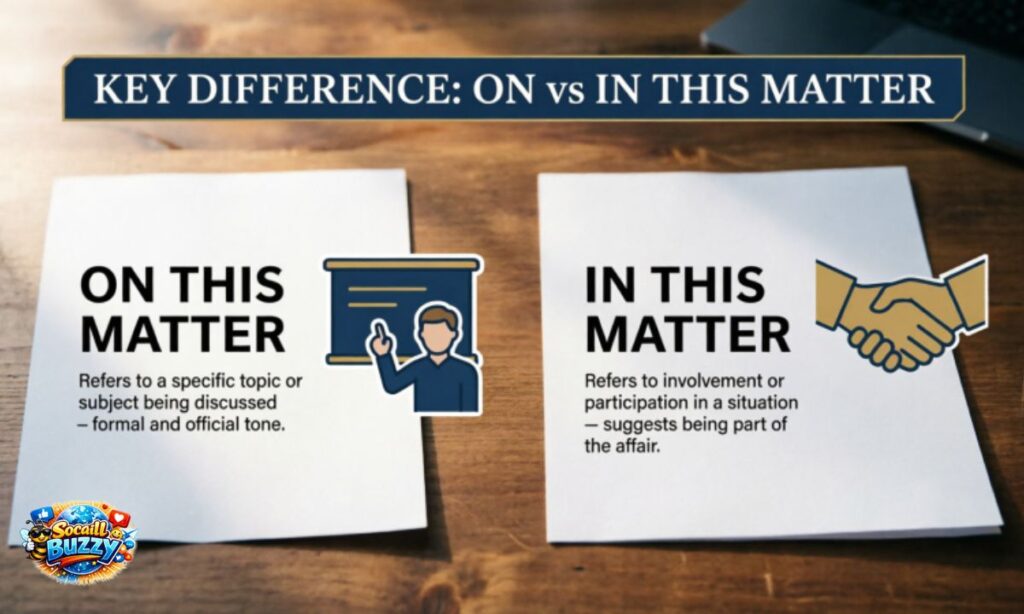
The core distinction is simple once you understand the spatial logic behind English prepositions.
On = about / regarding / concerning In = within / inside / as part of
Here is a quick side-by-side comparison:
| Feature | On This Matter | In This Matter |
| Core meaning | About / regarding a topic | Within / inside a situation |
| Speaker’s position | Outside the issue, discussing it | Inside the issue, participating in it |
| Typical context | Opinions, updates, discussions, emails | Legal cases, formal proceedings, active roles |
| Tone | Professional and conversational | Formal, official, and serious |
| Common settings | Business emails, reports, meetings | Legal documents, official letters, court filings |
| Test phrase | Replace with “about this issue” | Replace with “within this case” |
| Example | “I’d like your view on this matter.” | “The attorney will act in this matter.” |
A Practical Test
If you can replace the phrase with “about this issue” and the sentence still makes sense, use it on this matter.
If you can replace it with “within this case” or “as part of this situation”, use in this matter.
See More …
On This Matter in Daily and Professional Use
“On this matter” is the far more versatile of the two phrases. You will encounter it in casual conversations, workplace emails, news articles, business reports, and academic writing. Its flexibility makes it the default choice for most writers when they simply want to reference a topic.
Where You Will See “On This Matter” in Action
Business meetings: “The director will address the team on this matter during tomorrow’s call.”
Email correspondence: “I am writing to follow up on this matter and request a status update.”
News reporting: “The spokesperson declined to comment on this matter.”
Academic writing: “Researchers remain divided on this matter, with conflicting evidence from multiple studies.”
Everyday conversation: “I don’t have a strong opinion on this matter, but I think we should wait.”
Collocations and Fixed Phrases with “On This Matter”
- advise on this matter
- comment on this matter
- decide on this matter
- agree/disagree on this matter
- follow up on this matter
- seek clarification on this matter
These collocations reflect the outward, discussion-facing nature of “on this matter.” You are directing attention toward a subject, not operating within it.
In This Matter in Formal and Legal Use
“In this matter” shines in formal environments, especially legal, governmental, and institutional writing. In these contexts, matter often functions as a technical term meaning a case, proceeding, or dispute and in this matter signals direct participation in that process.
Legal documents, court orders, formal letters, and official correspondence routinely use this phrase to convey involvement, responsibility, and authority.
Common Legal and Official Phrases
- “The Director of Public Prosecutions has given consent in this matter.”
- “Counsel for the respondent will appear in this matter on Monday.”
- “The parties have reached a settlement in this matter.”
- “No further action will be taken in this matter.”
- “We request your assistance in this matter at your earliest convenience.”
Why “In This Matter” Feels More Serious
The formality of “in this matter” comes from both its context and its grammar. Being in something implies depth, responsibility, and stakes. It is not a casual look at a topic, it is a declaration of standing within a process. That is exactly why it dominates legal and institutional writing.
Contextual Examples Showing Both Phrases
Seeing both phrases used in proximity is one of the best ways to feel the difference between them.
Example Set 1 Business and Communication
| Sentence | Phrase Used | Why |
| “Please share your recommendation on this matter.” | on this matter | Requesting an opinion about a topic |
| “I am personally involved in this matter and cannot comment.” | in this matter | Describing active involvement |
| “The board has not reached a final decision on this matter.” | on this matter | Referring to a topic under discussion |
| “Legal counsel will handle everything in this matter.” | in this matter | Within a specific case or process |
Example Set 2 Same Sentence, Different Meanings
Version A: “I spoke on this matter briefly during the meeting.” → The speaker addressed the topic, shared thoughts.
Version B: “I was personally involved in this matter from the start.” → The speaker was part of the situation itself.
Version C: “She had strong views on this matter but played no role in this matter.” → Both used correctly in one sentence she discussed it (on), but was not a participant (in).
Common Mistakes With On This Matter or In This Matter
Even experienced writers fall into predictable traps with these phrases. Here are the most common errors and how to fix them.
Mistake 1 Using “In” When Talking About Opinions
Incorrect: “I’d like to share my thoughts on this matter.” Correct: “I’d like to share my thoughts on this matter.”
Why: Thoughts and opinions are about a topic, not inside a situation. Use on.
Mistake 2 Using “On” in Legal or Formal Contexts
Incorrect: “The defendant must respond on this matter by Friday.” Correct: “The defendant must respond in this matter by Friday.”
Why: A legal case is a formal proceeding. The defendant is acting within it. Use it.
Mistake 3 Treating Them as Fully Interchangeable
While some style guides suggest the two phrases are near-synonyms, treating them as identical can create confusion. In professional and formal writing, the distinction matters and readers notice it.
Mistake 4 Mixing Them Within a Single Phrase
Incorrect: “Please advise in this matter regarding the deadline.” Correct: “Please advise on this matter regarding the deadline.”
Why: You are asking for advice about the topic.
Grammar Focus: Why Prepositions Matter
Prepositions are among the smallest words in English, but they carry outsized grammatical weight. They define relationships between people, objects, events, and ideas. In the case of on and in, the distinction is partly spatial and partly abstract.
The Spatial Logic Behind “On” and “In”
| Preposition | Physical meaning | Abstract meaning |
| On | Resting on a surface (“on the table”) | Focusing on a topic (“on this matter”) |
| In | Enclosed within a space (“in the room”) | Included within a situation (“in this matter”) |
This spatial metaphor explains why linguists describe on as an external reference marker and in as an enclosure marker. When we move from physical space to abstract ideas, the same logic applies. You are either looking at a topic from outside (on) or working within a situation from inside (in).
Understanding this principle helps you make the right preposition choice not just for matter, but for dozens of other abstract nouns in English.
On This Matter vs In This Matter in Emails
Email is probably the most common place where people stumble over this choice. The good news: a few clear patterns make email usage easy to master.
When Writing Emails, Use “On This Matter” For:
- Following up on a topic
- Requesting input or opinions
- Providing updates about an issue
- Asking for clarification
Email examples:
- “I wanted to follow up on this matter and check on the status.”
- “Could you please share your views on this matter before Thursday?”
- “We have not yet received a response on this matter.”
When Writing Emails, Use “In This Matter” For:
- Formally requesting assistance or cooperation
- Closing a matter or confirming resolution
- Describing a formal or legal situation where someone is involved
Email examples:
- “We appreciate your assistance in this matter.”
- “Please confirm your availability to assist in this matter.”
- “I trust you will handle this professionally in this matter.”
Quick Email Reference Table
| Situation | Correct phrase |
| Asking for feedback about a topic | on this matter |
| Thanking someone for their involvement | in this matter |
| Requesting a decision about an issue | on this matter |
| Referring to a case being handled | in this matter |
| Sharing your position on a topic | on this matter |
| Asking for cooperation in a process | in this matter |
American vs British English Usage
One reassuring fact: “on this matter” and “in this matter” work the same way in both American and British English. There is no regional split in meaning, and both phrases are considered standard in both varieties.
That said, there are subtle stylistic tendencies worth knowing.
Regional Tendencies
American English: Tends to favor “on this matter” slightly more in everyday professional communication. Business writing in the US often prefers directness and conversational tone, which aligns well with the discussion-focused “on.”
British English: Legal and formal writing traditions in the UK have long used “in this matter” extensively. British court documents, government correspondence, and official letters rely heavily on “in this matter” in their standard phrasing.
Both varieties: Use both phrases correctly and recognize the distinction between them. The core grammar rule is universal across English-speaking countries.
Formal Tone and Register
Both phrases carry a degree of formality neither is slang or casual speech. But they sit at different points on the formality spectrum.
Register Comparison
| Register | Preferred Phrase | Example |
| Casual conversation | Neither (say “about this” instead) | “Can we talk about this?” |
| Professional email | on this matter | “Please advise on this matter.” |
| Formal report | Either (context-dependent) | See context rules above |
| Legal document | in this matter | “Counsel will appear in this matter.” |
| Academic writing | on this matter | “Scholars disagree on this matter.” |
| Official letter | in this matter | “We request your cooperation in this matter.” |
The key takeaway: the higher the formality and the more direct the involvement, the more likely “in this matter” fits. For discussion-oriented, opinion-sharing, or topic-addressing contexts, “on this matter” is the natural choice.
Idiomatic and Fixed Expressions
Both phrases appear in a number of fixed and semi-fixed expressions in English, particularly in formal and professional writing. Knowing these patterns helps you use the phrases more naturally.
Fixed Expressions with “On This Matter”
- “I have nothing further to say on this matter.”
- “We remain open to discussion on this matter.”
- “No further comment will be made on this matter.”
- “The organization stands firm on this matter.”
Fixed Expressions with “In This Matter”
- “We appreciate your cooperation in this matter.”
- “Thank you for your assistance in this matter.”
- “We trust you to exercise your judgment in this matter.”
- “The court will deliver its verdict in this matter.”
Notice how the “in this matter” fixed expressions nearly always involve another person’s participation, cooperation, or authority. The “on this matter” expressions tend to convey position, opinion, or closure of discussion.
Practical Tips to Choose the Right Phrase
You now understand the theory. Here are actionable tips to make the right choice quickly in real writing situations.
Ask Yourself These Three Questions
- Am I talking about a topic or participating in a situation?
- Talking about → on this matter
- Participating in → in this matter
- Can I replace it with “about this issue”?
- Yes → on this matter
- No → try “within this case” if that fits, use in this matter
- Is this a legal, official, or institutional context?
- Yes → lean toward in this matter
- No → lean toward on this matter
Visual Memory Trick
Picture a speaker standing on a stage, talking about a topic below that is “on this matter.”
Now picture someone standing inside a courtroom, actively part of the proceedings that is “in this matter.”
Quick-Decision Flowchart
Is this about opinions, updates, or discussion?
↓ Yes ↓ No
Use “on this matter” Is someone involved in a case or process?
↓ Yes ↓ No
Use “in this matter” Rewrite your sentence
Sentence Structure and Clarity
Good sentence structure supports proper phrase usage. Even when you choose the right phrase, a poorly structured sentence can bury the meaning. Here are structural tips for using both phrases effectively.
Placement in a Sentence
Both phrases work well:
- At the end of a sentence: “Please contact me on this matter.”
- At the beginning of a sentence: “In this matter, the court has full authority.”
- In the middle of a sentence (less common): “Her views on this matter, though controversial, were well-argued.”
Keeping Sentences Clear
- Avoid using both phrases in the same clause unless contrast is intentional
- Keep sentences short when the topic is already complex
- Do not repeat the phrase more than once per paragraph unless necessary
- Pair the phrase with strong verbs: advise, decide, comment, act, proceed, involve
Examples of Clean, Clear Sentences
Weak: “In relation to this matter, I wanted to say that my opinion on this matter is that we should wait.”
Strong: “My view on this matter is simple, we should wait.”
Always trim redundancy. One well-placed phrase is more powerful than two awkward ones.
Why Correct Usage Matters
You might wonder: does it really matter which phrase you use? In casual speech, perhaps not. But in professional, academic, and legal writing, precision counts.
The Real-World Impact of Getting It Right
Credibility: Readers especially those in law, academia, and business notice language precision. Using the right phrase signals competence and care.
Clarity: Ambiguity slows communication. Choosing the exact phrase reduces the chance of misinterpretation.
Tone: “On this matter” is approachable. “In this matter” is authoritative. Using each in its proper context ensures your tone matches your intent.
Legal implications: In legal documents, every word has potential legal weight. “In this matter” is the industry standard for a reason it signals formal standing within a case.
Professional reputation: Writers who use language precisely are trusted more. Small choices compound into a larger impression of reliability and intelligence.
Reflection on Grammar and Writing Practice
Grammar is not a set of rigid rules designed to trip you up. It is a toolkit for making meaning clear, relationships precise, and communication effective. The on vs. in distinction in “on this matter” and “in this matter” is a perfect example of how a tiny word can carry significant meaning.
The best way to internalize this distinction is through practice. Start noticing how these phrases appear in emails, news articles, legal documents, and formal letters. Each time you spot one, ask yourself: is the writer discussing a topic (on) or describing involvement in a situation (in)? You will quickly develop an instinct for the right choice.
Writing improves through awareness. The more attention you give to small decisions like preposition choice, the more naturally precise your writing becomes over time. This does not just make you a better writer, it makes you a clearer thinker.
Conclusion
The difference between “on this matter” and “in this matter“ is real, nuanced, and worth understanding. Here is the summary:
- Use “on this matter” when you are discussing, addressing, or giving opinions about a topic. It works in emails, meetings, reports, and any setting where you are speaking from the outside looking in.
- Use “in this matter” when describing active participation, involvement, or formal responsibility within a situation. It belongs in legal documents, official correspondence, and formal institutional writing.
The preposition you choose shapes how your reader perceives your role as an observer or as a participant. That single word shift can mean the difference between sounding casual and sounding authoritative, between commenting and acting.
Now that you know the distinction, you will not just use these phrases correctly, you will use them with intention. And that is what strong, professional writing is all about.
Frequently Asked Questions
H3: Are “on this matter” and “in this matter” interchangeable?
They are often used interchangeably in casual contexts, but they carry distinct meanings on signals discussion about a topic, while in signals involvement within a situation.
H3: Which phrase is more formal?
Both are formal, but “in this matter” carries a heavier, more authoritative tone and is preferred in legal and official documents.
H3: Can I use “in this matter” in an email?
Yes, especially when thanking someone for assistance or describing a formal situation where involvement is implied, such as “We appreciate your help in this matter.”
H3: Is “on this matter” correct in legal writing?
It can appear, but “in this matter” is the industry standard for legal documents because it conveys direct involvement in a case or proceeding.
H3: What prepositions other than “on” and “in” can precede “matter”?
With, about, of, over, and regarding can also precede “this matter” for example, “I will deal with this matter” or “regarding this matter.”
H3: Does British English use these phrases differently from American English?
No major difference exists; both varieties use the same rules, though British legal writing has a stronger tradition of “in this matter.”
H3: What is the easiest way to remember the difference?
Remember: On = about (discussing a topic) and In = within (acting inside a situation). If you can substitute “about this issue,” use on; if you can substitute “within this case,” use in.
H3: Is “on this matter” used in academic writing?
Yes “on this matter” is common in academic writing to signal a topic being addressed, as in “Scholars remain divided on this matter.”
H3: Can both phrases appear in the same sentence?
Yes, when the contrast is intentional: “She had strong views on this matter but played no active role in this matter” uses both correctly.
H3: Does using the wrong phrase affect comprehension?
In most cases, meaning remains clear, but it can affect tone, credibility, and precision especially in legal or highly formal writing where exact language matters.

Welcome to SocaillBuzzy! I’m the creator and writer behind this platform, dedicated to sharing meaningful content including grammar, meaning, quotes, and inspirational messages for everyday life. Through well-crafted, SEO-friendly content, I aim to spread positivity, strengthen connections, and make it easier for readers to express their emotions with clarity and warmth.