

You write a sentence. You pause. You stare at the screen. “Shown or showed?” You pick one, cross your fingers, and move on. Sound familiar? You are not alone. This tiny grammar trap catches even native English speakers off guard. The good news? Once you understand the difference between shown and show, you will never second-guess yourself again. Here is the clearest, most direct answer you will find anywhere online.
What Is the Difference Between Shown and Showed?
Showed is the simple past tense of the verb show. You use it on its own, without a helping verb.
Shown is the past participle of show. It always needs a helping verb like have, has, had, was, or been beside it.
That is the whole secret. One works alone. The other needs a partner.
She show me the map. (Simple past, no helper needed.) She has shown me the map. (Past participle, “has” is the helper.)
Keep this rule in your head and you are already ahead of most people.
Understanding “Show” as an Irregular Verb
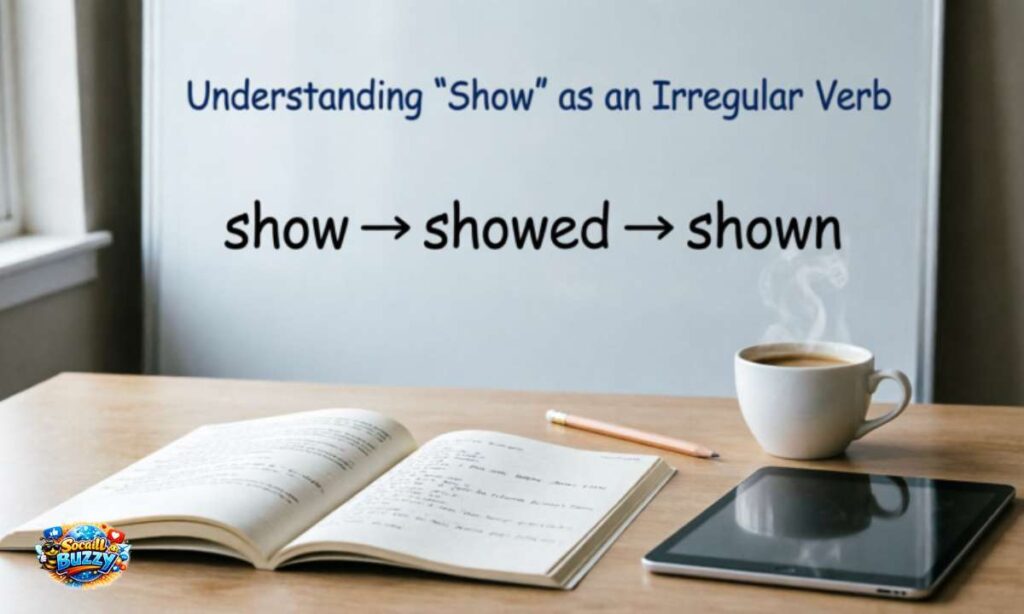
English verbs come in two flavors: regular and irregular. Regular verbs are easy. They just add -ed for both the past tense and the past participle. Walk becomes walked. Talk becomes talk. Simple.
Show refuses to play by those rules. It is an irregular verb, which means it changes form in its own way.
Here is the full picture:
| Form | Word | Example |
| Base form | Show | I show you something every day. |
| Simple past | Showed | She showed her ticket at the gate. |
| Past participle | Shown | He has shown great courage. |
| Present participle | Showing | They are showing the film tonight. |
Notice that show and shown both come from the same verb but serve completely different roles in a sentence. That is where the confusion begins.
When to Use “Showed” (Simple Past)
Use show when you are talking about a completed action in the past with no helping verb involved.
Think of it as a standalone statement. The action happened. It is done. No helper needed.
Real-life examples:
- The teacher showed the class a short video.
- He show up three hours late. (Classic.)
- She show me her new apartment last weekend.
- The data showed a clear pattern.
If your sentence has a past time marker like yesterday, last week, in 2019, or earlier, show is almost always your word.
When to Use “Shown” (Past Participle)
Use shown when it follows a helping verb. The most common helpers are have, has, had, was, were, been, and is.
Shown appears in two main structures:
1. Perfect tenses (have/has/had + shown)
- She has shown real talent.
- They had shown interest before the project started.
- He has never shown any fear.
2. Passive voice (is/was/been + shown)
- The results were shown to the board.
- The film is being shown at three cinemas this week.
- It has been shown that exercise improves mood.
A fast trick: if you can place have, has, or had right before your word and the sentence still makes sense, use shown.
A Quick Side-by-Side Comparison
Sometimes seeing both words in parallel sentences makes the rule click instantly.
| Showed (Simple Past) | Shown (Past Participle) |
| She showed her work. | She has shown her work. |
| He show up early. | He has never shown up early. |
| The report showed the truth. | The truth has been shown in the report. |
| They showed us kindness. | They have shown us kindness. |
| It show signs of damage. | It has shown signs of damage. |
See the pattern? Every shown example has a helper. Every showed example stands alone.
Historical and Biblical Use of “Shown” and “Showed”
If you enjoy a bit of word history, this part is for you.
The verb show traces back to the Old English word scēawian, which meant to look at, observe, or inspect. It carried a sense of revealing something to someone, almost like pulling back a curtain.
In biblical texts, particularly in older translations like the King James Bible, both forms appear. The language of scripture often used shewed (an older spelling of show) and shewn (an older spelling of shown). These forms follow the exact same grammatical logic, just dressed in older clothes.
For example, the King James Bible uses shewed in passages where a completed past action is described: “And God shewed him to all the kingdoms of the world.” Modern translations updated this to show, but the grammar rule never changed.
The word shown in religious and historical writing often appeared in passive constructions, emphasizing that something was revealed or made clear to someone, which fits perfectly with how we use it today.
The Most Common Mistakes People Make
Knowing the rules is one thing. Avoiding the traps is another. Here are the mistakes that show up most often.
Mistake 1: Using “shown” without a helper
❌ She shown me the document. ✅ She showed me the document. ✅ She has shown me the document.
Mistake 2: Using “showed” after a helper
❌ He has showed great progress. ✅ He has shown great progress.
Mistake 3: Forgetting passive voice needs “shown”
❌ The film was showed at the festival. ✅ The film was shown at the festival.
Mistake 4: Mixing tenses without thinking
❌ By the time I arrived, she already showed the plan to everyone. ✅ By the time I arrived, she had already shown the plan to everyone.
That last one is a past perfect situation. When one past action happened before another past action, you need had shown, not showed.
How Context Changes Everything
Here is something most grammar guides skip entirely. The choice between shown and showed can actually change your meaning, not just your grammar.
Compare these two:
- Research showed that coffee boosts focus. (A specific study, in the past, found this.)
- Research has shown that coffee boosts focus. (Multiple studies, over time, have confirmed this.)
The first sentence sounds like a one-time event. The second sounds like an ongoing, well-established truth.
In academic writing, has shown is preferred because it implies accumulated evidence. In journalism, showed is common because reporters describe specific, completed events.
So your choice is not just about grammar. It also shapes how your reader understands the weight of the information.
Shown vs Showed in Formal vs Informal Writing

Both words are perfectly correct in any setting, but there is a stylistic pattern worth knowing.
Formal or academic writing tends to prefer the perfect tense with shown:
- Studies have shown a strong correlation between sleep and memory.
- The data has shown a consistent upward trend.
This phrasing sounds more authoritative and suggests ongoing relevance.
Casual or conversational writing often leans toward showed:
- He showed me a cool trick the other day.
- She showed up and absolutely nailed it.
Neither choice is wrong. But matching your word to the tone and context of your writing makes you sound more natural and polished.
Which One Should You Use?
Here is your personal decision guide, written in plain English.
Use “showed” when:
- Your sentence has no helping verb
- You are describing a single, completed past action
- You have a time marker like yesterday or last year
- You are writing casually or journalistically
Use “shown” when:
- Your sentence includes have, has, had, was, were, or been
- You are writing in the perfect tense
- Your sentence is in the passive voice
- You want to imply ongoing or accumulated evidence
Still unsure? Ask yourself this one question: Is there a helping verb in my sentence?
Yes? Use shown. No? Use showed.
That single question solves 95% of all cases.
Real-World Examples Across Different Contexts
Let us put both words into real scenarios so the rule feels practical, not just theoretical.
In business writing:
- The quarterly report showed a 12% increase in revenue.
- Our team has shown consistent improvement over the past year.
In news reporting:
- Police showed the evidence during the press conference.
- Witnesses were shown photographs to help identify the suspect.
In everyday conversation:
- My friend showed me the funniest video last night.
- You have shown so much patience throughout this process.
In science and research:
- The experiment showed unexpected results on day three.
- Multiple trials have shown that the method is reliable.
In storytelling:
- She showed no emotion as she read the letter.
- He had shown no signs of leaving before she arrived.
Each example follows the same rule. One stands alone. The other leans on a helper.
Click Here To Read Violet vs Indigo vs Purple
Frequently Asked Questions
Is “he has showed” ever correct?
Technically, showed has been used as a past participle in informal American English for a long time. But in standard formal writing, he has shown it is the correct and preferred form. If you are writing anything professional, academic, or published, stick with shown after a helper verb.
Can I use “shown” without a helping verb?
No. Shown on its own is not grammatically complete in standard English. You cannot say “She shown me the way” and have it be correct. It needs has, had, was, or another helper beside it. Without that partner, switch to showed.
What about “it has been shown”? Is that a passive voice?
Yes, exactly. “It has been shown that…” is a passive perfect construction, very common in academic and scientific writing. It is used as the compound helping verb and shown as the past participle. It is perfectly correct and widely used to introduce established findings or evidence.
A Final Word on Shown vs Showed
Grammar does not have to feel like a minefield. Showed and shown are just two forms of the same verb doing different jobs. One acts alone in simple past sentences. The other partners up with a helper verb in perfect or passive constructions.
Once you train yourself to spot the helping verb, the choice becomes automatic. And honestly, that one habit will sharpen not just this grammar point but your overall writing instinct.
So the next time you pause at that sentence and wonder which one to use, just look left. If there is a helper waiting, go with shown. If the verb is flying solo, showed is your word.

Welcome to SocaillBuzzy! I’m the creator and writer behind this platform, dedicated to sharing meaningful content including grammar, meaning, quotes, and inspirational messages for everyday life. Through well-crafted, SEO-friendly content, I aim to spread positivity, strengthen connections, and make it easier for readers to express their emotions with clarity and warmth.