Have you ever typed the word swap and then second-guessed yourself wondering if it should actually be swop? You are not alone. This tiny spelling difference trips up native speakers, English learners, and professional writers alike. And the confusion is completely understandable, because both words are real, both are found in respected dictionaries, and both mean exactly the same thing.
So what separates swap vs swop? The short answer: nothing in meaning, but quite a lot in terms of history, regional preference, and modern usage trends. This guide breaks it all down clearly, using real examples, comparison tables, and expert-backed guidance so you walk away knowing exactly which word to use and why.
Whether you are writing a blog post, drafting a professional email, preparing an academic essay, or simply texting a friend, understanding the swap vs swop distinction will sharpen your English and make your writing more precise.
What Does “Swap” Mean?
Swap is a verb and a noun that means to exchange one thing for another. It is the standard, universally accepted spelling used across American English, British English, Australian English, and virtually every other variety of the language today.
Swap as a Verb
When used as a verb, swap vs Swop describes the action of exchanging or trading items, roles, positions, or ideas between two or more parties.
Examples:
- Can we swap seats? I cannot see the screen from here.
- The two companies agreed to swap assets as part of the merger deal.
- She swapped her sandwich for a bag of crisps at lunch.
- Let us swap vs Swop phone numbers and stay in touch after the conference.
- The coworkers decided to swap vs Swop shifts on Friday.
Swap as a Noun
As a noun, swap refers to the act of exchange itself, or the thing being exchanged.
Examples:
- It was a fair swap my bicycle for his guitar.
- The finance team arranged a currency swap vs Swop before the international transfer.
- We did a book swap vs Swop at the end of the school term.
What Does “Swop” Mean?
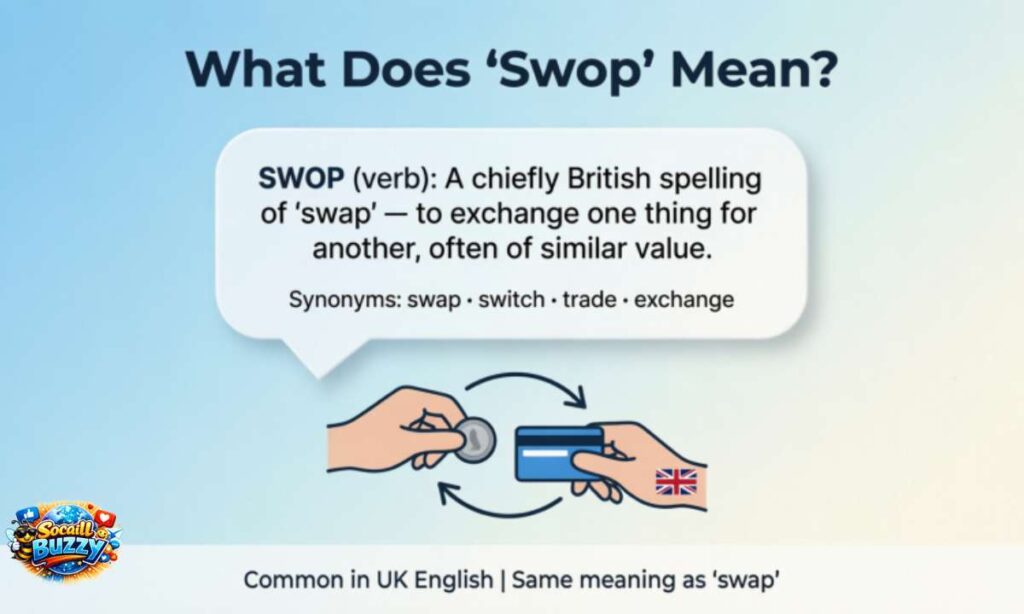
Swop carries the exact same meaning as swap. It is an alternative spelling not a different word that refers to the act of exchanging or trading one thing for another. The key difference is that swop is primarily associated with British English and is considered an older, more regional variant.
Swop as a Verb
- The children decided to swop their packed lunches at break time.
- He swopped his old stamp collection for a set of vintage coins.
Swop as a Noun
- They made a quiet swop of their test papers when the teacher was not looking.
As you can see, the meaning is identical. The word you choose depends entirely on your context, your audience, and the regional variety of English you are writing in not on any difference in what you want to say.
Click Here To Read Analysis vs Analyses
Swap vs Swop: Side-by-Side Comparison Table
| Feature | Swap | Swop |
| Meaning | To exchange one thing for another | To exchange one thing for another |
| Part of Speech | Verb and Noun | Verb and Noun |
| Pronunciation | /swɒp/ | /swɒp/ |
| Spelling | Modern, standard | Older, variant |
| Regional Use | Global (US, UK, AU, etc.) | Primarily historical British English |
| Frequency | Extremely common | Rare in modern writing |
| Formal Writing | ✅ Recommended | ⚠️ Not recommended |
| Academic Writing | ✅ Accepted | ❌ Best avoided |
| American English | ✅ Standard | ❌ Not used |
| British English | ✅ Preferred today | ⚠️ Older/regional only |
| Australian English | ✅ Standard | ❌ Rarely used |
| Dictionary Status | Primary entry in all major dictionaries | Listed as a variant/alternative spelling |
| SEO / Digital Writing | ✅ Better visibility | ⚠️ Lower search volume |
| Autocorrect | Kept as-is | Often corrected to “swap” |
The History and Etymology of Swap and Swop
To truly understand the swap vs swop debate, you need to travel back several centuries. The story behind these two spellings is a fascinating window into how English evolves over time.
Origins in Middle English
The word swap vs Swop traces its roots to Middle English, where the verb swappen originally meant “to strike” or “to hurl.” According to the Oxford English Dictionary, the earliest recorded evidence for the noun swap vs Swop appears around 1384, in the writings of Geoffrey Chaucer. As a verb, it is recorded even earlier, before 1375, in William of Palerne.
The connection between “striking” and “exchanging” makes sense when you consider the old custom of striking hands together with a handshake when concluding a business deal. The physical act of slapping hands sealed the trade, and over time, the word itself came to mean the trade or exchange itself.
By the 1500s, the meaning had fully shifted from “to strike blows” to “to exchange things.” This is the meaning that has survived into modern English.
Why “Swop” Appeared
The spelling swap emerged later, most likely as a phonetic variant tied to regional dialects. In certain parts of England particularly in the north the vowel in swap was pronounced more like an “o” sound. Writers and printers in those regions began spelling it swap to match the local pronunciation, much the same way American and British spelling differences arose (think color vs colour, or honor vs honour).
The earliest recorded evidence for swop in this phonetic sense appears around the late 18th century in regional texts. It gained some traction in British print during the 19th and early 20th centuries, appearing in newspapers, children’s books, and informal writing. But it never displaced swap as the primary spelling and by the mid-20th century, swap had become the overwhelming choice in virtually all major publications.
The Language Evolution Timeline
| Period | Development |
| Pre-1375 | Swappen appears in Middle English, meaning “to strike” |
| ~1384 | Earliest recorded noun form, cited in Chaucer |
| 1500s | Meaning shifts to “to exchange” |
| Late 1700s | Swop appears as a dialectal spelling variant |
| 1800s–early 1900s | Both spellings used in British English |
| Mid-1900s onwards | Swap dominates globally; swop becomes rare |
| Today | Swap is the universal standard; swop is a historical footnote |
Regional Usage: Where Is Each Spelling Used?
American English
In American English, swap is the only accepted spelling. Swop does not appear in major American dictionaries as a standard entry; it is not part of the American English vocabulary in any meaningful way. If you write swop in a US context, most readers will assume it is a typo.
Culturally, swap vs Swop is deeply embedded in the American language. “Swap meet” a marketplace for trading goods is a well-known American English phrase that became popular in California and spread nationwide. This kind of compound usage further cemented swap vs Swop as the definitive spelling.
British English
Here is where it gets slightly more nuanced. Swap was historically more present in British English than anywhere else, and you can still find it in older British texts, vintage children’s books, and traditional literature. However, modern British English strongly prefers swap.
British newspapers, the BBC, and contemporary British authors overwhelmingly use swap. The appearance of swop in modern British writing is increasingly rare and where it does appear, it tends to feel deliberately old-fashioned or nostalgic rather than standard.
The Oxford English Dictionary (OED), which is the most authoritative reference for British English, explicitly recommends swap vs Swop as the preferred spelling and lists swap as a variant.
Australian and Other Varieties
Australian English, Canadian English, South African English, and most other varieties of English worldwide follow the same convention as American English: swap is standard, swap is not used.
What Do Dictionaries Say About Swap vs Swop?
Dictionary guidance matters enormously when settling spelling questions. Here is what the leading authorities say:
| Dictionary | Entry for “Swap” | Entry for “Swop” |
| Oxford English Dictionary (OED) | Primary entry; recommends swap | Listed as a chiefly British variant |
| Merriam-Webster | Primary entry; standard American usage | Not listed as a standard entry |
| Collins English Dictionary | Primary entry; includes both swapper and swopper as derived forms | Acknowledged as a variant spelling |
| Cambridge Dictionary | Primary entry; swap listed as standard | Notes swop as an older British spelling |
| Macmillan Dictionary | Standard entry | Not featured |
The consensus is clear: swap is the recommended spelling across all major reference works. Swop has dictionary acknowledgment, but only as a variant not as the preferred form.
Swap vs Swop in Formal and Informal Writing
Understanding when each spelling is appropriate (even if one is always technically safer) helps you make smarter choices for your specific writing context.
Formal Writing (Business, Legal, Academic)
In formal writing contexts, always use swap. This applies to:
- Business emails and professional correspondence
- Legal contracts and financial documents
- Academic essays and research papers
- Journalism and news reporting
- Technical documentation and manuals
Using swop in any of these contexts risks looking careless, dated, or non-standard even if the reader understands the meaning. Professional writing demands clarity, and the universally recognized spelling (swap) is always the cleaner choice.
Informal Writing (Social Media, Texting, Casual Blogs)
In casual, everyday communication, both words technically convey the same idea. However, even in informal settings, swap is far more natural and widely understood. Most autocorrect systems on smartphones and word processors will flag swap and suggest swap automatically, another practical reason to stick with the standard spelling.
If you are quoting an older British text, or writing in a deliberately historical or nostalgic style, swop can appear as a stylistic choice. But this is a very narrow, specific exception.
Common Mistakes Writers Make with Swap and Swop
Even experienced writers make errors around these two words. Here are the most frequent pitfalls to avoid:
Mistake 1: Using “Swop” in American English
Incorrect: Let’s swop our tickets for the Friday show. Correct: Let’s swap our tickets for the Friday show.
Swop is simply not part of American English vocabulary. In a US context, it will almost always read as a typo.
Mistake 2: Mixing Both Spellings in the Same Document
Incorrect: We decided to swap lunches, and later they swapped phone cases too. Correct: We decided to swap lunches, and later they swapped phone cases too.
Consistency matters in writing. Pick one spelling swap and stick to it throughout your document.
Mistake 3: Assuming “Swop” Is Slang or Incorrect
Some people assume swop is simply wrong or is internet slang. It is neither. Swop is a legitimate, historically documented variant found in respected dictionaries. It is simply outdated and regional, not incorrect in an absolute sense.
Mistake 4: Using “Swop” to Sound More British
Some writers use swop thinking it makes their writing sound more British or sophisticated. In reality, modern British English prefers swap just as strongly as American English does. Using swop today is more likely to sound old-fashioned than distinctively British.
Mistake 5: Overcorrecting in Academic Papers
Students writing for British universities sometimes use swop thinking it is the “correct” British form. Swap is the standard and preferred spelling in British academic writing today.
Practical Examples: Using “Swap” Correctly in Different Contexts
Seeing a word in real-world sentences across different contexts helps reinforce correct usage. Here are examples of swap used naturally in various settings:
In Everyday Conversation
- “Do you want to swap seats? You will get a better view from here.”
- “I’ll swap my chocolate bar for your packet of crisps.”
- “They swapped gifts at the Secret Santa event last December.”
In Professional and Business Settings
- “Both teams agreed to swap deadlines to accommodate the client’s request.”
- “The HR department allows employees to swap shifts with prior approval.”
- “The two firms entered into an interest rate swap agreement last quarter.”
In Finance and Economics
- “A swap contract allows two parties to exchange cash flows over a defined period.”
- “Currency swaps are commonly used by multinational corporations to manage exchange rate risk.”
- “The bank facilitated an asset swap that benefited both counterparties.”
In Technology and Computing
- “The developer used a memory swap to handle the overflow during peak load.”
- “You can swap out the default theme with a custom one in the settings.”
- “The IT team performed a hot swap of the failing hard drive without shutting down the server.”
In Creative and Literary Writing
- “With one silent swap, she replaced the original painting with a forgery.”
- “The magician swapped the red card for a black one in a single sleight of hand.”
- “They swapped stories long into the night, each tale more extraordinary than the last.”
Swap in Finance: A Specialized Meaning

One area where swap carries a particularly important and specific meaning is finance and economics. In financial contexts, a swap refers to a derivative contract in which two parties agree to exchange financial instruments or cash flows over a set period.
Common types of financial swaps include:
- Interest Rate Swap exchanging fixed-rate interest payments for variable-rate payments
- Currency Swap exchanging principal and interest in different currencies
- Credit Default Swap (CDS) a form of insurance against the default of a borrower
- Commodity Swap exchanging cash flows based on the price of a commodity
In this highly technical, specialized domain, swap is the only accepted spelling. You will never encounter swop in a financial contract, a banking regulation document, or an economics textbook.
Why “Swap” Wins the SEO and Digital Writing Battle
For content creators, bloggers, and digital marketers, there is one more compelling reason to always choose swap over swop: search behavior.
People search for swap millions of times per month across Google, Bing, and other search engines. Searches for swop are a tiny fraction of that volume. When you use the more widely recognized and searched spelling in your content, you:
- Align with natural user language and search intent
- Improve readability for a global audience
- Avoid confusion or the impression of a typo
- Match the vocabulary used by authoritative, high-ranking websites
In SEO terms, swap is the primary keyword. Swop might function as a secondary or long-tail term, but it should never replace swap as your main word choice in digital content.
Quick-Reference Summary: Swap vs Swop
Here is a one-glance guide for making the right choice every time:
| Situation | Use |
| Writing for a global audience | Swap |
| American English context | Swap |
| Modern British English | Swap |
| Academic writing | Swap |
| Business and professional writing | Swap |
| Finance and economics | Swap |
| Technology and computing | Swap |
| Social media and casual writing | Swap |
| Quoting older British texts | Swop (as in the original) |
| Historical or nostalgic literary style | Swop (as a stylistic choice) |
| When unsure | Swap always |
Frequently Asked Questions (FAQs)
Q: Is “swop” a correct spelling?
Yes, swop is a legitimate English word listed in major dictionaries, but it is an older British variant that is rarely used in modern writing swap is the recommended spelling.
Q: Are swap and swop pronounced the same way?
Yes, both words are pronounced identically /swɒp/ with no difference in sound whatsoever.
Q: Which is correct: swap vs swop?
Both are technically correct, but swap is the standard, modern, and universally accepted spelling recommended by all major style guides and dictionaries.
Q: Is “swop” used in American English?
No swop is not part of American English and is not listed in standard American dictionaries like Merriam-Webster.
Q: Can I use “swop” in formal writing?
It is best to avoid it; swap is the professional and widely accepted choice in all formal writing contexts.
Q: Why does autocorrect change “swop” to “swap”?
Because swap is the dominant, recognized spelling in modern English, autocorrect systems are programmed to default to the standard form.
Q: Does the Oxford English Dictionary prefer swap or swop?
The OED explicitly recommends swap as the preferred spelling and lists swop only as a chiefly British variant.
Q: Is “swop” considered a typo?
In most modern contexts, especially outside the UK many readers will interpret swop as a typo for swap, even though it is technically a valid spelling.
Q: When did “swap” first appear in English?
The OED records the verb swap from before 1375, making it one of the older words in the English language, rooted in Middle English swappen.
Q: What is a “swap meet”?
A swap meet is an American English term for an outdoor marketplace or flea market where people trade, barter, or buy goods the phrase uses swap, not swop.
Conclusion: Which Word Should You Use?
The swap vs swop debate is, at its heart, not really a debate at all. Both words mean the same thing to exchange or trade one thing for another. They are pronounced identically. Their grammatical function is identical. The only real differences lie in spelling, age, and geography.
Swap is the clear winner in every practical sense:
- It is the primary spelling in every major dictionary worldwide
- It is the only form used in American English
- It is the strongly preferred form in modern British English
- It is standard in academic, professional, financial, and technical writing
- It is recognized and understood by every English speaker on the planet
- It performs better in digital and SEO contexts
Swap is not wrong, it is simply outdated. You will encounter it in older British books, vintage newspapers, and perhaps the occasional regional publication. Understanding it allows you to read historical texts with ease. But in your own writing, for any audience and any purpose, swap is the correct, confident, and modern choice.
Language evolves, spellings shift, and regional forms come and go. In the story of swap and swop, the evolution is complete. The winner has been clear for decades. Use swap always and move forward with confidence.

Welcome to SocaillBuzzy! I’m the creator and writer behind this platform, dedicated to sharing meaningful content including grammar, meaning, quotes, and inspirational messages for everyday life. Through well-crafted, SEO-friendly content, I aim to spread positivity, strengthen connections, and make it easier for readers to express their emotions with clarity and warmth.