
Have you ever stopped mid-sentence and asked yourself should this be “myself” or “my self”? If so, you are far from alone. This seemingly tiny distinction trips up English learners, seasoned writers, and even native speakers every single day. The two forms look almost identical, yet they belong to completely different worlds: one is a grammatical pronoun, the other a philosophical concept.
In this complete guide, you will learn exactly when to write myself versus my self, understand the grammar rules that govern each form, explore the psychological and philosophical contexts where the two-word version appears, and pick up practical tips to avoid the most common mistakes. By the time you finish reading, this confusion will be gone for good.
What Is “Myself”? Definition and Grammatical Role
Myself is a reflexive pronoun in English grammar. It belongs to the same family as yourself, himself, herself, itself, ourselves, yourselves, and themselves. These pronouns are formed by attaching -self (singular) or -selves (plural) to a personal pronoun.
Reflexive pronouns serve two core grammatical functions:
- Reflexive use when the subject and the object of the sentence are the same person
- Emphatic (intensive) use when you want to stress that the subject performed an action personally
As a single, fused word, myself has been the standard spelling in English for centuries. It is the only correct form to use in everyday grammar, formal writing, academic essays, and professional communication.
Quick Definition
Myself (pronoun): A reflexive pronoun used when the speaker is both the subject and the object of an action, or when the speaker wants to add emphasis to a statement.
What Is “My Self”? Definition and Context
My self is not a standard grammatical pronoun. Written as two separate words, it treats self as a noun specifically, as a reference to one’s personal identity, inner consciousness, or psychological essence.
You will encounter “my self” in:
- Philosophy texts discussing personal identity and consciousness
- Psychology literature dealing with self-concept, self-awareness, and self-esteem
- Self-help and mindfulness writing that explores the inner self
- Poetry and literary prose where the spacing creates intentional stylistic emphasis
The key distinction is this: my self is not about grammar, it is about identity. When someone writes “I need to reconnect with myself,” they are not making a pronoun error. They are using self as a meaningful noun that refers to their inner being.
Myself vs My Self: Core Difference at a Glance
| Feature | Myself | My Self |
| Word type | Reflexive / emphatic pronoun | Noun phrase |
| Standard grammar usage | ✅ Yes | ❌ No (non-standard) |
| Used in everyday writing | ✅ Yes | Rarely |
| Philosophical/psychological usage | ❌ No | ✅ Yes |
| Can replace “me” or “I” | ❌ No | ❌ No |
| Refers to inner identity | ❌ No | ✅ Yes |
| Example | I cooked dinner for myself. | I am trying to understand my self. |
The Two Key Uses of “Myself” in Grammar
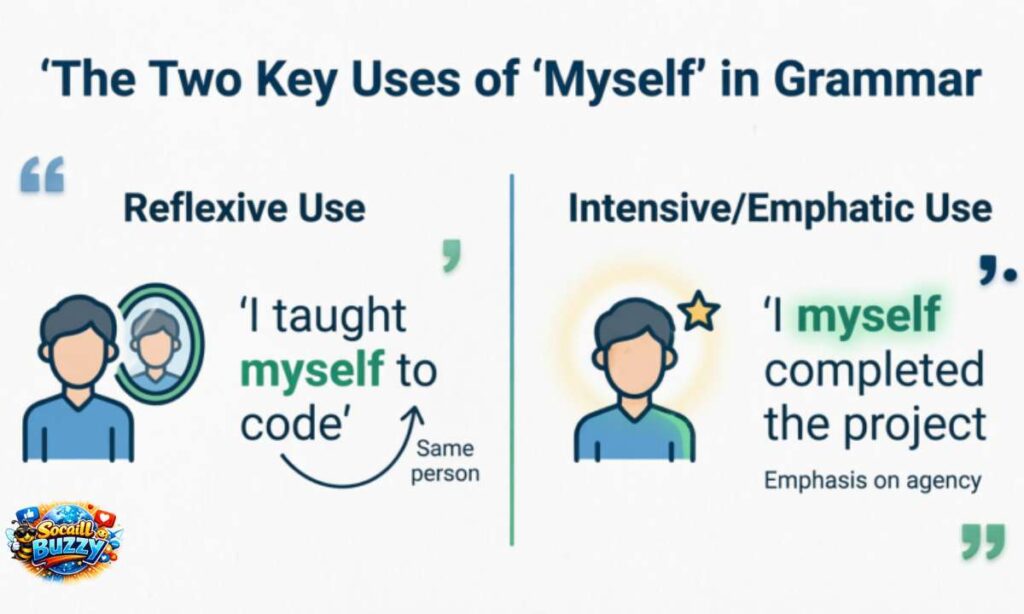
Understanding how myself works grammatically comes down to two functions: reflexive use and emphatic use. Let us look at each one closely.
1. Reflexive Use of “Myself”
A pronoun is used reflexively when the subject of the sentence performs an action on itself that is, when the subject and the object are the same person. With myself, this means the speaker (I) is both doing the action and receiving it.
Examples of reflexive use:
- I burned myself on the stove.
- She introduced herself to the team. (herself = same pattern)
- I taught myself how to code.
- I need to take better care of myself.
- He prepared himself for the interview. (himself = same pattern)
In all these sentences, removing myself would either break the grammar or change the meaning entirely. The reflexive pronoun is essential to the sentence structure.
Click Here To Read Swap vs Swop
2. Emphatic (Intensive) Use of “Myself”
Emphatic pronouns are identical in form to reflexive pronouns, but they serve a different purpose. Instead of showing that the subject acted on itself, an emphatic pronoun simply stresses that the subject and nobody else performed the action.
The critical test: If you can remove the pronoun and the sentence still makes complete grammatical sense, it is emphatic.
Examples of emphatic use:
- I myself witnessed the entire event. (I witnessed the entire event still grammatical)
- I’ll handle the complaint myself. (I’ll handle the complaint still grammatical)
- She herself told me the news. (She told me the news still grammatical)
- I, myself, don’t agree with that decision.
Notice how the sentences work without the emphatic pronoun but they lose the additional force and stress that comes with it.
Common Mistakes with “Myself” And How to Fix Them
Despite being a straightforward word, myself is one of the most misused pronouns in English. The most widespread mistake is using it as a polite or formal substitute for me or I. This is called hypercorrection trying to sound refined but accidentally creating a grammatical error.
Mistake #1: Using “Myself” Instead of “Me”
This error typically happens in compound objects, where people feel uncertain about whether to use me or I.
| ❌ Incorrect | ✅ Correct |
| Please send the report to John and myself. | Please send the report to John and me. |
| She gave the award to Sarah and myself. | She gave the award to Sarah and her. |
| Contact myself if you have questions. | Contact me if you have questions. |
| The invitation was sent to Tom and myself. | The invitation was sent to Tom and me. |
Quick test: Remove the other person from the sentence. “She gave the award to myself” sounds wrong immediately because it is. That tells me is the correct choice.
Mistake #2: Using “Myself” as the Subject
Myself should never be the subject of a sentence. The subject always takes me.
| ❌ Incorrect | ✅ Correct |
| Myself went to the conference. | I went to the conference. |
| Myself and John reviewed the file. | John and I reviewed the file. |
| Myself am responsible for this. | I am responsible for this. |
Mistake #3: Writing “My Self” When You Mean “Myself”
This is the direct reversal of the philosophical confusion. In everyday grammar, writing “my self” as two words when you mean the reflexive pronoun is non-standard.
| ❌ Non-standard | ✅ Correct |
| I told my self to stay calm. | I told myself to stay calm. |
| I bought my self a gift. | I bought myself a gift. |
| I did it all by my self. | I did it all by myself. |
When “My Self” Is Correct: Philosophical and Psychological Contexts
Now let us explore the specific contexts where writing my self as two separate words is not only acceptable, it can be the more precise and meaningful choice.
The Self as a Psychological Concept
In psychology, the self is a foundational concept. Thinkers from Sigmund Freud to Carl Jung explored the self as the center of consciousness and personal identity. Modern psychology distinguishes between several related concepts:
- Self-concept the collection of beliefs you hold about yourself; the answer to “Who am I?”
- Self-esteem how you evaluate and value yourself
- Self-awareness the degree to which you recognize and understand your own thoughts, emotions, and behaviors
- True self vs. false self the authentic inner being versus the persona presented to the outside world
When writers want to refer to this inner psychological construct directly, treating self as a standalone noun makes sense. “My self” in this context means “my inner being” or “the person I truly am.”
Examples in psychological writing:
- “Therapy helped me reconnect with my self after years of emotional disconnection.”
- “My self is not defined by the roles I play for others.”
- “I am learning to accept my self without judgment.”
The Self as a Philosophical Concept
Philosophers have grappled with the nature of the self for millennia. René Descartes famously anchored personal identity in conscious thought (cogito, ergo sum I think, therefore I am). The self, in philosophy, is what persists through time and changes the thing that makes you the same person you were ten years ago despite everything that has changed.
When writers engage with this philosophical tradition and treat self as a philosophical noun, writing it as a separate word (“my self”) signals that they are stepping outside of ordinary grammar into the realm of identity and consciousness.
Historical Usage: Shakespeare and Early Modern English
It may surprise you to learn that “my self” as two words is actually the older form. In Middle English and Early Modern English, reflexive pronouns were often written as two words. William Shakespeare himself used this spelling regularly:
“I do betray my self with blushing.” Othello
Over time, standardization pushed English toward the merged single-word form myself for grammatical usage. The two-word form retreated into poetic, philosophical, and literary writing, where it retains a distinctive flavor to this day.
Side-by-Side Sentence Comparisons
One of the clearest ways to grasp this distinction is to see both forms used in the same context. Notice how the meaning shifts dramatically.
| Sentence with myself | Sentence with my self |
| I reminded myself to stay focused. | I am rediscovering my self after years of stress. |
| I bought myself a coffee this morning. | My self is at peace when I am in nature. |
| I introduced myself to the new team member. | Meditation has brought me closer to my self. |
| I hurt myself during the hike. | My self is not what others project onto me. |
| I myself handled the entire project. | I am trying to understand my self more deeply. |
The difference becomes clear: myself always connects back to a grammatical action, while my self always points inward, toward identity and consciousness.
LSI and Related Grammar Terms You Should Know
To fully master this topic, it helps to understand a few related concepts that appear across grammar resources and top-ranking discussions of this subject.
Reflexive pronoun A pronoun that refers back to the subject of the clause. The complete list in English: myself, yourself, himself, herself, itself, ourselves, yourselves, themselves, oneself.
Emphatic pronoun (intensive pronoun) A pronoun used to add stress or emphasis. Identical in form to reflexive pronouns but optional the sentence remains grammatical without them.
Hypercorrection An error made by someone trying to sound more formal or correct, such as using myself in place of me in compound objects.
Self-reference The grammatical and cognitive act of referring to oneself. Myself is the primary self-referential pronoun for the first person singular.
Personal identity The philosophical concept of what makes a person the same individual across time and change, closely tied to the noun use of self and “my self.”
Pronoun case The grammatical category that determines which form of a pronoun to use (I vs. me vs. myself). Understanding pronoun case is essential to avoiding the common mistakes covered above.
“Myself” in Formal vs. Informal Writing
The appropriateness of myself can also shift depending on the register of your writing.
Formal Writing (Academic, Professional, Legal)
In formal writing, precision matters most. Use myself only when it is grammatically correct either as a reflexive pronoun where the subject and object are the same, or as an emphatic pronoun where you want to stress personal involvement.
Avoid using myself as a replacement for me or I in formal documents. Phrases like “Please direct inquiries to myself” or “Myself and my colleagues reviewed the contract” are grammatically incorrect regardless of how formal they sound.
Informal and Conversational Writing
In casual speech and informal writing, people use myself more loosely. You might hear “Feel free to ask myself or any of the team” in everyday conversation, and while it is not technically correct, native speakers widely tolerate it. However, in anything written emails, reports, social media posts where you want to appear professional, sticking to the grammatical rule is always the safer choice.
Quick Reference: When to Use Each Form
Use this checklist every time you are unsure which form to choose.
Use myself when:
- ✅ The subject (I) and the object are the same person (I hurt myself)
- ✅ You want to emphasize that you personally did something (I handled it myself)
- ✅ The sentence would still make sense without it, but you want extra stress
- ✅ You are writing in any standard context academic, professional, or everyday
Use my self when:
- ✅ You are writing about personal identity, inner consciousness, or psychological essence
- ✅ You are working in a philosophical, spiritual, or introspective context
- ✅ Self is functioning as a noun, not as part of a pronoun
- ✅ You are writing poetry or literary prose where the spacing is a deliberate stylistic choice
Never use either form when:
- ❌ You need a subject pronoun use I
- ❌ You need a simple object pronoun use me
- ❌ You are writing a compound subject like “John and ___” use I or me as appropriate
Practical Exercises to Test Your Understanding
Try these short exercises. The answers follow each set.
Exercise 1 Choose the correct form:
- I made the entire presentation _______ .
- Please send all inquiries to James or _______ .
- _______ went to the doctor this morning.
- I am trying to understand _______ better after years of self-doubt.
- The president _______ signed the document.
Answers:
- myself (emphatic I did it personally)
- me (object pronoun in a compound not myself)
- I (subject pronoun never myself)
- my self (referring to inner identity and psychological growth)
- himself (emphatic with a different subject)
Exercise 2 Correct the errors:
- ❌ Myself and my partner opened the business together.
- ❌ She told my self to stop worrying about grammar.
- ❌ The manager gave the bonus to Sarah and myself.
- ❌ Myself don’t think that’s the right approach.
Corrections:
- ✅ My partner and I opened the business together.
- ✅ She told myself to stop worrying about grammar. (reflexive she told me about myself)
- ✅ The manager gave the bonus to Sarah and me.
- ✅ I don’t think that’s the right approach
FAQs: Myself vs My Self
Is “my self” a grammatical error?
In standard everyday grammar, yes. Use the single word myself for reflexive and emphatic purposes. The two-word form is only appropriate in philosophical, psychological, or literary contexts where self functions as a noun.
Can I use “myself” instead of “me” to sound more formal?
No. Using myself in place of me (e.g., “contact myself”) is a grammatical error regardless of how formal it sounds.
Is “myself” a subject pronoun?
No. It is the subject pronoun. Myself should never be used as the subject of a sentence.
When did “myself” become one word?
Around the 18th century, as English grammar became standardized, grammarians began treating reflexive pronouns as single lexical units. Before that, “my self” as two words was common, including in Shakespeare’s writing.
Does “my self” appear in modern dictionaries?
Most standard dictionaries list myself as the pronoun. The two-word “my self” is discussed in philosophical and psychology dictionaries in the context of personal identity and the self.
Can “myself” be used for emphasis in a sentence?
Yes. “I myself completed the entire report” is a correct emphatic use of myself, stressing that you and nobody else did the work.
Is it correct to say “by myself”?
Yes. The phrase “by myself” is a standard idiomatic expression meaning alone or without help. “I finished the project by myself” is perfectly correct.
What is the plural form of “myself”?
The plural form is ourselves. When you switch from first person singular (I) to first person plural (we), the reflexive pronoun changes accordingly.
Should I use “myself” in professional emails?
Use myself only when grammatically correct. Avoid writing “please reach out to myself” write “please reach out to me” instead.
Can “my self” be used in a journal or self-help writing?
Yes. In personal, reflective, or mindfulness-oriented writing, “my self” as two words is an appropriate way to refer to your inner being or psychological identity.
Conclusion
The difference between myself and my self is small in appearance but significant in meaning. As a reflexive and emphatic pronoun, myself belongs to the grammar of everyday English. It is the correct choice in the overwhelming majority of situations. The two-word form myself, on the other hand, steps outside grammar and into identity, consciousness, and philosophical reflection.
Getting this right comes down to asking one simple question: Am I referring to a grammatical action (reflexive or emphatic), or am I referring to my inner being as a concept? In the first case, use myself. In the second, “my self” is acceptable and can even be more precise.
The most common mistake is using myself as a polished substitute for me or I. This hypercorrection is extremely widespread, but it is still an error in professional writing, academic work, and formal communication; it undermines the clarity and credibility of your language.
Master this distinction, and you will not just avoid a grammatical pitfall. You will sharpen your writing, communicate with greater precision, and demonstrate the kind of attention to language that separates competent writers from truly excellent ones.

Welcome to SocaillBuzzy! I’m the creator and writer behind this platform, dedicated to sharing meaningful content including grammar, meaning, quotes, and inspirational messages for everyday life. Through well-crafted, SEO-friendly content, I aim to spread positivity, strengthen connections, and make it easier for readers to express their emotions with clarity and warmth.