
Have you ever typed “that speech really resignated with me” only to pause and wonder if that looks right? You are not alone. Every day, thousands of people across emails, social media posts, and professional documents write “resignate” when they actually mean “resonate.” It feels natural. It sounds formal. And that is exactly why the mistake keeps spreading.
The truth is simple: “resignate” is not a real English word. It never has been. There is no dictionary entry for it, no grammar authority that recognizes it, and no linguistic history behind it. Only one word belongs in your sentence and that word is “resonate.”
In this comprehensive guide, you will learn the correct word to use, what it means, where it comes from, how to use it in context, and why so many people keep getting it wrong. Whether you are a student, a professional, or someone who just wants to write with confidence this is the resource you need.
What Is the Difference Between Resignate and Resonate?
Let’s answer this immediately and clearly, because everything else flows from it.
| Word | Real Word? | Meaning | Dictionary Entry |
| Resonate | ✅ Yes | To produce or evoke a deep sound or emotional connection | Merriam-Webster, Oxford, Cambridge |
| Resignate | ❌ No | No meaning does not exist | Not found in any major dictionary |
Resonate is the correct word in every context, every time.
Resignate is a phantom word, a misspelling that sounds legitimate but carries no meaning and has no place in standard English.
Why Do People Write “Resignate”?
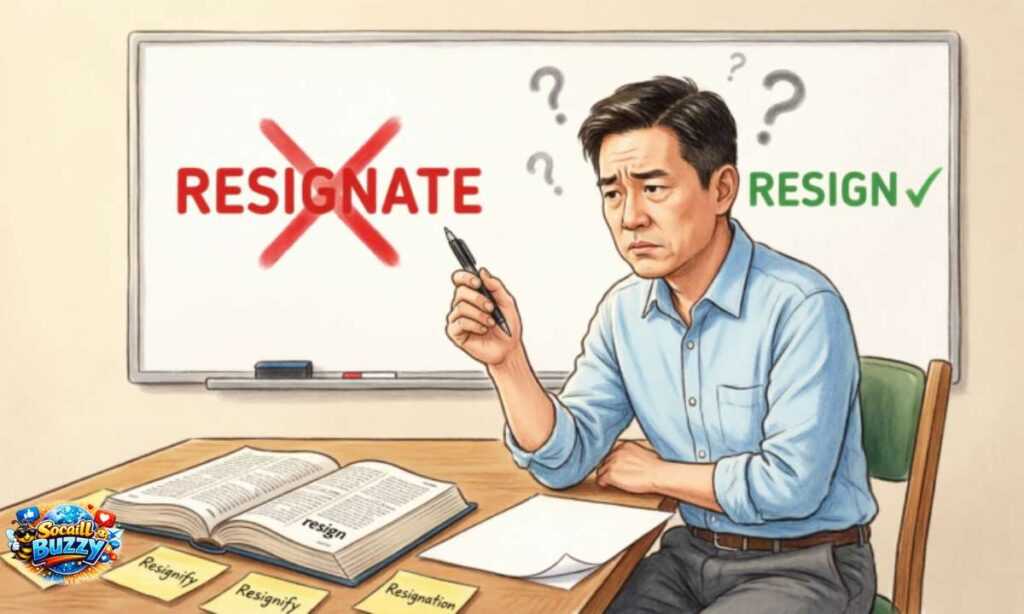
This is actually a fascinating question from a linguistic perspective. If resignate doesn’t exist, why does it feel so natural to say it?
There are three main reasons:
1. It Sounds Like Real Words
English speakers are familiar with words like designate, navigate, originate, and allocate all of which end in “-ate” and are perfectly legitimate verbs. The brain hears “resignate” and categorizes it alongside these words without questioning it.
2. It Sounds Like “Resign”
The word resign is real and widely used. When someone hears “resonate” spoken quickly, especially in conversation or media, the brain sometimes maps it onto the familiar “resign” and attaches the common verb suffix “-ate.” The result is the invented word “resignate.”
3. It Is Used in Fast Speech
When people say “that really resonated with me” quickly, the “-res-” sound can be misheard or misinterpreted. The phonetic closeness between res-o-nate and re-sig-nate fools listeners and then those listeners write down what they thought they heard.
As one grammar analysis noted, resignate appears to emerge from a blend of resign and resonate, creating a hybrid that sounds authentic but simply is not.
Click Here To Read Accumulative vs Cumulative
The Correct Word: Resonate Full Definition and Etymology
Where Does “Resonate” Come From?
The word resonate has a well-documented and rich linguistic history. It comes from the Latin word resonare, which means “to resound.” The root breaks down as:
- Re- again, back
- Sonare to sound (the same root behind words like sonic, sonnet, and consonant)
The Oxford English Dictionary traces the earliest known use of “resonate” in English to the mid-1600s, making it a well-established word with nearly four centuries of documented usage.
By the 1980s, political journalist William Safire noted that “resonate” had become a “vogue word” used so widely in culture, business, media, and politics that its figurative applications had expanded dramatically beyond its original acoustic meaning.
Official Dictionary Definitions
Merriam-Webster defines “resonate” as:
- To produce or exhibit resonance
- To relate harmoniously; to strike a chord
- To have a repetitive pattern that resembles resonance
Oxford Learner’s Dictionary defines it as:
- (Of a place) to be filled with sound; to make a sound continue longer
- To remind someone of something; to be similar to what someone thinks or believes
- (Literary) to be full of a particular quality or feeling
Cambridge Dictionary describes it as producing or being filled with a clear, continuing sound, or to have a particular meaning or importance.
The Two Core Meanings of Resonate
Understanding how to use “resonate” confidently means understanding its two distinct applications: literal and figurative.
Literal Meaning Sound and Acoustics
In its original and technical sense, “resonate” refers to the physical phenomenon of sound vibrating and continuing through a space. This is the acoustic, scientific use of the word.
Examples:
- “The church bells resonated across the valley for several minutes.”
- “The body of the violin acts as a resonating chamber, amplifying the sound.”
- “Her voice resonated through the entire concert hall.”
- “Deep sounds from the bassoon resonated throughout the auditorium.”
In physics and electronics, resonance refers to an object or circuit vibrating at its natural frequency when stimulated by an external source. A tuning fork resonates. A radio circuit resonates to pick up a specific frequency. This technical usage underpins the word’s broader meanings.
Figurative Meaning Emotional Connection and Meaning
This is the usage most people are reaching for and the one most often misspelled as “resignate.” When something resonates with you figuratively, it means it strikes a deep chord emotionally, intellectually, or experientially.
It suggests more than simple agreement. To resonate with something means it vibrates at the frequency of your own experience your memories, values, beliefs, or emotions are stirred by it.
Examples:
- “The candidate’s message resonated deeply with working-class voters.”
- “That novel resonated with me because it mirrored my own childhood.”
- “Her story about loss resonated with everyone in the room.”
- “The campaign’s theme resonated with young consumers nationwide.”
Think of it this way: a guitar string resonates when it vibrates at exactly the right frequency. A story or message resonates with a person when it vibrates at the frequency of their own inner world.
Resonate in Context: Correct Usage Across Different Settings
One of the marks of a strong vocabulary is knowing how a word works across different contexts. Here is how “resonate” is correctly used in professional, creative, academic, and everyday settings.
In Professional Writing and Business Communication
| Incorrect (resignate) | Correct (resonate) |
| The brand’s story resignated with consumers. | The brand’s story resonated with consumers. |
| Her presentation resignated with the board. | Her presentation resonated with the board. |
| The new policy doesn’t resignate with employees. | The new policy doesn’t resonate with employees. |
| This vision should resignate across departments. | This vision should resonate across departments. |
In Everyday Conversation and Social Media
People most frequently stumble on this word in informal writing text messages, social media captions, personal essays, and comment sections. The fix is simple:
- ❌ “That movie really resignated with me.”
- ✅ “That movie really resonated with me.”
- ❌ “His words resignate with my experience.”
- ✅ “His words resonate with my experience.”
- ❌ “The song resignated through the whole venue.”
- ✅ “The song resonated through the whole venue.”
In Academic and Literary Writing
“Resonate” is a powerful word in academic analysis. It is often used when discussing how a text, argument, or theme connects meaningfully with an audience or reader.
- “The themes in the novel resonate with broader questions of identity and belonging.”
- “This argument resonates with earlier scholarship on post-colonial theory.”
- “The imagery resonates throughout the entire poem, building emotional depth.”
How to Pronounce “Resonate” Correctly
One of the reasons “resignate” persists is that people sometimes mispronounce “resonate,” which then reinforces the wrong spelling.
Correct pronunciation: REZ-uh-nate
Break it down:
- REZ rhymes with “fez”
- uh a short, unstressed middle syllable
- nate like the name “Nate”
Do not pronounce it as “re-SIGN-ate” ; that mispronunciation is what gives rise to the written error “resignate.” When you get the pronunciation right, the correct spelling follows naturally.
Synonyms for Resonate When You Need a Different Word
Good writers know that variety keeps prose engaging. Here are strong alternatives to “resonate” for both its literal and figurative meanings:
Synonyms for the Literal (Sound) Meaning
| Synonym | Example Usage |
| Echo | “Her voice echoed through the empty hall.” |
| Reverberate | “Music reverberated off the stone walls.” |
| Resound | “The applause resounded throughout the theater.” |
| Ring out | “Church bells rang out across the countryside.” |
| Vibrate | “The bass vibrated through the floor.” |
Synonyms for the Figurative (Emotional) Meaning
| Synonym | Example Usage |
| Strike a chord | “The story struck a chord with readers.” |
| Connect | “Her message connected deeply with the audience.” |
| Speak to | “That poem speaks to universal human experience.” |
| Hit home | “The documentary really hit home for survivors.” |
| Ring true | “His words rang true for many voters.” |
| Reverberate | “The scandal continued to reverberate through the industry.” |
Each of these captures something slightly different in tone and intensity. “Strike a chord” is idiomatic and vivid. “Ring true” implies authenticity. “Connect” is more neutral and straightforward. “Reverberate” retains a sense of ongoing impact. Choose based on what best fits your context.
Common Mistakes to Avoid When Using “Resonate”
Knowing the right word is only part of the battle. Here are the most frequent errors writers make and how to fix them.
Mistake 1: Confusing “Resignate” and “Resonate”
This is the central error of this guide. The correction is absolute: always use resonate.
Mistake 2: Saying “I resonate with you” When You Mean “I relate to you”
While “resonate” can imply identification, saying “I resonate with you” sounds slightly awkward as a personal statement. The more natural phrasing is:
- ✅ “That resonates with me.”
- ✅ “Your experience resonates with my own.”
- ❌ “I resonate with you.” (grammatically unusual avoid)
Mistake 3: Overusing “Resonate” in a Single Piece of Writing
“Resonate” is impactful precisely because it carries emotional weight. Using it three or four times in the same paragraph weakens it. When the word appears too often, it starts to feel like filler. Use it selectively, and let the synonyms listed above carry the load in adjacent sentences.
Mistake 4: Using “Resonate” When “Echo” Is More Precise
If you are talking about sound literally bouncing or repeating, echo or reverberate may be more technically precise than “resonate.” Reserve “resonate” for the richer concept of vibrating at a matching frequency.
Mistake 5: Forgetting the Preposition “With”
In its figurative use, “resonate” typically takes the preposition “with”:
- ✅ “The message resonated with the audience.”
- ❌ “The message resonated the audience.”
Quick-Reference Summary: Resignate vs. Resonate
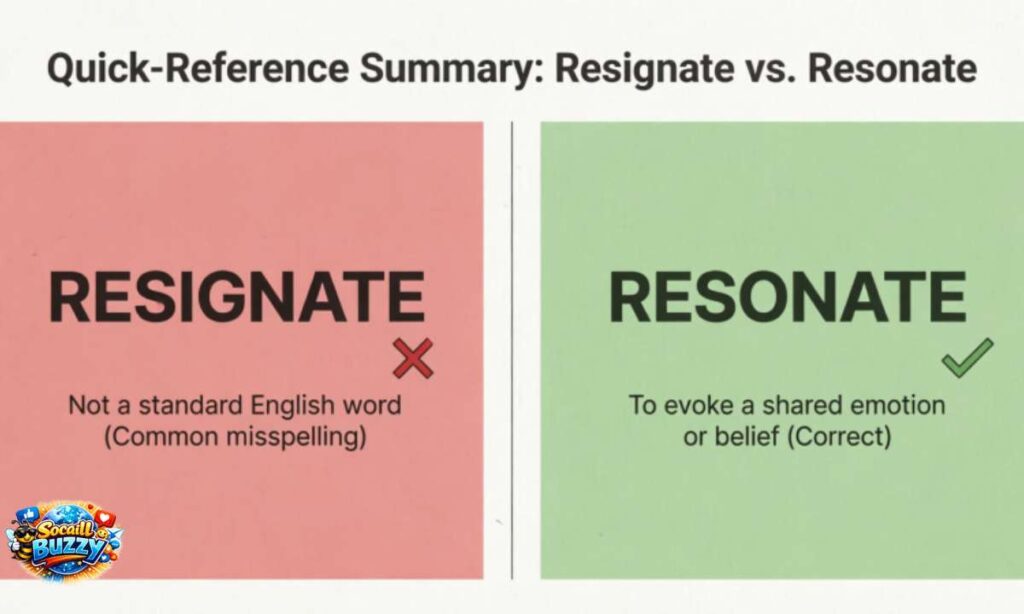
| Feature | Resignate | Resonate |
| Is it a real word? | ❌ No | ✅ Yes |
| Found in dictionaries? | ❌ No | ✅ Merriam-Webster, Oxford, Cambridge |
| Has a meaning? | ❌ No | ✅ Multiple (sound + emotional connection) |
| Correct in professional writing? | ❌ Never | ✅ Always |
| Latin origin? | ❌ None | ✅ Resonare (to resound) |
| Documented in history? | ❌ No | ✅ Since the 1600s |
The answer is unambiguous. There is no situation, context, or register in which “resignate” is the right choice. It does not belong in formal writing, casual conversation, academic essays, business emails, or social media captions.
Why This Matters for Your Credibility
You might be thinking: it’s just one word. Does it really matter?
It does more than you might expect.
When a recruiter reads a cover letter and sees “resignated,” it raises a quiet question about attention to detail. When a client receives a proposal with “resignate,” it chips away at the writer’s professional credibility. When a student submits an essay using a non-existent word, it signals something to the grader.
Language is a tool of trust. The words you choose signal your level of care, your engagement with the subject, and your respect for the reader. Getting a commonly misused word right is a small act but it contributes to something bigger: writing that people read with confidence rather than distraction.
Frequently Asked Questions
Q: Is “resignate” ever correct?
No. “Resignate” is not a recognized word in any standard English dictionary and should never be used.
Q: What does “resonate” mean in simple terms?
It means something produces a strong, lasting sound or emotionally connects with someone in a deep, meaningful way.
Q: Can I use “resonate” and “reverberate” interchangeably?
Not always. “Resonate” implies a matching frequency or emotional depth; “reverberate” emphasizes ongoing echo or prolonged impact.
Q: How do I remember the correct spelling?
Think of the word “resonance” or “resonant” both clearly spelled with “res-o” and work backward to “resonate.”
Q: Is “resonate” formal or informal?
Both. It works in academic essays, business presentations, creative writing, and everyday conversation.
Q: What preposition follows “resonate”?
The most common usage is “resonate with” as in “the speech resonated with the crowd.”
Q: Can “resonate” be used in a scientific context?
Yes. In physics and electronics, “resonance” and “resonate” describe the phenomenon of vibration at a natural frequency.
Q: Is “resonated” the past tense of “resonate”?
Yes. “The message resonated with voters” past tense is “resonated.”
Q: What’s a simpler word than “resonate”?
Depending on context: “connect,” “relate to,” “ring true,” or “strike a chord.”
Q: Did “resignate” ever appear in older English?
No. There is no recorded historical usage of “resignate” in Latin, Old English, Middle English, or any form of the language.
Conclusion
The confusion between “resignate” and “resonate” is one of those quiet language mistakes that feels small but matters more than people realize. Now you know the full story.
Resonate is the word. It is the only word. It has centuries of history, multiple dictionary definitions, and the endorsement of every grammar authority in the English-speaking world. It works in both literal and figurative contexts, and it brings a sense of depth and emotional richness to writing when used well.
Resignate is not a word. It has no meaning, no history, and no place in your writing.
The next time you want to say that something struck a deep chord that is connected with your values, your memory, your experience you know exactly which word to reach for. Reach for resonance, and reach for it with confidence.

Welcome to SocaillBuzzy! I’m the creator and writer behind this platform, dedicated to sharing meaningful content including grammar, meaning, quotes, and inspirational messages for everyday life. Through well-crafted, SEO-friendly content, I aim to spread positivity, strengthen connections, and make it easier for readers to express their emotions with clarity and warmth.