Have you ever typed a sentence and paused, wondering whether to write become or became? You are not alone. This is one of the most commonly searched grammar questions in English, and for good reason. These two words look similar, come from the same verb, and both describe change. Yet they do completely different jobs in a sentence. Use the wrong one and your writing loses accuracy, clarity, and credibility instantly.
This guide explains exactly when to use become vs became, covers all the key verb tenses, shows you real sentence examples, and walks through the most common mistakes people make. By the end, choosing between these two words will feel second nature.
What Does the Verb “Become” Mean?
The verb become means to change into something, to start being something, or to grow into a new state or role. It describes transformation over time and is used across every tense in English.
Some everyday synonyms for become include: change into, turn into, grow into, develop into, evolve into, and transform into.
Here are a few simple examples showing its core meaning:
- 🔵 She wants to become a nurse.
- 🔵 He will become a better version of himself.
- 🔵 Water can become steam when heated.
What makes become special is that it is an irregular verb. That means its past tense form does NOT follow the standard pattern of adding “-ed” to the base. You do not write “becomed.” You write be.came.
Click Here To Read “Too Early” vs “To Early”
The V1 V2 V3 Forms of Become

Before understanding the become vs became debate, it helps to know the three principal forms of this verb:
| Form | Word | When It Is Used |
| V1 (Base Form) | become | Present simple, future simple |
| V2 (Past Simple) | became | Simple past tense |
| V3 (Past Participle) | become | Present perfect, past perfect, passive voice |
This table is the foundation of everything. Notice that V1 and V3 are identical both are the word become. Only V2 changes to became. This is why so many people mix them up.
When to Use “Become” (Full Breakdown by Tense)
Present Simple Tense
Use become or becomes in the present tense to describe habits, general truths, or actions that happen regularly.
- 🔵 I become nervous in crowded rooms.
- 🔵 She becomes happy every time she reads.
- 🔵 They become better at their craft with every practice session.
Quick rule: Use becomes with singular subjects he, she, it, or any singular noun. Use become with plural subjects and with I, you, we, they.
Future Simple Tense
Use become when talking about something that will happen in the future, often with will or going to.
- 🔵 He will become a great leader someday.
- 🔵 She is going to become a doctor.
- 🔵 This habit will become permanent if you keep at it.
Present Perfect Tense
Use has become or have become when an action started in the past but still connects to the present.
- 🔵 She has become one of the most respected teachers in the school.
- 🔵 They have become very close friends over the years.
- 🔵 Remote work has become a standard part of modern life.
Important note: The present perfect tense always uses become, never be.came. The formula is: has/have + become.
Past Perfect Tense
Use had become when you are describing a past action that happened before another past event. This form keeps your timeline clear.
- 🔵 By the time she arrived, the room had become completely silent.
- 🔵 He had become well known long before his book was published.
- 🔵 The situation had become dangerous before anyone noticed.
Conditional and Hypothetical Sentences
Use would become for hypothetical situations, predictions, and repeated past habits.
- 🔵 If she practiced daily, she would become a champion.
- 🔵 He told me he would become a chef one day.
- 🔵 Every time there was thunder, the dog would become anxious.
When to Use “Became” (The Simple Past Tense)
Became is the simple past tense of become. That is its only job. Use it when you are describing a completed transformation or change that happened at a specific point in the past.
There are no helping verbs with be.came. It stands alone.
- 🔴 She be.came a lawyer in 2015.
- 🔴 The sky be/came dark just before the storm.
- 🔴 He be/came more patient after becoming a parent.
- 🔴 They became best friends in college.
If the change is fully over and done with, and you are simply reporting what happened in the past, became is your word.
Become vs Became: Side-by-Side Comparison Table
This comparison table shows the clearest differences between these two words:
| Feature | Become | Became |
| Verb form | V1 (base) / V3 (participle) | V2 (past simple) |
| Tense | Present, future, perfect | Simple past only |
| Used with helping verbs | Yes (has, have, had, will) | No |
| Time reference | Now, later, or connected to present | Completely in the past |
| Example | She has become confident. | She became confident. |
| Negative form | has not become / did not become | — |
Common Mistakes With Become and Became
These errors appear in student essays, professional emails, social media posts, and even published content. Learn to spot and avoid them.
Mistake 1: “Has Became” (Very Common)
This is the most frequent error. People replace become with be/came after a helping verb. This is always wrong.
- ❌ She has became the team leader.
- ✅ She has become the team leader.
- ❌ The company has be/came a global brand.
- ✅ The company has be/come a global brand.
Why it’s wrong: Became is a simple past form (V2). Helping verbs like has and have require the past participle (V3), which for this verb is become, not became.
Mistake 2: “Have Became” (Same Error, Plural Subject)
- ❌ They have became excellent musicians.
- ✅ They have became excellent musicians.
Wait here’s the corrected version:
- ✅ They have become excellent musicians.
Mistake 3: “He Become a Doctor Last Year”
Using the base form when you need simple past is equally incorrect.
- ❌ He become a doctor last year.
- ✅ He became a doctor last year.
Mistake 4: “Had Be/came” in Past Perfect
- ❌ By the time we left, it had became too late.
- ✅ By the time we left, it had become too late.
Mistake 5: “Would Became” in Conditional Sentences
- ❌ She said she would be/came a teacher.
- ✅ She said she would become a teacher.
Quick Decision Guide: How to Choose Every Time
Not sure which form to use? Run this quick check:
- Does your sentence have a helping verb? (has, have, had, will, would) → If yes, use become.
- Is the event fully completed in the past, with no helping verb? → If yes, use became.
- Are you talking about the present or future? → Use become or becomes.
That three-step filter will catch almost every mistake.
Real-World Sentence Examples by Context
Here are practical examples across common contexts so you can see both words working naturally:
Career and Professional Life
- 🔵 She became the youngest CEO in the company’s history.
- 🔵 He has become a trusted advisor over the past decade.
- 🔵 With the right training, anyone can become a skilled professional.
Education
- 🔵 The school be.came known for its innovative programs.
- 🔵 Students become more confident when they receive consistent feedback.
- 🔵 She has become one of the most decorated graduates of her class.
Personal Growth
- 🔵 He became a better person after years of self-reflection.
- 🔵 Patience becomes easier with practice.
- 🔵 They have become much more open-minded since moving abroad.
Technology and Society
- 🔵 Smartphones became mainstream in the early 2010s.
- 🔵 Artificial intelligence has become a transformative force in many industries.
- 🔵 Online shopping will become even more dominant in the coming years.
Nature and Science
- 🔵 The caterpillar be/came a butterfly after two weeks.
- 🔵 This region has become a habitat for endangered species.
- 🔵 Temperatures become extreme during the summer months.
“Become” as an Irregular Verb: Why the Rules Are Different
Regular English verbs form the past tense by adding -ed to the base form. For example: walk → walked, talk → talked, start → started.
Become does not follow this rule. It is an irregular verb, which means its forms change in unpredictable ways that you simply have to memorize.
Here is how become compares to a regular verb:
| Tense | Regular Verb (Walk) | Irregular Verb (Become) |
| Present | walk | become |
| Past Simple | walked | became |
| Past Participle | walked | become |
| Present Perfect | has walked | has become |
| Past Perfect | had walked | had become |
The key insight: with regular verbs, the V2 and V3 forms are identical (walked = walked). With become, the V2 form (became) is different from the V3 form (become). This mismatch is the root cause of most errors.
“Become” vs “Became” in British and American English
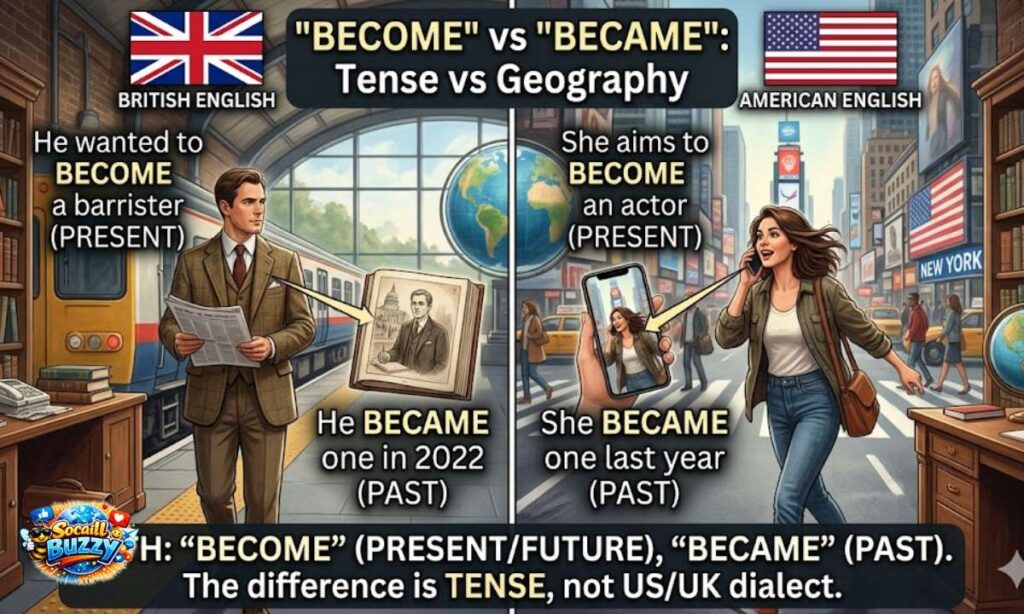
Good news here: there is no difference between British and American English when it comes to become and became. Both dialects use the same forms.
- British English: She became a renowned surgeon. ✅
- American English: She became a renowned surgeon. ✅
Unlike some irregular verbs that have separate British and American forms (such as dreamed vs dreamt), become/became follows the same pattern in both varieties worldwide.
Advanced Usage: Become in Passive Voice
Become also appears in passive constructions, most often when describing a process of change applied to a subject.
- 🔵 The proposal has become widely accepted.
- 🔵 The policy became outdated within a year.
- 🔵 New standards have become part of everyday operations.
In passive voice, the same rules apply: use became for completed past actions and become for perfect tenses or present states.
Summary Table: All Forms of “Become” at a Glance
| Tense | Form | Example |
| Present Simple | become / becomes | She becomes stronger each day. |
| Simple Past | became | He became a pilot in 2018. |
| Present Perfect | has/have become | They have become close allies. |
| Past Perfect | had become | She had become famous before 30. |
| Future Simple | will become | You will become great at this. |
| Conditional | would become | He said he would become a chef. |
| Future Perfect | will have become | By then, it will have become standard. |
Frequently Asked Questions (FAQs)
Q: What is the difference between become and became?
Become is the base/present/past participle form, while be/came is the simple past tense used for completed past events.
Q: Is “has became” correct?
No. The correct form is always “has become” since be/came cannot follow a helping verb.
Q: Can I use “became” in present tense?
No. Became is only used for the simple past tense.
Q: What is the past participle of become? The past participle is become, not be/came. It is used with has, have, and had.
Q: Is “had became” grammatically correct?
No. The correct past perfect form is “had become,” not “had be/came.”
Q: What is the difference between “became” and “had become”?
Be/came is simple past (one completed action); had become is past perfect, used when one past action happened before another past action.
Q: Can “become” be used in the future tense?
Yes. Use “will become” for future predictions and “is going to become” for planned future events.
Q: Does “become” change form in British vs American English?
No. Both British and American English use the same forms: become (present/participle) and became (simple past).
Q: When should I use “would become”?
Use “would become” in conditional sentences, reported speech, or to describe repeated past habits.
Q: What is the third form (V3) of become?
The third form is become, which is the same as the base form V1.
Conclusion
The become vs became question has one clean answer once you understand verb tenses. Become is your go-to word for the present, future, and all perfect tenses. Became is reserved for the simple past completed changes that belong entirely in the past, standing alone without any helping verb.
The biggest rule to remember: never write “has became” or “have became.” Those phrases are always wrong. After has, have, or had, you always need to become.
Master these two words and you will produce sharper writing, avoid the grammar slip-ups that weaken professional communication, and express transformation with total confidence. Whether you are writing an academic essay, a business email, or a personal story, the right word tells the right story at the right time.

Welcome to SocaillBuzzy! I’m the creator and writer behind this platform, dedicated to sharing meaningful content including grammar, meaning, quotes, and inspirational messages for everyday life. Through well-crafted, SEO-friendly content, I aim to spread positivity, strengthen connections, and make it easier for readers to express their emotions with clarity and warmth.