
You typed it fast. It looked fine. Spellcheck didn’t flag it. But somewhere in your email, your caption, or your report, you wrote “to early” and it was wrong.
This is one of the most common grammar slip-ups in English, and it happens to native speakers just as often as learners. Both words sound identical when spoken, so the error rarely gets caught out loud. But in writing, the difference matters and once you understand why, you’ll never mix them up again.
This guide breaks down the “too early” vs “to early” confusion completely, with clear rules, real examples, comparison tables, and memory tricks to make correct usage stick for good.
Quick Answer: “Too Early” or “To Early”?
“Too early” is always correct. “To early” is always wrong in standard English.
The word too is an adverb meaning excessively or more than needed. In the phrase “too early,” it tells you that something happened before the right or desired time. It modifies the word “early” directly.
The word to is a preposition or part of an infinitive verb (like to go, to leave, to sleep). It does not modify adjectives or adverbs. Because “early” is an adjective/adverb not a verb or noun “to early” has no grammatical function and breaks the rules of English sentence structure.
| Phrase | Correct? | Why |
| Too early | ✅ Yes | Too is an adverb modifying early |
| To early | ❌ No | To cannot modify an adjective/adverb |
Understanding “To” and “Too” The Root of the Confusion
These two words are homophones they sound exactly the same in speech (/tuː/) but carry completely different meanings and grammatical roles. That identical sound is why the mistake persists even among experienced writers.
What Does “To” Mean?
To is one of the most versatile words in English. It operates in two main ways:
- As a preposition showing direction, destination, or recipient
- 🔵 I’m driving to the office.
- 🔵 She handed the report to her manager.
- 🔵 He walked to the corner.
- As an infinitive marker connecting with a base verb to form a verb phrase
- 🔵 I want to leave now.
- 🔵 She decided to go home.
- 🔵 It’s time to start.
Notice that in every correct use of to, it is either followed by a noun (showing direction) or by a verb (forming an infinitive). “Early” is neither an adjective nor an adverb, which means to have no place in front of it when you’re expressing excess timing.
What Does “Too” Mean?
Too is an adverb with two distinct meanings:
- Excessively / more than desired signals that something crosses an acceptable limit
- 🟢 It’s too hot to work outside.
- 🟢 She arrived too late for the show.
- 🟢 You’re speaking too fast.
- Also / in addition used at the end of a clause
- 🟢 I want to come too.
- 🟢 He was tired, and she was too.
In “too early”, the word carries the first meaning the timing is more early than is wanted, appropriate, or expected.
Why “To Early” Is Grammatically Impossible
The phrase “to early” fails at the structural level. Here’s a clear breakdown of why:
“To” as a preposition needs a noun after it.
- ✅ To the store / To school / To her
“To” as an infinitive marker needs a verb after it.
- ✅ To leave / To decide / To wake up
“Early” is an adjective or adverb that describes timing.
- ❌ “To early” gives “to” nothing grammatically valid to attach to.
The sentence structure simply collapses. There is no job for “to” in that position. As soon as you replace it with “too,” everything works:
- ❌ It’s to early to leave. (broken)
- ✅ It’s too early to leave. (correct too modifies early, early modified by too, then to + verb follows)
Side-by-Side Examples: “Too Early” vs “To Early”
The table below shows common sentences where writers get confused, with the wrong version crossed out and the correct version confirmed.
| Incorrect Version | Correct Version |
| ❌ It’s to early to wake up. | ✅ It’s too early to wake up. |
| ❌ You arrived to early for the meeting. | ✅ You arrived too early for the meeting. |
| ❌ The results came in to early. | ✅ The results came in too early. |
| ❌ Is it to early to call? | ✅ Is it too early to call? |
| ❌ We left to early and had to wait outside. | ✅ We left too early and had to wait outside. |
| ❌ The announcement was made to early. | ✅ The announcement was made too early. |
| ❌ It’s to early to judge the outcome. | ✅ It’s too early to judge the outcome. |
| ❌ They started to early and ran out of ideas. | ✅ They started too early and ran out of ideas. |
Click Here To Read Sweet vs Sweat
When “To” and “Too” Appear in the Same Sentence
One of the trickiest situations is when both words appear in the same sentence. Writers sometimes see this and get confused about which usage goes where.
The structure “too early to [verb]” is extremely common in English and is perfectly correct:
- ✅ It’s too early to tell who will win.
- ✅ It’s too early to make a final decision.
- ✅ It’s too early to celebrate just yet.
- ✅ It’s too early to panic about the results.
- ✅ It’s too early to give up on the project.
In every one of these examples:
- Too modifies early (it intensifies/qualifies the adjective/adverb)
- To introduce an infinitive verb that follows (to tell, to make, to celebrate, etc.)
They are doing completely different jobs which is exactly why they can coexist in the same phrase without any conflict.
| Word | Role in “too early to decide” | Example |
| too | Adverb modifying early | too early |
| early | Adjective/adverb being modified | too early |
| to | Infinitive marker introducing a verb | to decide |
| decide | Verb in the infinitive phrase | to decide |
“Too Early” vs “Very Early” vs “Early” Knowing the Difference
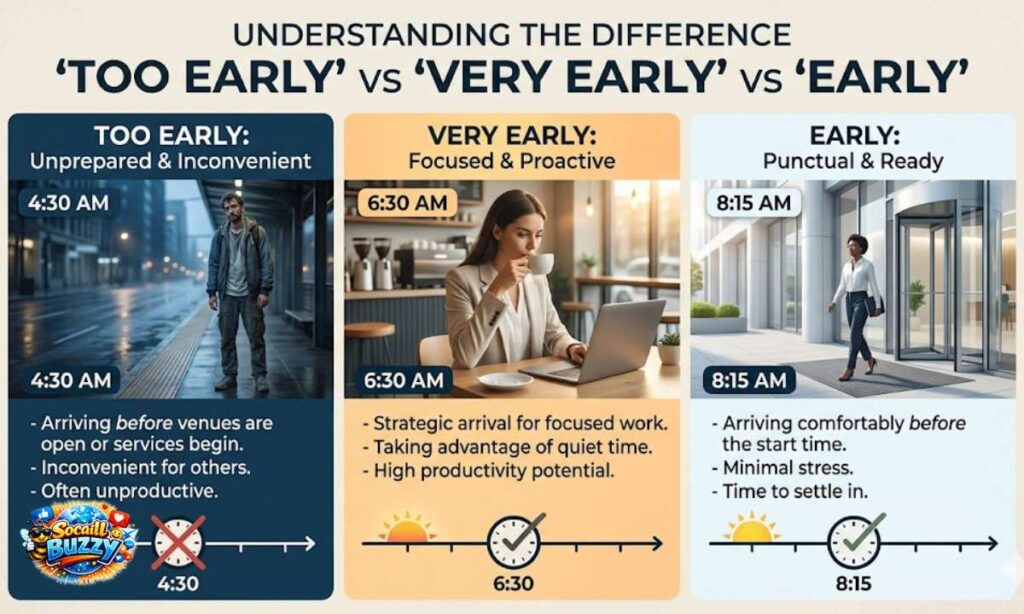
Not all early arrivals or events are “too early.” The choice between these phrases changes the meaning significantly.
| Phrase | Meaning | Example |
| Early | Before the usual or scheduled time; neutral | She arrived early to get a good seat. |
| Very early | Much earlier than usual; emphasis without judgment | He woke up very early to catch the sunrise. |
| Too early | Earlier than is appropriate, comfortable, or useful | We showed up too early and the doors were still locked. |
The key difference with too early is the implication of consequence or inconvenience: something went wrong, was premature, or crossed a threshold.
- 🔵 She woke up early to pray. (neutral intentional, positive)
- 🔵 She woke up very early to pray. (more emphasis, but still positive)
- 🔵 She woke up too early and couldn’t fall back asleep. (problem implied)
This nuance matters for precise, professional writing.
Real-World Contexts Where “Too Early” Is Used
The phrase “too early” shows up across virtually every type of writing and conversation. Here are common settings where it naturally appears:
Workplace and Professional Writing
- 🔷 “It’s too early to draw conclusions from the Q1 data.”
- 🔷 “Launching the campaign now would be too early we haven’t finished testing.”
- 🔷 “The meeting was scheduled too early for the West Coast team.”
Academic and Formal Writing
- 🔷 “It is too early to determine the long-term effects of the policy.”
- 🔷 “Declaring a winner at this stage is too early given incomplete data.”
- 🔷 “The research was conducted too early in the product development cycle.”
Everyday Conversation and Texting
- 🔷 “Isn’t it too early to be texting me on a Saturday?”
- 🔷 “We got there too early and had to wait outside in the cold.”
- 🔷 “I think it’s too early for holiday decorations, honestly.”
News, Media, and Journalism
- 🔷 “It’s still too early to call the election results.”
- 🔷 “Analysts say it’s too early to predict market recovery.”
- 🔷 “Critics argue the sequel was made too early without enough development time.”
Why This Mistake Happens (Even to Native Speakers)
Understanding why this error is so common helps you guard against it more effectively.
1. Homophones are tricky in fast typing. When you type quickly, your fingers follow sound rather than spelling rules. Both words sound like /tuː/, so your brain grabs whichever comes first and “to” is far more common in English than “too,” making it the default slip.
2. Autocorrect and spellcheck don’t catch it. This is critical. Spellcheck sees “to” as a perfectly valid English word and lets it pass. There is no red underline, no warning, no flag. The error hides in plain sight.
3. Context doesn’t always trigger self-correction. When a reader encounters “too early,” their brain often auto-corrects it in the reading process, understanding the intended meaning despite the error. This makes writers think nothing is wrong because “it sounds fine.”
4. The words are visually similar. One letter apart. In a long document or a fast email, that single extra “o” is easy to miss especially when reading your own writing.
Memory Tricks to Never Get It Wrong Again
These simple techniques help lock in the correct usage permanently.
Trick 1: The “Extra O” Rule
“Too” has an extra O just like it means something extra or more than needed. Too much. Too many. Too early. Every time you use “too” in the sense of excess, think: extra O = extra amount.
Trick 2: The “Very” Substitution Test
If you can replace the word with “very” and the sentence still makes sense, you need “too.”
- It’s too early → It’s very early ✅ (makes sense, so “too” is right)
- I’m going to the store → I’m going very the store ❌ (nonsense, so “to” is correct)
Trick 3: Ask What Job the Word Is Doing
- Is it showing direction or introducing a verb? → Use to
- Is it saying something is excessive or does it mean something else? → Use too
Trick 4: Weight Test
“Too” expresses more so it weighs more. It needs two O’s to carry all that meaning. This visual association (more letters = more meaning) helps many writers remember the difference intuitively.
What Dictionaries and Style Guides Say
Major reference works are unanimous on this distinction.
| Authority | Definition of “too” | Notes |
| Cambridge Dictionary | “More than is acceptable or suitable” | Specifically used to modify adjectives and adverbs |
| Merriam-Webster | “To an excessive degree; also” | Contrasts to (preposition/infinitive marker) directly |
| Chicago Manual of Style | Adverbs like to modify adjectives and adverbs | Confirms that to cannot serve this role |
| Oxford English Dictionary | Intensifier indicating degree beyond what is desired | Historical distinction between to and too traced to Old English |
Every major grammar resource confirms: when expressing timing that is more early than desired, the only correct choice is too early.
Common Phrases That Always Use “Too Early”
Certain expressions with “too early” have become idiomatic widely used fixed phrases in English. These are worth memorizing as complete units:
- 📌 “Too early to tell” it’s premature to predict an outcome
- 📌 “Too early to say” not enough information yet to make a statement
- 📌 “Too early to judge” conditions aren’t ready for a fair evaluation
- 📌 “Too early to celebrate” success hasn’t been confirmed yet
- 📌 “Too early to give up” progress hasn’t been exhausted
- 📌 “Too early in the morning” used colloquially to mean an unreasonably early hour
- 📌 “Too early to announce” timing isn’t right for a public statement
- 📌 “Far too early” intensified version; significantly before the right time
None of these phrases can ever use “to” they are all cases where an excessive degree of early timing is being expressed.
The Grammar Behind It: Adverbs, Adjectives, and Modifiers
To truly understand why “too early” works and “to early” doesn’t, it helps to look at basic sentence structure not in a dry, textbook way, but in a way that makes the logic obvious.
Adverbs modify adjectives and other adverbs. That’s one of their core functions. When you want to intensify or qualify a descriptive word, you place an adverb in front of it.
- extremely cold (adverb + adjective)
- surprisingly fast (adverb + adverb)
- dangerously late (adverb + adjective)
- too early (adverb + adjective/adverb) ✅
“Too” is an adverb. It belongs in that slot. It modifies “early” and tells the reader by how much specifically, more than is appropriate or desired.
“To” is not an adverb. It cannot fill that slot. Placing “to” in front of “early” leaves the sentence without a modifier; it just dangles there, grammatically homeless.
This is the reason that style guides, grammar textbooks, and dictionary usage notes all agree without exception: the intensifying role before “early” belongs to “too,” never to “to.”
Once you see this through the lens of word function rather than sound, the confusion dissolves completely.
Does the Error Affect Professional Credibility?

You might wonder: does one small grammar mistake actually matter? The answer, in many contexts, is yes.
In professional settings, using “too early” in a report, pitch deck, or formal email can signal a lack of attention to detail particularly to readers who notice grammar. Hiring managers, editors, professors, and senior executives often form impressions based on small writing choices.
In content creation, grammar errors undermine authority. If you are trying to establish expertise in your field whether through a blog, a LinkedIn post, or a news article consistent correctness builds trust with your audience.
In academic writing, grammar matters enormously. Professors and peer reviewers look for precision in language as a proxy for precision in thinking. An error like “to early” in a thesis or research paper reflects poorly on the author’s proofreading habits.
On social media, the stakes are lower but the visibility is higher. Millions of posts use “to early” without consequence but for professionals and public-facing communicators, correct grammar adds a layer of polish that differentiates your content.
The good news is that this particular mistake is one of the easiest to fix permanently. Once you know the rule, you know it forever.
“Too Early” in Emotional and Abstract Contexts
Beyond physical timing, “too early” also appears in emotional, metaphorical, and abstract situations and the rule stays exactly the same.
- 🔸 It’s too early to know if the relationship will last.
- 🔸 Losing someone always feels too early.
- 🔸 The world said it was too early for ideas like his.
- 🔸 She felt it was too early in her career to ask for a raise.
- 🔸 It’s never too early to start planning for retirement.
- 🔸 Sometimes you know too early that something won’t work out.
In every abstract or emotional context, “too” still carries the sense of premature or more than the situation calls for and “to” would still be grammatically incorrect.
Quick Reference Summary Table
| Feature | “To” | “Too” |
| Part of speech | Preposition / Infinitive marker | Adverb |
| Primary meaning | Direction, destination, purpose | Excess, also/additionally |
| Modifies | Nouns (prep) or verbs (infinitive) | Adjectives and adverbs |
| Example | I’m going to school | It’s too cold |
| With “early” | ❌ “to early” always wrong | ✅ “too early” always correct |
| Memory trick | Think: destination or action | Think: extra O = extra amount |
| Caught by spellcheck? | ❌ No | ✅ N/A already correct |
Frequently Asked Questions
Is “to early” ever correct in any form of English?
No. In standard English, “too early” is always grammatically incorrect when expressing premature timing. There are no dialects or exceptions where this form is accepted.
Can “to” appear in a sentence with “early”?
Yes, but in a different position. In “She woke up early to study,” the word “to” is part of the infinitive phrase “to study” ; it connects with the verb, not with “early.”
What’s the correct way to say something happened before the right time?
Always use “too early.” Example: “The product launched too early and wasn’t ready for consumers.”
Is “too early” formal enough for academic writing?
Absolutely. “Too early” is standard in all registers of English academic, professional, journalistic, and conversational.
Does “too early” mean the same as “premature”?
Very close. “Too early” is the adverbial phrase; “premature” is the adjective form conveying the same idea. “The announcement was too early” and “The announcement was premature” are near-synonyms.
Why doesn’t autocorrect catch “to early”?
Because “to” is a valid English word. Spellcheck verifies spelling, not grammar. Only a grammar checker that analyzes sentence structure like Grammarly’s advanced mode may catch it.
Is “too early to tell” a common phrase?
Yes, it is one of the most widely used fixed expressions in English, particularly in news reporting, sports commentary, and business analysis.
What if I’m not sure which one to use?
Use the substitution test: replace the word with “very.” If the sentence makes sense, write “too.” If it doesn’t, write “to.”
Conclusion
The difference between “too early” and “to early” comes down to a single letter but that single letter reflects a fundamental difference in grammar and meaning.
“Too early” is the only correct form. The word “too” is an adverb that intensifies “early,” telling your reader that something happened more early than is wanted, expected, or appropriate. The word “to,” by contrast, is a preposition or infinitive marker; it connects nouns and verbs, but it cannot modify an adjective.
The mistake is understandable. Both words sound identical, autocorrect lets “to early” slide, and readers often fill in the intended meaning regardless. But in professional emails, academic papers, business reports, and public-facing content, correct grammar signals precision and credibility. One extra “O” is all it takes.
Remember the rule: The extra O in “too” stands for extra meaning too much, too many, too soon, too early.
Once that clicks, you’ll never have to pause over this one again.

Welcome to SocaillBuzzy! I’m the creator and writer behind this platform, dedicated to sharing meaningful content including grammar, meaning, quotes, and inspirational messages for everyday life. Through well-crafted, SEO-friendly content, I aim to spread positivity, strengthen connections, and make it easier for readers to express their emotions with clarity and warmth.