
Emersion or Immersion:
Have you ever paused while typing an email or essay, unsure whether the word you needed was “emersion” or “immersion”? You’re not alone. These two words look almost identical, share the same Latin family tree, and even sound alike when spoken quickly yet they describe nearly opposite ideas.
Immersion is the word you already know: it shows up in language classes, virtual reality headsets, gaming reviews, and travel blogs. Emersion, on the other hand, is the quieter, rarer cousin that hides out in scientific journals, astronomy reports, and the occasional poetic reflection.
This guide breaks down both words in plain English, shows you exactly when to use each one, and gives you real-world examples from science, education, psychology, and everyday language. By the end, you’ll never second-guess yourself again.
Emersion or Immersion: A Quick Comparison
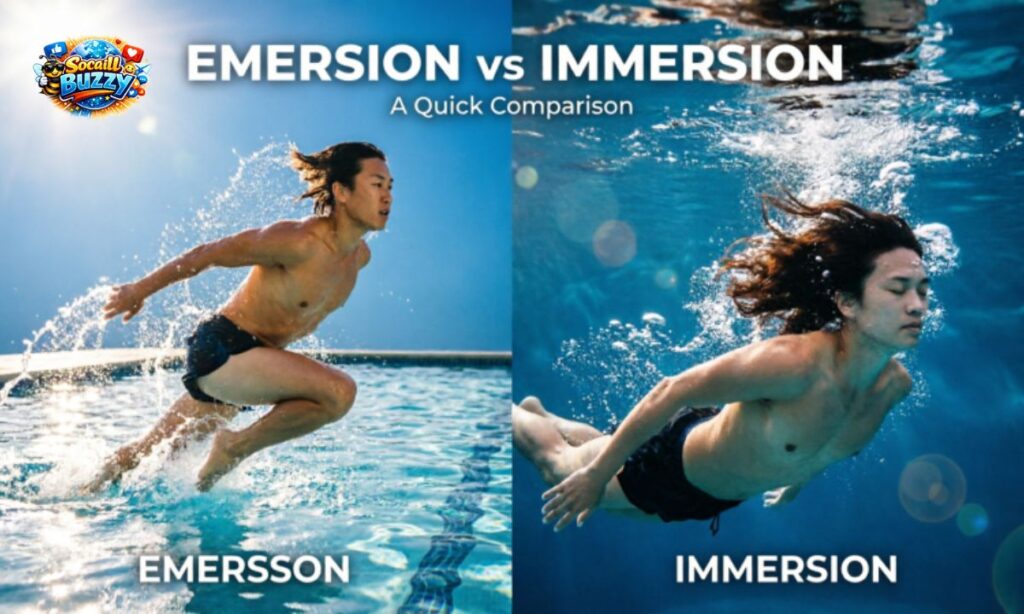
Before diving into the details, here’s a side-by-side snapshot that captures the core distinction Emersion or Immersion.
| Feature | Emersion | Immersion |
| Core meaning | Coming out or rising above a surface | Going into or being fully surrounded |
| Direction | Outward / upward | Inward / downward |
| Common fields | Marine biology, astronomy, environmental science | Education, gaming, VR, psychology, travel |
| Frequency of use | Rare, technical | Common, everyday |
| Example sentence | The tide’s emersion revealed the reef at low water. | She learned French through total immersion. |
| Etymology | Latin emergere (“to rise out”) | Latin immersio (“to plunge into”) |
| Emotional tone | Detachment, reflection, visibility | Engagement, absorption, involvement |
Keep this table in mind as a mental anchor. Everything below expands on these six points.
Click Here To Read Really vs Realy
Emersion Meaning, Definition and Scientific Context
Emersion Definition
Emersion is a noun that describes the act of emerging rising up out of a liquid, a shadow, or a hidden state so that something becomes visible again. It’s the opposite of sinking or disappearing beneath a surface.
In everyday grammar terms, emersion is an action noun: it names the process, not the object performing it. You won’t hear it often in casual conversation, but once you spot it, the meaning is straightforward something that was covered or hidden is now coming into view.
A simple way to picture it: imagine a submarine rising to the surface of the ocean. The moment its hull breaks through the water and becomes visible is emersion.
Scientific Fields Where Emersion Is Used
Because emersion describes a precise physical transition, it has found a permanent home in a handful of technical disciplines.
Marine biology
In marine biology, emersion refers to the period when organisms living in tidal zones are exposed to air rather than covered by seawater. Barnacles, mussels, and intertidal algae experience daily cycles of immersion (when the tide covers them) and emersion (when the tide recedes and exposes them).
Researchers studying these creatures often measure “emersion time” to understand how species cope with temperature changes, dehydration, and sun exposure.
Astronomy
Astronomy is where emersion first gained popularity as a technical term. During a solar eclipse or a lunar occultation, a celestial body appears to vanish behind another object and then reappear. That reappearance is called emersion, while the disappearance is called immersion. Astronomers still use both terms today when timing the exact moments a star or moon reemerges from behind an obstructing body.
Environmental science
Environmental scientists use emersion when describing coastal ecosystems, wetlands, and floodplains. A riverbank that becomes dry after floodwaters recede is undergoing emersion. This concept matters for tracking soil exposure, plant regrowth, and the health of ecosystems that cycle between wet and dry conditions.
Origin and Etymology of Emersion
Emersion traces back to the Latin word emergere, meaning “to rise out” or “to come forth.” The word entered English in the early 1600s, initially as a technical term in astronomy used to describe stars or planets reappearing after an eclipse.
Over time, writers borrowed the word for broader, more figurative uses describing someone “emerging” from a difficult period, a depression, or a phase of isolation.
Despite this expansion, emersion never became a common everyday word the way its counterpart did. It remained largely confined to scientific and literary writing, which is part of why it still feels unfamiliar to many English speakers today.
Emersion in Literature and Metaphorical Use
Outside the lab, emersion occasionally appears in literary and reflective writing to symbolize a personal transformation. Writers use it to describe a character stepping out of grief, confusion, or a long period of introspection and reentering ordinary life with new clarity.
For example, a memoir might describe the author’s “emersion from years of self-doubt” after starting therapy. This metaphorical use borrows the scientific image of something rising from beneath the surface, but applies it to emotional or psychological growth instead of water or shadow.
While this poetic usage is valid, it’s far less common than the plain old word “emerge” or phrases like “coming out of” a difficult time so use emersion sparingly in creative writing unless you want a deliberately formal or scientific tone.
Immersion Definition and Meaning
Immersion Definition
Immersion is a noun describing the state of being fully submerged, surrounded, or deeply engaged in something whether that’s a liquid, an activity, an environment, or an experience. Unlike emersion, immersion is a word most people use without even thinking twice, because it appears constantly in education, technology, travel, and pop culture.
At its core, immersion carries two closely related meanings:
- A physical state of being covered or submerged in a substance (usually water or another liquid)
- A mental or emotional state of being completely absorbed in an activity, story, or environment
Physical Immersion
Physical immersion refers to literally placing an object or a person into a liquid so that it’s fully covered. A classic example is baptism by immersion, where a person is fully submerged in water as part of a religious ceremony. Cooking also uses this sense: an “immersion blender” is a handheld device you dip directly into a pot of soup or sauce.
Psychological Immersion
Psychological immersion describes a mental state where a person becomes so absorbed in an activity that they lose awareness of their surroundings. This is the sense most people mean when they talk about being “immersed” in a book, a movie, or a video game. Psychologists sometimes link this state to “flow,” a concept describing total focus and enjoyment during an activity.
Immersion in Technology and Digital Environments
Modern technology has given immersion a whole new life, especially as digital experiences aim to feel as real as possible.
Virtual reality
Virtual reality (VR) is built entirely around the idea of immersion. VR headsets surround users with 360-degree visuals and spatial audio, tricking the brain into feeling physically present inside a digital world. Developers measure “immersion quality” based on how convincingly a headset blocks out the real world and replaces it with a simulated one.
Gaming and entertainment
In gaming, immersion refers to how deeply a player feels absorbed into a game’s story, mechanics, and world. Open-world games, detailed sound design, and responsive storytelling all aim to increase immersion so players forget they’re holding a controller.
Streaming platforms and interactive films use similar techniques, layering sound, visuals, and pacing to keep viewers emotionally locked in.
Emersion or Immersion: Key Differences
Now that both definitions are clear, let’s break down exactly where they diverge.
Direction of Experience (Emersion or Immersion)
The clearest distinction is direction. Immersion moves inward you go into water, a story, or an activity. Emersion moves outward something rises out of water, shadow, or a hidden state. Think of immersion as “entering” and emersion as “exiting.”
Stage of Experience (Emersion or Immersion)
Immersion typically describes the active, ongoing stage of an experience you’re currently engaged, submerged, or absorbed. Emersion describes the concluding stage the moment you step back out, whether that’s finishing a task, surfacing from water, or reflecting after an event has ended.
Frequency of Use (Emersion or Immersion)
Immersion is a common, everyday word used across marketing, education, psychology, and technology. Emersion is rare and largely restricted to scientific, academic, or occasionally poetic writing.
If you’re unsure which word fits a sentence, the safe bet in most everyday writing is immersion emersion should only appear when you specifically mean “coming out” or “emerging,” usually in a scientific context.
Emersion or Immersion in Education
Immersion Learning Programs
Immersion learning programs place students directly inside an environment where they must use a new skill or language constantly, rather than studying it from a distance. Language immersion schools, for example, teach every subject math, science, history in the target language, forcing students to think and communicate in it all day.
Benefits of immersive learning
Immersive learning offers several well-documented advantages:
- Faster real-world skill retention compared to traditional classroom methods
- Increased confidence through repeated, low-stakes practice
- Stronger contextual understanding, since concepts are learned in realistic situations
- Improved motivation, as learners see immediate, practical results
Because these programs focus on constant engagement, the word “emersion” rarely appears here the entire model is built around staying immersed, not coming out of it.
Emersion or Immersion in Language Learning

Language acquisition is one of the few areas where both words can meaningfully appear side by side, describing two different phases of the learning journey (Emersion or Immersion).
Immersion phase
During the immersion phase, a learner is surrounded by the target language constantly through conversation, media, and daily life. This phase demands active use, mistakes, and continuous listening and speaking practice.
Emersion phase
The emersion phase happens afterward, when a learner steps back from constant exposure and reflects on what they’ve absorbed. This might occur after returning home from a study-abroad program, when the learner processes new vocabulary, grammar patterns, and cultural insights without the pressure of active immersion.
Some language educators argue this reflective stage is just as important as the immersive one, because it’s where new knowledge consolidates into long-term memory.
Emersion or Immersion Psychology
Psychological Immersion
In psychology, immersion describes a heightened state of attention and engagement where external distractions fade into the background.
This concept overlaps with “flow state,” first popularized by psychologist Mihaly Csikszentmihalyi, describing complete absorption in a task that feels both challenging and rewarding.
Emersion Reflection in Psychology
Emersion, by contrast, is used less formally in psychology to describe the reflective period after an intense experience ends a kind of psychological “resurfacing.”
Therapists and coaches sometimes use this framing when discussing how clients process an emotionally intense session, a retreat, or a period of deep personal work. The emersion phase allows the mind to integrate what happened during immersion into everyday awareness.
Emersion or Immersion Examples
Seeing both words in real sentences makes the contrast much easier to remember.
Examples of Emersion
- The emersion of the coral reef at low tide revealed dozens of hidden sea creatures.
- Astronomers recorded the exact moment of the star’s emersion from behind the moon.
- After months of isolation, her emersion back into social life felt slow but steady.
- The wetland’s seasonal emersion allows new plant growth once the floodwater drains.
Examples of Immersion
- He achieved fluency through six months of total immersion in Spain.
- The museum’s new exhibit uses immersion technology to transport visitors into ancient Rome.
- She was in such deep immersion while painting that she didn’t hear the phone ring.
- The chef used an immersion blender to smooth out the soup directly in the pot.
Cultural Emersion or Immersion Through Travel
Travel is one of the most popular real-world applications of immersion. Cultural immersion means engaging directly with a destination’s language, food, customs, and daily rhythms instead of observing from a distance as a typical tourist. Travelers seeking cultural immersion often:
- Stay with local host families instead of hotels
- Learn basic phrases in the local language before and during the trip
- Eat at family-run restaurants rather than international chains
- Participate in local festivals, markets, or community events
- Avoid rigid tourist itineraries in favor of spontaneous exploration
This kind of travel creates lasting memories and deeper cultural understanding precisely because it prioritizes full engagement over passive sightseeing.
Common Mistakes Writers Make (Emersion or Immersion)
Even experienced writers occasionally slip up with these two words. Here are the most frequent errors.
Mistake: Using immersion when emersion is correct (Emersion or Immersion)
Because immersion is so much more common, writers sometimes default to it even when describing something emerging or rising up. For example, writing “the diver’s immersion from the water” is incorrect. The diver is coming out of the water, so “emersion” is the accurate word.
Mistake: Assuming the words mean the same thing (Emersion or Immersion)
Some writers assume these are simply alternate spellings of the same concept, given how similar they look. In reality, they describe opposite directions of movement, so swapping one for the other can genuinely reverse the meaning of a sentence.
Memory Trick for Emersion or Immersion
Here’s a simple trick that sticks: “Immersion = In. Emersion = Exit.” Both immersion and “in” start with the letter I, reminding you it means going inward. Both emersion and “exit” relate to coming out, reminding you it means emerging or surfacing.
Another visual trick: picture a person diving into a pool (immersion) and then climbing back out onto the deck (emersion). If your sentence describes the dive, use immersion. If it describes the climb-out, use emersion.
Key Takeaways (Emersion or Immersion)
Emersion
- Means coming out, rising up, or emerging from a hidden or submerged state
- Rare word, mostly used in marine biology, astronomy, and environmental science
- Comes from the Latin emergere, “to rise out”
- Can be used metaphorically for emotional or psychological transformation
Immersion
- Means being fully submerged, surrounded, or deeply engaged
- Common word, used across education, technology, psychology, and travel
- Comes from the Latin immersio, “to plunge into”
- Describes both physical submersion and mental absorption
Reference: Cambridge Dictionary Definitions Emersion or Immersion
According to the Cambridge Dictionary, immersion is defined as the act of putting someone or something into a liquid so it’s completely covered, or the state of being completely involved in something.
Emersion, while less frequently listed in general dictionaries, follows the same pattern found in scientific and etymological references: the act of coming out from a covering or concealed position. Consulting a trusted dictionary is always a good practice when you want to confirm formal usage before publishing important or academic writing.
Frequently Asked Questions (Emersion or Immersion)
What is the difference between immersion or emersion?
Immersion means going into or being fully surrounded by something, while emersion means coming out or rising up from a submerged or hidden state.
Is it immersion or emersion?
It depends on direction: use immersion for entering or engaging deeply, and immersion for emerging or surfacing.
What is the correct spelling of emersion?
The correct spelling is “emersion” e-m-e-r-s-i-o-n with no double letters and no variant spellings in standard English.
What is the difference between immersion and immersive?
Immersion is the noun describing the state or act of being submerged or absorbed, while immersive is the adjective describing an experience or technology designed to create that state.
Final Thoughts (Emersion or Immersion)
Emersion or immersion may look like near-twins on the page, but they point in opposite directions. Immersion pulls you into water, language, culture, or a gripping story. Emersion brings you back out rising from the tide, reappearing from an eclipse, or stepping back from an intense experience to reflect.
Once you anchor the distinction to direction “in” versus “out” you’ll never confuse them again. Whether you’re writing a marine biology report, describing a language-learning journey, or crafting a travel blog about cultural immersion, choosing the right word signals precision and confidence in your writing. Keep this guide handy, and let the small details set your writing apart.

Welcome to SocaillBuzzy! I’m the creator and writer behind this platform, dedicated to sharing meaningful content including grammar, meaning, quotes, and inspirational messages for everyday life. Through well-crafted, SEO-friendly content, I aim to spread positivity, strengthen connections, and make it easier for readers to express their emotions with clarity and warmth.