

If you’ve ever typed a sentence, paused, and stared at the word “realy” wondering if it looks right, you’re not alone. This one-letter mix-up shows up in emails, text messages, essays, and even resumes more often than most people admit. It seems harmless just a missing letter but small spelling slips like this can quietly undercut how professional and credible your writing looks.
This guide settles the debate for good. You’ll learn the correct spelling, the grammar rules behind it, how to pronounce it in American and British English, and how to avoid the mistake permanently. By the end, “really vs realy” will never confuse you again.
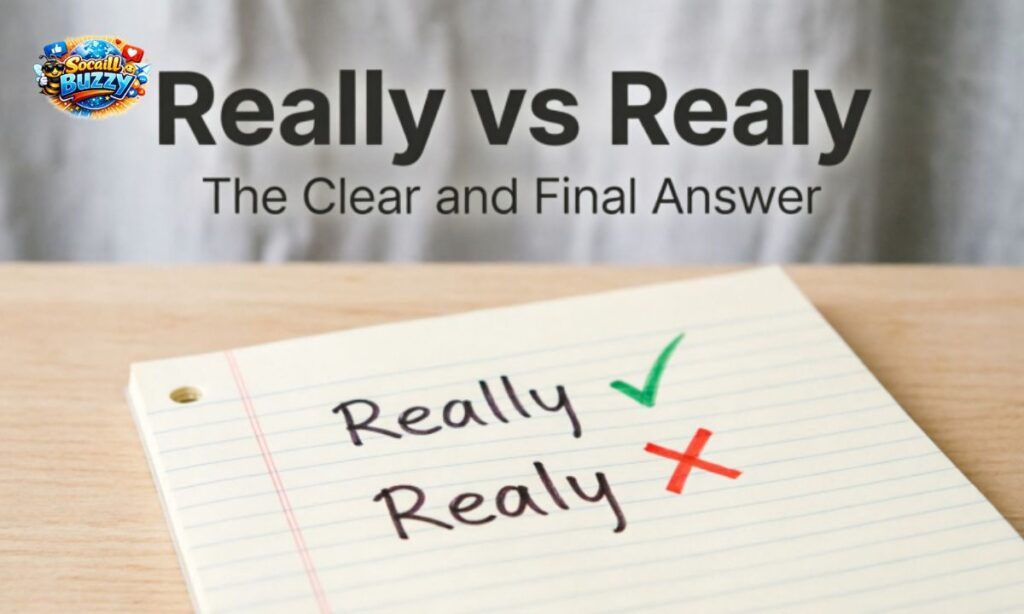
Really vs Realy: The Clear and Final Answer
Let’s get straight to it, because there’s no gray area here.
“Really” is the only correct spelling. “Realy” is not a real word in the English language it’s simply a common misspelling.
No dictionary, style guide, or grammar authority recognizes “realy” as a legitimate word. It doesn’t matter whether you’re writing casually on social media or formally in a business report the rule stays the same everywhere English is used.
| Word | Status | Notes |
| Really | ✅ Correct | Standard adverb in all English dialects |
| Realy | ❌ Incorrect | Misspelling caused by dropping one “l” |
Once you understand why the double “l” belongs there, this mistake becomes easy to catch and even easier to avoid.
Click Here To Read Meating vs Meeting
The Meaning of “Really”
Before diving into spelling rules, it helps to understand what the word actually does in a sentence.
What does it really mean in English?
“Really” is an adverb that means in actual fact, truly, or genuinely. It’s used to:
- Emphasize a statement (“I really enjoyed the concert”)
- Confirm that something is true (“Did that really happen?”)
- Express surprise or disbelief (“Really? I had no idea”)
- Add intensity in place of “very” in casual speech (“That soup is really good”)
Because it’s so flexible, “really” is one of the most frequently used intensifiers in spoken and written English. That popularity is exactly why the misspelling “realy” shows up so often the word gets typed constantly, and speed leads to dropped letters.
Is Realy a Word? A Direct and Honest Explanation
Is realy a word?
No. “Realy” has no entry in any major dictionary, including Merriam-Webster, Oxford, or Cambridge. It is not an alternate spelling, a regional variant, or an informal short form. It is simply an error.
Why is realy incorrect in English?
The confusion comes down to how English forms adverbs. Most adjectives become adverbs by adding “-ly” to the end:
- quick → quickly
- sudden → suddenly
- real → really
Notice that “real” already ends in the letter “l.” When you add the “-ly” suffix, that existing “l” combines with the new one, creating a double “l.” Dropping one of them breaks the word’s structure, which is why “realy” looks wrong the moment you know the rule.
Realy meaning in English (incorrect usage)
“Realy” has no meaning of its own. It carries no separate definition it’s simply the intended word “really” with a spelling error. If you meant to express truth, emphasis, or surprise, “really” is always the word you’re looking for.
Grammar Rules for Really
How to use really in grammar
“Really” functions as an adverb, which means it typically modifies:
- Adjectives: “She is really talented.”
- Verbs: “I really appreciate this.”
- Other adverbs: “He finished really quickly.”
- Entire sentences (as a sentence adverb): “Really, I don’t mind at all.”
It can also stand alone as an interjection to express surprise: “Really?”
Why placement matters
Where you place “really” in a sentence can shift emphasis or even meaning slightly.
- “I really don’t want to go” (strong emphasis on reluctance)
- “I don’t really want to go” (softer, more hesitant tone)
Both sentences are grammatically correct, but they communicate slightly different levels of certainty. Paying attention to placement helps you control tone, which matters especially in professional or persuasive writing.
Why Is “Really” Spelled with Two Ls?
How to spell really correctly
The safest way to remember the spelling is to break the word into its two parts:
real + ly = really
Since “real” ends in “l” and the suffix “-ly” begins with “l,” the two letters simply sit next to each other. Nothing is added artificially it’s just how the base word and suffix naturally combine.
The double consonant pattern
This isn’t a random quirk. English has several words that follow the same “double letter through suffix combination” pattern:
| Base Word | Suffix | Result |
| real | -ly | really |
| full | -ly | fully |
| cool | -ly | coolly |
| final | -ly | finally |
Whenever a word ends in a consonant and you add a suffix starting with the same letter, both letters stay in place.
Why do we drop the “e” in truly?
A common follow-up question is why “true” becomes “truly” instead of “truely.” The answer is simpler than it looks: when an adjective ends in a silent “e,” that “e” is usually dropped before adding “-ly.”
- true → truly
- due → duly
- whole → wholly (exception: keeps both Ls because “whole” ends in “l,” not silent “e”)
This is a different rule from the one governing “really,” which is why the two words are often confused even though their spelling logic works in opposite directions.
What Is the Difference Between Really vs Realy?
At this point, the difference is simple to summarize:
- Really is a properly spelled, dictionary-recognized adverb.
- Realy is not a word at all, it’s a spelling mistake caused by omitting one letter.
There is no scenario, formal or informal, American or British, where “realy” is the accepted form. The comparison isn’t really about two valid alternatives; it’s about one correct word and one common typo.
Really vs Realy in Sentences
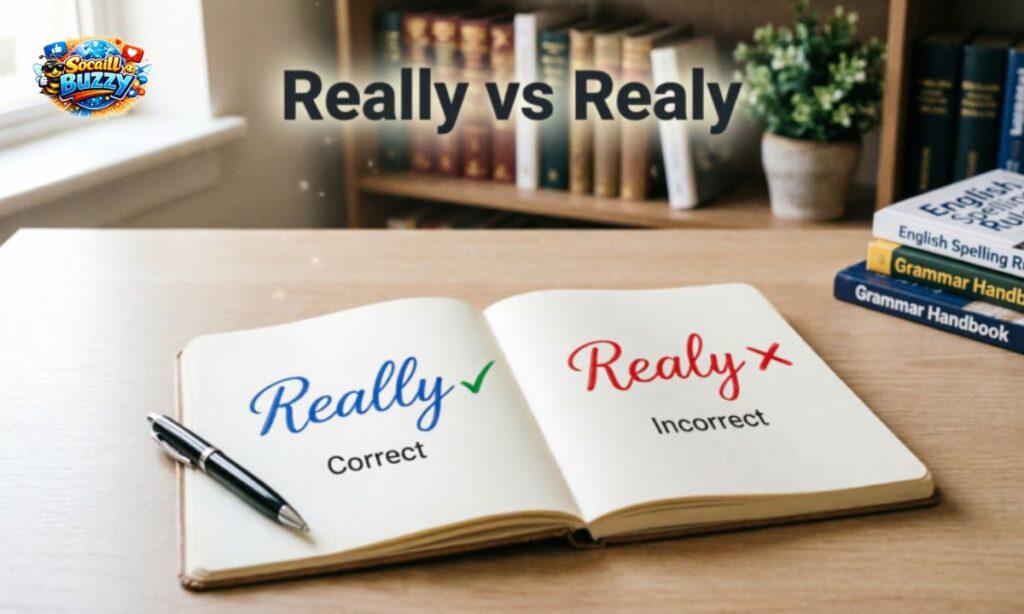
Seeing both forms side by side makes the error easy to spot.
| Incorrect (Realy) | Correct (Really) |
| I realy want to try that restaurant. | I really want to try that restaurant. |
| She realy knows her subject well. | She really knows her subject well. |
| He is realy excited about the promotion. | He is really excited about the promotion. |
| We realy should leave early. | We really should leave early. |
| That movie was realy good. | That movie was really good. |
If you ever catch yourself typing “realy,” pause, add the second “l,” and move on. Over time, this small correction becomes automatic.
A Common Source of Confusion
Part of why this mistake persists is that “really” often gets compared and sometimes confused with other similar-sounding intensifiers.
Really vs actually difference
“Really” and “actually” are often used interchangeably in casual speech, but they carry slightly different shades of meaning:
- Really emphasizes degree or intensity: “I really loved that book.”
- Actually emphasizes factual correction or contrast: “I actually didn’t like that book” (implying a surprising or contrary fact).
Both are correct words with distinct spellings, so neither should be confused with “realy,” which remains an error regardless of context.
Pronunciation of Really (US vs UK)
How do Americans pronounce really?
In American English, “really” is typically pronounced as REE-uh-lee or a slightly compressed REE-lee, depending on speaking speed.
Realy vs really British vs American English
British English pronunciation leans closer to RIH-uh-lee, with a softer vowel sound at the start. Despite these pronunciation differences, the spelling never changes. Whether you’re writing for a US audience or a UK audience, “really” never “realy” is the standard form.
| Region | Pronunciation Style | Correct Spelling |
| American English | REE-lee | really |
| British English | RIH-uh-lee | really |
This is actually one of the reasons the misspelling happens so often because the word is pronounced quickly and the “double l” sound tends to blur together in speech, making it easy to forget when typing.
Can You Use Really in Formal Writing?
Yes, but with some caution. “Really” is grammatically acceptable in formal writing, but it can sometimes feel vague or conversational compared to more precise alternatives.
Consider these two versions:
- “This is really important.” (correct, but casual)
- “This is essential.” (more precise, more formal)
Neither sentence is wrong. The first works well in blogs, emails, and everyday communication. The second suits academic papers, business reports, or formal proposals where precision carries more weight than emphasis. A good rule of thumb: use “really” freely in conversational writing, and consider swapping it for stronger vocabulary in formal documents.
Common Spelling Mistakes and How to Avoid Them
The “really vs realy” mix-up belongs to a wider category of English spelling errors that trip up even experienced writers. Here’s how to reduce these mistakes across the board:
- Slow down while typing. Most errors like “realy” happen from rushing, not from a lack of knowledge.
- Proofread before sending. Even a quick read-through catches missing letters.
- Use spelling and grammar tools but don’t rely on them completely, since autocorrect sometimes misses context-based errors.
- Learn the word’s structure, not just its sound. Spelling based on pronunciation is exactly how “realy” happens in the first place.
- Keep a personal list of words you frequently misspell, and review it occasionally.
An Example Why This Mistake Matters
Consider a real-world scenario: a job applicant emails a hiring manager about a writing position and types, “I am realy interested in this opportunity.” The recruiter notices the typo immediately. The candidate may still be considered, but that first impression takes a hit especially for a role centered on written communication.
This example highlights something important: spelling errors like “realy” aren’t just cosmetic. In resumes, client emails, and professional documents, they can quietly undermine trust before your ideas even get a fair reading.
How “Really” Fits into English Grammar
“Really” belongs to a category of adverbs called intensifiers words that strengthen or emphasize the meaning of another word. Intensifiers don’t change the grammatical structure of a sentence; they change its emotional weight or certainty.
For example:
- “The food was good.” (neutral statement)
- “The food was really good.” (stronger, more emphatic statement)
Understanding this function helps explain why “really” appears so frequently across everyday English; it’s a flexible tool for adding emphasis without needing to restructure a sentence.
Really vs Very vs Truly
These three words often get grouped together because they all function as intensifiers, but they aren’t perfectly interchangeable.
| Word | Primary Use | Formality Level | Example |
| Really | Emphasis, surprise, confirmation | Casual to neutral | “I really enjoyed the trip.” |
| Very | Straightforward intensity | Neutral to formal | “The trip was very enjoyable.” |
| Truly | Sincerity, genuine feeling | Formal, heartfelt | “I truly appreciate your help.” |
- Use really in everyday conversation and casual writing.
- Use very when you want a clean, neutral intensifier suitable for most formal contexts.
- Use truly when expressing sincerity, gratitude, or emotional depth.
None of these words are interchangeable with “realy,” which remains incorrect in every context.
Practice Exercises
Practicing with real examples is the fastest way to make the correct spelling automatic.
Fill in the Blank
Choose the correct word for each sentence (remember: “really” is always correct; “realy” is always wrong).
- I ___ enjoyed the movie; it was brilliant.
- She is ___ talented at playing the piano.
- The weather is ___ cold today.
- I can’t believe he ___ finished the marathon.
- We ___ need to leave before traffic gets worse.
Correct the Mistakes
Rewrite these sentences with the correct spelling:
- I realy want to try that new restaurant.
- She realy knows her subject well.
- He is realy excited about the promotion.
- We realy should leave early to avoid traffic.
Rewriting for Precision
Take a casual sentence using “really” and rewrite it for formal writing by replacing it with a stronger word:
- Casual: “This is really important.”
- Formal: “This is essential.”
Try this with three more sentences of your own.
Identify Misuse in Context
Read the paragraph below and find every incorrect instance of “realy”:
“I realy think we should reconsider this plan. It’s realy going to affect the whole team, and I realy don’t want to see it fail.”
(All three instances of “realy” should be corrected to “really.”)
Tips for Practice
- Read your writing aloud mispronunciations often reveal spelling gaps.
- Keep a running list of words you tend to misspell.
- Revisit this article whenever you feel unsure.
- Practice a little every day rather than cramming once.
Frequently Asked Question
Is it realy or really?
It’s always “really.” “Realy” is not a recognized word in any form of English.
What is the difference between real and really?
“Real” is an adjective meaning genuine or authentic, while “really” is an adverb meaning truly or very.
Why do kids say “actually” instead of “really”?
Children often pick up “actually” from adult speech patterns as a way to correct or clarify statements, and it can simply become a favored conversational habit.
What is the meaning of realy?
“Realy” has no meaning of its own it is only a misspelling of “really.”
Final Thoughts
The debate over “really vs realy” isn’t really a debate at all. “Really” is the correct, dictionary-recognized spelling, while “realy” is nothing more than a typing slip caused by dropping one letter. Understanding the word’s structure real + ly makes the double “l” easy to remember permanently.
Spelling mistakes like this one are small, but they add up. Clean, accurate writing builds trust with readers, employers, and clients alike. So the next time you type this word, remember the rule: real + ly = really, and let every letter count toward writing that reads as polished and credible as it should.

Welcome to SocaillBuzzy! I’m the creator and writer behind this platform, dedicated to sharing meaningful content including grammar, meaning, quotes, and inspirational messages for everyday life. Through well-crafted, SEO-friendly content, I aim to spread positivity, strengthen connections, and make it easier for readers to express their emotions with clarity and warmth.