

If you have ever sat in a meeting wondering whether to say “let me brief you” or “let me debrief you,” you are not alone. These two words trip up English learners and native speakers alike. They share the same root, sound similar, and often appear in the same professional settings yet they mean entirely different things.
Understanding brief vs debrief is not just a grammar exercise. It is a practical communication skill that can sharpen how you speak in boardrooms, classrooms, military briefings, project wrap-ups, and everyday conversations. Use the wrong word, and you signal the wrong timing, wrong tone, and even the wrong purpose.
This complete grammar guide breaks down every angle: definitions, parts of speech, conjugation rules, real-life examples, common mistakes, synonyms, antonyms, and industry-specific usage. By the end, you will know exactly when and how to use each word with full confidence.
What Does “Brief” Mean? (Full Definition)
The word brief has a rich and flexible role in English. It can function as an adjective, a noun, and a verb making it one of the more versatile words in professional communication.
Brief as an Adjective
As an adjective, brief means short in duration or length, something that does not take much time or cover too much detail.
Examples:
- The CEO gave a brief statement to the press.
- We had a brief conversation about the project timeline.
- His brief absence went unnoticed.
The comparative form is briefer and the superlative is briefest. The adverb form is briefly.
Brief as a Noun
As a noun, brief refers to a short written summary or document commonly used in legal, journalistic, and military contexts. In legal settings, a brief is a formal document that summarizes arguments for a court case.
Examples:
- The lawyer submitted a detailed brief to the judge.
- Please prepare a brief outlining the key findings.
- The marketing team circulated a creative brief for the campaign.
The plural form is briefs.
Brief as a Verb
As a verb, brief means to give someone concise, essential information before a task or event begins. This is the meaning most relevant to the brief vs debrief distinction.
Examples:
- The general will brief the soldiers before they deploy.
- I need to brief you on the changes before the client call.
- She was briefed by her supervisor before the press conference.
Click Here To Read Disloyal vs Unloyal
What Does “Debrief” Mean? (Full Definition)
Debrief is primarily a verb, and occasionally a noun. Unlike brief, it does not function as an adjective at all. Its meaning is focused on what happens after an event, mission, or task.
Debrief as a Verb
As a verb, debrief means to question or discuss with someone after they have completed a task, mission, or significant event in order to gather information, reflect on performance, and identify lessons learned.
The word originated in military and intelligence contexts during the 1940s and has since expanded into business, healthcare, education, and everyday life.
Examples:
- The intelligence officers debriefed the agent after her return from the field.
- We will debrief the entire team after the product launch.
- The doctor debriefed the surgical team following the procedure.
Debrief as a Noun
When used as a noun, debrief (or debriefing) refers to the session or process itself a structured conversation that happens after the fact.
Examples:
- The post-mission debrief lasted two hours.
- Let’s schedule a debrief for Friday afternoon.
- The debriefing revealed several areas for improvement.
Brief vs Debrief: Side-by-Side Comparison
The simplest way to lock in the difference is to look at them together. Here is a structured comparison:
| Feature | Brief | Debrief |
| Part of Speech | Adjective, Noun, Verb | Primarily Verb (also Noun) |
| Timing | Before an event or task | After an event or task |
| Purpose | To prepare, instruct, or inform | To review, evaluate, or debrief |
| Focus | Future action and expectations | Past performance and lessons |
| Tone | Concise, goal-oriented, forward-looking | Reflective, analytical, retrospective |
| Common Contexts | Military, business, law, journalism | Military, business, research, healthcare |
| Can Be an Adjective? | Yes | No |
| Can Be a Noun? | Yes (briefing, briefs) | Yes (debrief, debriefing) |
| Requires an Object? | Yes (as a verb) | Yes (as a verb) |
| Origin | Old French / Latin “brevis” (short) | “De-” prefix + “brief” (mid-20th century) |
The “De-” Prefix: Why It Changes Everything Brief vs Debrief
Many people assume that because debrief starts with “de-,” it must be the opposite of brief as in, something long or detailed. That assumption is understandable but incorrect.
The prefix de- in English can mean several things:
- Reversal or undoing (de-frost, de-activate)
- Removal (de-bone, de-seed)
- Completion or extraction (de-brief = to extract the briefing)
In the case of debrief, the “de-” indicates the extraction or review of information after the event essentially, going back over what happened and pulling out the key details. It does not mean “long” or “the opposite of short.”
So while brief means to load someone with necessary information going in, debrief means to unload or process information coming out.
Memory Trick: Think of a brief as a briefcase you pack before a trip. A debrief is unpacking that briefcase when you get home and reviewing what you found.
Grammar Rules: How to Use Each Word Correctly Brief vs Debrief
Rules for Using “Brief”
- As an adjective, it modifies a noun and should be placed before it.
- ✅ a brief meeting
- ❌ a meeting brief (grammatically different meaning here “brief” becomes a noun)
- As a verb, it must have a direct object (you cannot brief no one).
- ✅ I will brief the team.
- ❌ I will brief. (incomplete)
- As a noun, it takes articles and plurals normally.
- ✅ Submit the brief by Monday.
- ✅ The briefs were circulated before the session.
Conjugation of “Brief” (Verb)
| Tense | Form |
| Base | brief |
| Present (3rd person) | briefs |
| Past tense | briefed |
| Past participle | briefed |
| Present participle | briefing |
Example sentences:
- She briefs the team every Monday morning.
- He briefed the new interns before the workshop.
- The director is briefing stakeholders right now.
Rules for Using “Debrief”
- Debrief is almost always a verb. It should not be used as an adjective.
- ✅ Let’s debrief the team after the exercise.
- ❌ That was a very debrief meeting. (incorrect use “brief” here)
- As a verb, it also requires a direct object.
- ✅ We debriefed the participants.
- ❌ We debriefed. (acceptable but uncommon object is implied)
- Timing matters. Debrief always refers to something that has already happened.
- ✅ We will debrief the volunteers after the event ends.
- ❌ We will debrief the volunteers before the event. (this is a brief, not a debrief)
Conjugation of “Debrief” (Verb)
| Tense | Form |
| Base | debrief |
| Present (3rd person) | debriefs |
| Past tense | debriefed |
| Past participle | debriefed |
| Present participle | debriefing |
Example sentences:
- The team leader debriefs staff after every client presentation.
- The pilots were debriefed immediately after landing.
- HR is currently debriefing employees who participated in the trial.
The Brief vs Debrief Cycle: How They Work Together

In professional and operational environments, these two words are not rivals, they are partners. Together, they create a continuous improvement loop that strong teams use to prepare, perform, and grow.
Here is how the cycle works:
- Brief The team leader provides clear goals, responsibilities, and expectations before the task begins.
- Execute The team carries out the mission, project, event, or task.
- Debrief The team reviews what happened: what worked, what did not, and what to change.
- Apply Lessons from the debrief feed into the next brief.
This loop appears in virtually every high-performance industry from military special forces to hospital surgical teams to agile software development. Organizations that skip either step tend to repeat mistakes or miss opportunities to improve.
Real-World Usage Across Industries Brief vs Debrief
Military and Intelligence Brief vs Debrief
The terms brief and debrief originated largely in military and intelligence circles. Before a mission, commanding officers brief soldiers on the objective, terrain, risks, and rules of engagement. After the mission, intelligence officers debrief returning operatives to gather information, assess threats, and document outcomes.
Example:
The general briefed the unit at 0600. After the operation, each soldier was debriefed individually by the intelligence team.
Business and Project Management Brief vs Debrief
In corporate environments, project managers brief their teams before a product launch, campaign rollout, or client presentation. After the work concludes, the team holds a debrief (sometimes called a post-mortem or retrospective) to evaluate performance.
Example:
The marketing director briefed the agency on the new brand guidelines. After the campaign launched, the entire team debriefed to assess what drove conversions.
Healthcare and Medical Teams Brief vs Debrief
Surgical teams and emergency responders frequently use both terms. Before a complex operation, the lead surgeon briefs the team on the procedure and potential complications. Afterward, the team may debrief to review critical moments and improve future protocols.
Example:
The surgeon briefed the operating team on the patient’s history. Following the procedure, the team debriefed to address the unexpected complications that arose.
Education and Training Brief vs Debrief
Educators and facilitators brief learners at the start of an activity or simulation, outlining objectives and instructions. After the exercise, a structured debrief session allows learners to process what they experienced and extract key takeaways.
Example:
The trainer briefed the participants on the role-play scenario. After the exercise, she debriefed the group to draw out reflections and key lessons.
Law and Journalism Brief vs Debrief
In legal contexts, a brief is a formal written document summarizing arguments. In journalism, a journalist is briefed by an editor before a story, and after a major event, sources and spokespeople may be debriefed to compile a full picture.
Common Mistakes and How to Avoid Them Brief vs Debrief
Even experienced writers and professionals make errors with these two words. Here are the most frequent mistakes and how to fix them.
Mistake 1: Using “Debrief” Before an Event
Wrong: I will debrief the sales team before the pitch. Right: I will brief the sales team before the pitch.
Remember: debrief always follows a completed action. If the event has not happened yet, you want brief.
Mistake 2: Using “Brief” After an Event
Wrong: Let’s brief each other on what went wrong during the presentation. Right: Let’s debrief on what went wrong during the presentation.
After the fact, the correct word is debrief especially when the goal is reflection and learning.
Mistake 3: Using “Debrief” as an Adjective
Wrong: That was a very debrief summary. Right: That was a very brief summary.
Only brief functions as an adjective. Debrief does not.
Mistake 4: Omitting the Object After a Verb
Wrong: I briefed before the meeting. (Who did you brief?) Right: I briefed the team before the meeting.
Both brief and debrief, when used as verbs, typically require a direct object.
Mistake 5: Treating Them as Synonyms
Wrong: We need to debrief new employees on company policy. Right: We need to brief new employees on company policy.
New employees have not yet participated in any company activity so there is nothing to debrief them on. You are giving them information going forward, which makes brief the correct choice.
Synonyms and Antonyms Brief vs Debrief
Synonyms for “Brief” (verb)
- Inform
- Instruct
- Prepare
- Orient
- Advise
- Notify
- Update
Synonyms for “Debrief” (verb)
- Interrogate (in formal or intelligence contexts)
- Debrief
- Review
- Assess
- Evaluate
- Examine
- Debrief
- Reflect on
- Analyze
Antonyms
| Word | Antonym / Contrast |
| Brief (adjective: short) | Long, lengthy, extended |
| Brief (verb: to instruct beforehand) | Debrief (to review afterward) |
| Debrief (to review after) | Brief (to instruct before) |
Quick Reference: When to Use Brief vs Debrief
Use this checklist whenever you are unsure which word fits:
Use “brief” when:
- [ ] The event, task, or mission has not happened yet
- [ ] You are giving instructions, goals, or context
- [ ] You want to describe something as short or concise (adjective)
- [ ] You are referring to a formal written summary or document (noun)
Use “debrief” when:
- [ ] The event, task, or mission has already been completed
- [ ] You are gathering information, reviewing performance, or drawing lessons
- [ ] The purpose is reflection, analysis, or documentation after the fact
- [ ] You need a noun to describe the review session itself
Pronunciation Guide Brief vs Debrief
Both words are straightforward to pronounce, but here is a clear breakdown:
| Word | Phonetic | Audio Tip |
| Brief | /briːf/ | Rhymes with “leaf” or “reef” |
| Debrief | /ˌdiːˈbriːf/ | Stress on the second syllable: “dih-BREEF” |
The only real difference is the “dih” sound at the start of debrief. Both share the same “-brief” ending.
Brief vs Briefing vs Debriefing: What’s the Difference?
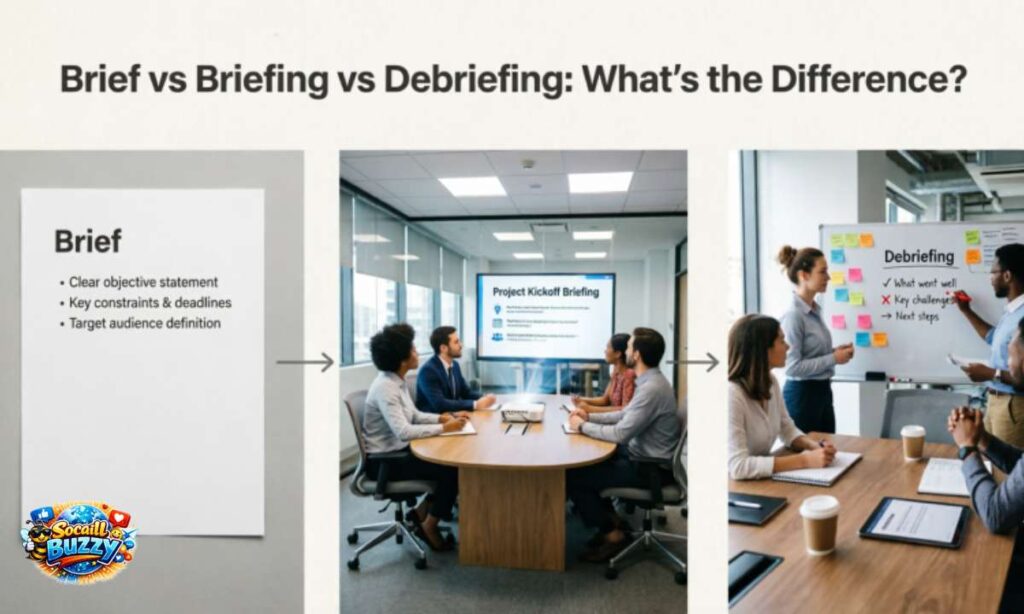
These related forms are worth distinguishing, since they often appear in the same contexts:
| Term | Type | Meaning |
| Brief | Verb / Noun / Adjective | To instruct beforehand; a document; concise |
| Briefing | Noun (gerund form) | A session in which information is given before a task |
| Debrief | Verb / Noun | To review after; a session after a task |
| Debriefing | Noun (gerund form) | The formal session of review and analysis after an event |
Example sentences:
- The morning briefing covered all objectives for the day.
- After the exercise, the instructor conducted a thorough debriefing.
- The project manager will brief the developers at 9 AM.
- We plan to debrief the entire sales team by end of week
Frequently Asked Questions (Brief vs Debrief)
Q: Is “debrief” the opposite of “brief”?
No. They are not opposites in the traditional sense. Brief happens before an event; debrief happens after. They are sequential, not contrasting.
Q: Can “debrief” be used as an adjective?
No. Only brief functions as an adjective (e.g., “a brief explanation”). Debrief is a verb and occasionally a noun.
Q: Is “debriefing” one word or two?
It is one word: debriefing. There is no hyphen.
Q: Can you have a debrief without a prior brief?
Yes. A debrief simply requires a completed activity to reflect on not necessarily a prior formal briefing session.
Q: What is the noun form of “debrief”?
The noun forms are debrief (e.g., “We had a debrief”) and debriefing (e.g., “The debriefing lasted an hour”).
Q: Are “brief” and “briefing” the same thing?
Not exactly. Brief (as a noun) often refers to a written document. A briefing is typically the spoken or structured session in which information is shared before an event.
Q: Is “debrief” formal or informal?
It leans formal, with roots in military and professional settings but it is widely used in casual workplace conversations too.
Q: Can “brief” and “debrief” appear in the same sentence?
Yes. “The coach will brief the players before the match and debrief them afterward.”
Q: What is the past tense of “debrief”?
The past tense is debriefed. Example: “The team was debriefed after the simulation.”
Q: Does “de-” in “debrief” mean the opposite?
Not here. In debrief, the prefix “de-” signals extraction or reversal meaning to draw out or revisit the briefing content after the fact, not to negate it.
Conclusion: Mastering Brief vs Debrief in Everyday Communication
At first glance, Brief vs Debrief look like two sides of the same coin and in a sense, they are. But they represent entirely different moments in the life of any project, mission, or professional interaction.
Brief is the starting gun. It arms people with what they need to know before they act. It can be an adjective, a noun, or a verb and it always looks forward.
Debrief is the closing bell. It gathers people after the action to reflect, review, and improve. It is almost always a verb or noun and it always looks backward.
Together, they form a complete communication cycle: prepare → act → reflect → improve. Mastering both words when to use them, how to conjugate them, and where they fit grammatically makes you a sharper, more credible communicator in any environment.
Whether you are managing a team, writing a report, studying for an English exam, or simply trying to sound more professional in a meeting, the difference between brief and debrief is one of those small details that makes a lasting impression.

Welcome to SocaillBuzzy! I’m the creator and writer behind this platform, dedicated to sharing meaningful content including grammar, meaning, quotes, and inspirational messages for everyday life. Through well-crafted, SEO-friendly content, I aim to spread positivity, strengthen connections, and make it easier for readers to express their emotions with clarity and warmth.