You typed “more friendlier” and something felt off. Maybe your grammar checker underlined it in angry red. Maybe a teacher circled it in class. Either way, you are not alone. Millions of people mix up “friendly” and “friendlier” every single day. The good news? The rule behind this is surprisingly simple, and once you see it, you will never mix them up again.
What Is the Difference Between “Friendly” and “Friendlier”?
“Friendly” is an adjective. It describes someone or something that is warm, kind, and easy to be around.
“Friendlier” is the comparative form of “friendly. You use it when you are comparing two people, places, or things to say one has more of that friend quality than the other.
Here is the fast version:
- Friendly = describes a quality (“She is friend.”)
- Friendlier = compares two things (“She is friendlier than her brother.”)
Simple. Clean. Done. Now let us go deeper.
How Does English Form Comparatives? (The Rule That Explains Everything)
English has two ways to make a comparative adjective, and choosing the right one depends almost entirely on the length of the word.
Short adjectives (one syllable): Add -er
tall → taller, fast → faster, cold → colder
Long adjectives (two or more syllables): Add “more” in front
beautiful → more beautiful, intelligent → more intelligent
“Friendly” has two syllables: friend and ly. So where does it fall?
This is where things get interesting. Adjectives ending in -ly behave like short adjectives. They take -er instead of “more.” That is why “friendlier” is correct, and “more friend” is technically acceptable but less common in standard usage.
The key takeaway: “more friendlier” is always wrong. That is a double comparative, and English does not allow two comparison markers at once.
The Double Comparative: History’s Most Charming Grammar Mistake
Here is a fun fact to impress people at dinner parties.
Shakespeare himself used double comparatives. In Julius Caesar, he wrote: “the most unkindest cut of all.” In Othello: “more better.” If the greatest writer in English history bent the rules, you are in good company.
But times have changed. Modern standard English considers double comparatives like “more friendlier” a grammatical error. In casual speech, you might hear it. In writing, especially professional or academic writing, it will raise eyebrows.
The historical roots go back to Old English and Middle English, when grammar was far more flexible. Over centuries, English standardized, and the double comparative was quietly retired from formal use. Consider it a grammatical relic, charming in Shakespeare, awkward in your work email.
“Friendly” in a Sentence: Real Examples That Show It Right
Let us see “friendly” doing its job correctly:
- “The customer service team was incredibly friendly.”
- “This is a friendly reminder to submit your report.”
- “She has a friend face that puts people at ease.”
- “The new software has a user-friend interface.”
Notice that in every sentence above, “friendly” simply describes a noun. No comparison is happening. Nobody is being measured against anyone else.
“Friendlier” in a Sentence: When Comparison Enters the Room
Now watch how “friendlier” changes everything:
- “The staff at this hotel are friendlier than at the last one.”
- “Small towns tend to feel friendlier than big cities.”
- “After a cup of coffee, she becomes considerably friendlier.”
- “The new version of the app is far friendlier to beginners.”
Every single example above involves a comparison, either stated or implied. Two things are being held up against each other, and one comes out with more of the “friend” quality. That is exactly the job of a comparative adjective.
Quick Comparison Table: Friendly vs Friendlier
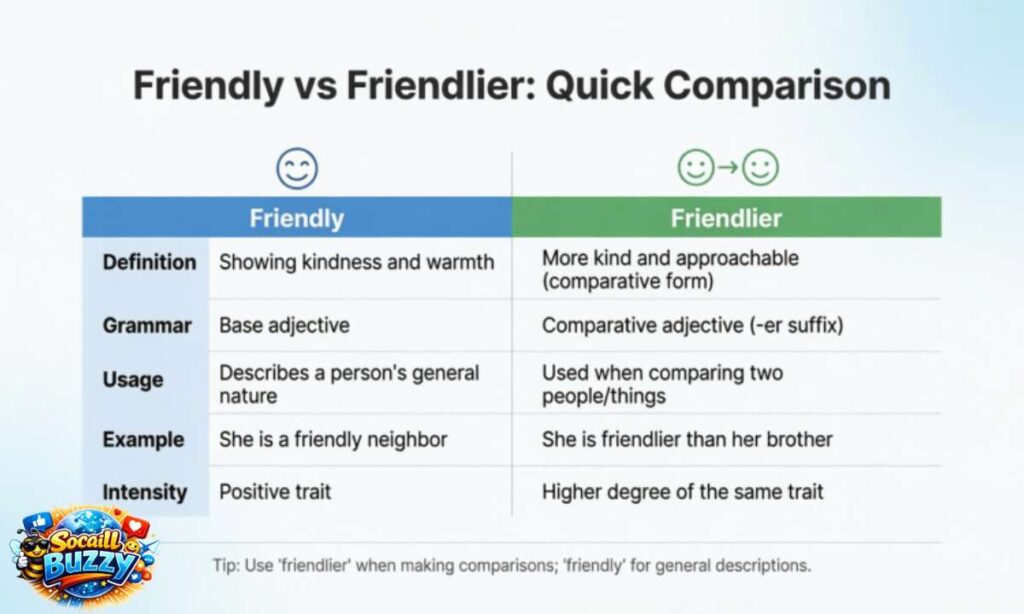
| Feature | Friendly | Friendlier |
| Type | Adjective | Comparative Adjective |
| Purpose | Describes a quality | Compares two things |
| Usage | No comparison needed | When comparing two subjects |
| Example | “He is friendly.” | “He is friendlier than she is.” |
| Correct pairing | Stands alone | Paired with “than” |
| Common error | Using it when a comparison is needed | Saying “more friendlier” |
“More Friendly” vs “Friendlier”: Are Both Correct?
Yes, but with a small asterisk.
“Friendlier” is the standard, preferred form. Most style guides and grammar authorities recommend it.
“More friendly” is not wrong. It sounds slightly more formal and is sometimes used for emphasis or rhythm in a sentence. For example: “The new policy is designed to be more friendly to small businesses.”
Both are understood. Both are grammatically defensible. But if you want to sound natural and write clean English, “friendlier” is your go-to word.
The one form that is always wrong: “more friendlier.” Combining both comparison signals at once is redundant and incorrect. Pick one lane and stay in it.
Common Mistakes People Make with These Words
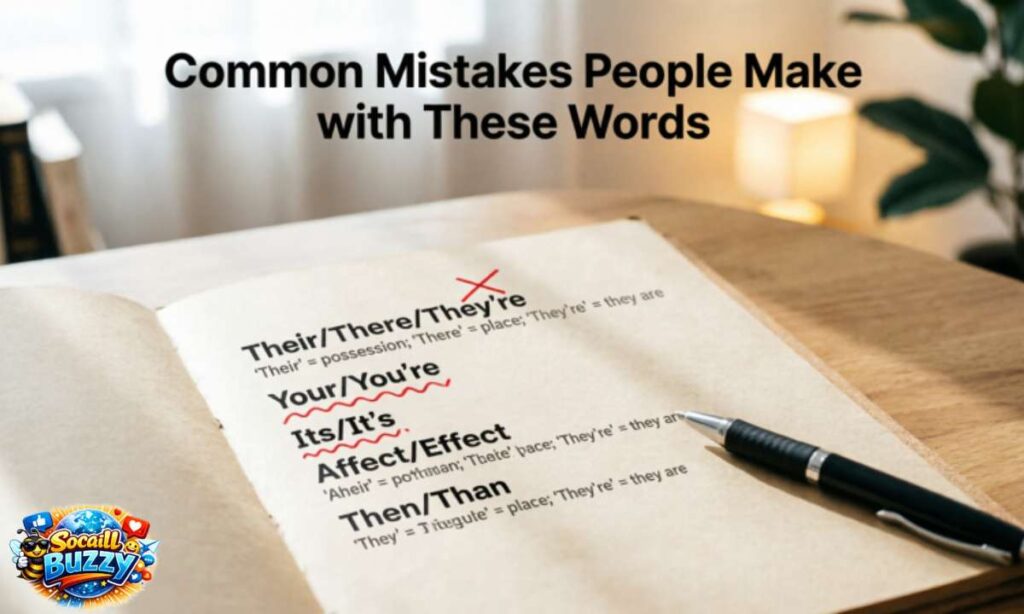
Mistake 1: Using “more friendlier” Wrong: “This neighborhood is friendlier than downtown.” Right: “This neighborhood is friendlier than downtown.”
Mistake 2: Using “friendly” when comparison is needed Wrong: “She is more friendly than her coworker.” Right: “She is friendlier than her coworker.”
Mistake 3: Forgetting “than” after “friendlier” Awkward: “The dog is friendlier.” Better: “The dog is friendlier than the cat.”
Without “than,” “friendlier” floats without context. Your reader will wonder: friendlier than what? Give the comparison its other half.
Mistake 4: Applying the same rule to longer adjectives Wrong: “She is more hospitabler.” Right: “She is more hospitable.”
“Friendlier” works because of its short two-syllable structure. Do not assume all adjectives ending in “-ly” follow the same path. Lovely becomes lovelier. Lively becomes livelier. But friendly is the most commonly tested one.
Which One Should You Use?
Use “friendly” when you are simply describing someone or something without making a comparison.
Use “friendlier” when you are comparing two things and one has a more friendly quality.
Never use “more friendlier.” It is always a double error.
Here is a simple test: Ask yourself, “Am I comparing two things right now?” If yes, use friendlier. If not, use friendly. That is the whole decision tree, and it fits in one sentence.
Related Keywords Worth Knowing
While you are here, a few related grammar terms worth understanding:
Superlative adjectives: When comparing three or more things, use friendliest. (“She is the friendliest person in the office.”)
Positive degree: The base form with no comparison at all. That is your plain “friendly.”
Comparative degree: One step up, comparing two things. That is “friendlier.”
Absolute adjective: Words like “unique” or “perfect” that technically cannot be compared. Friendly is not in this category, so compare away.
Click Here To Read More
Frequently Asked Questions
Q: Is “more friendly” ever correct?
Yes. “More friendly” is grammatically acceptable, especially in formal or emphatic writing. However, “friendlier” is the more natural and widely preferred form in everyday English.
Q: Can I say “most friendlier”?
No. “Most friendlier” is a double superlative error. The correct superlative form is simply “friendliest.” (“She is the friendliest teacher I have ever had.”)
Q: Why do some people say “more friendlier” naturally?
Because spoken language often runs on instinct rather than grammar rules. In casual conversation, double comparatives have a long history even in formal literature. But in written English today, stick with “friendlier” to stay clear and correct.
Final Words
“Friendly” describes. “Friendlier” compares. “More friendlier” is a grammar mistake with a Shakespearean excuse, but no modern pass.
The rule is clean: short adjectives and those ending in “-y” or “-ly” take -er for their comparative form. No “more” needed. No doubling up.
Now that you know this, you will probably start noticing “more friendlier” everywhere. Menus, emails, social media posts. Consider it your new grammar superpower. Use it wisely, and maybe be a little friendlier when you point it out to others.
Welcome to SocaillBuzzy! I’m the creator and writer behind this platform, dedicated to sharing meaningful content including grammar, meaning, quotes, and inspirational messages for everyday life. Through well-crafted, SEO-friendly content, I aim to spread positivity, strengthen connections, and make it easier for readers to express their emotions with clarity and warmth.