
You’re texting a friend before takeoff. You type: “I’m in the plane, see you tomorrow!” then pause. Something feels off. Should it be on the plane? Or does in the plane make more sense, since you’re literally sitting inside it?
This tiny two-letter swap trips up native English speakers, ESL learners, and even seasoned travelers. The good news? There’s a clear answer and once you understand the logic behind it, you’ll never second-guess yourself again. This guide walks you through everything: the grammar rules, the history, the exceptions, real-life sentence examples, and a quick-reference cheat sheet you can bookmark for later.
The Short Answer: Which Phrase Is Correct?
“On the plane” is the correct and widely preferred phrase in modern English.
When you’re talking about traveling by aircraft, boarding, sitting, flying, or anything that happens during a flight “on the plane” is the right choice almost every single time.
That said, “in the plane” isn’t always wrong. It shows up in specific technical or descriptive contexts. The difference comes down to what you’re trying to say, not just where you are physically.
Understanding English Prepositions: “On” vs. “In”
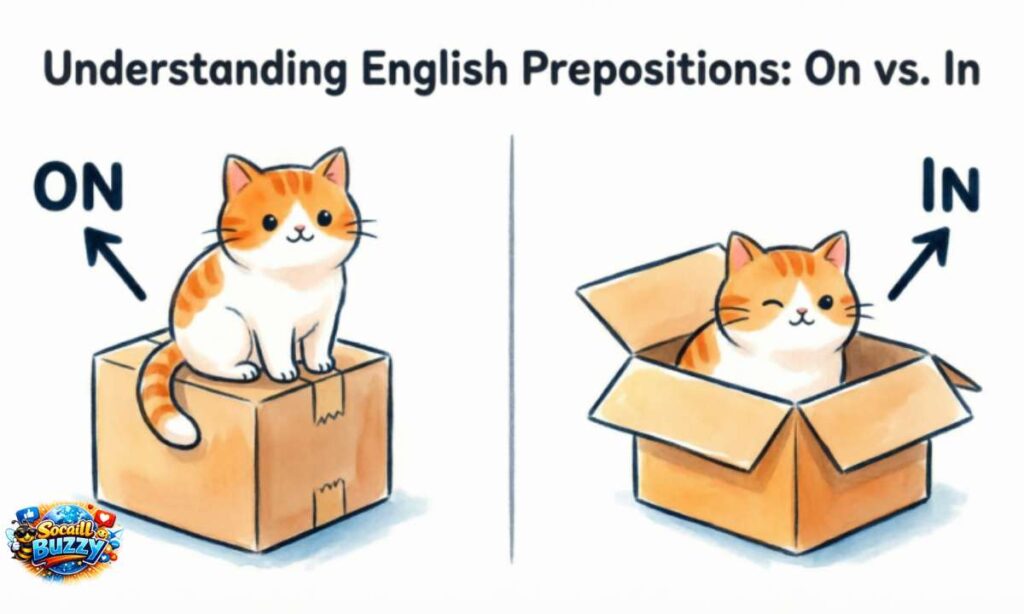
Before diving into planes specifically, it helps to understand what these two prepositions actually mean in English.
What Does “On” Mean?
“On” signals contact with a surface, or being part of a larger system or structure. It’s used when something is positioned atop, aboard, or connected to something else.
Examples:
- “She’s on the bus.”
- “He sat on the chair.”
- “Put the book on the table.”
What Does “In” Mean?
“In” signals that something is enclosed or contained within a defined space.
Examples:
- “The keys are in the drawer.”
- “She’s in the car.”
- “There’s smoke in the room.”
Click Here To Read Sustain vs Substain
Why Planes Follow the “On” Rule
Here’s the core grammar rule for transportation prepositions:
Use “on” for large, public vehicles where passengers can move around. Use “in” for small, private, or enclosed vehicles.
| Vehicle Type | Preposition | Example |
| Plane | on | “I’m on the plane.” |
| Train | on | “She fell asleep on the train.” |
| Bus | on | “He’s on the bus.” |
| Ship / Boat | on | “We’re on the ferry.” |
| Car | in | “The kids are in the car.” |
| Taxi | in | “She’s in the taxi.” |
| Canoe | in | “They’re in the canoe.” |
| Helicopter | in | “The pilot was in the helicopter.” |
A commercial airplane is treated like a train or bus a shared platform where passengers can stand, walk the aisle, use the restroom, and move around. That’s why English attaches the preposition “on” to it, even though you’re physically inside the aircraft.
Why “On the Plane” Became the Dominant Form
A Historical Shift
The “on the plane” vs. “in the plane” debate isn’t new. According to Google Ngram Viewer data, back in the 1960s, “in the plane” was actually more common in written English. At that time, air travel was rare, expensive, and carried by a smaller, elite group of passengers. The language reflected that novelty.
As commercial aviation exploded through the 1970s, 80s, and 90s, flying became an everyday experience for millions of people. When that happened, the language shifted too. “On the plane” already the norm for buses, trains, and ships became the default phrase for air travel as well.
By the early 2000s, “on the plane” had overtaken “in the plane” in everyday usage, and the gap has only widened since.
The Nautical Connection
English’s “on” rule for transportation traces back to nautical language. Sailors and passengers have long been described as being “on board” a ship not “in board.” When trains came along in the 19th century, the same logic transferred: “on the train.” When planes followed in the 20th century, the idiom carried over once more.
So when you say “on the plane,” you’re actually echoing centuries of travel language from sailing ships to steam trains to commercial jets.
When to Use “On the Plane”
Use “on the plane” whenever you’re talking about:
- Being a passenger during a flight
- “I slept the whole time I was on the plane.”
- “She watched three movies on the plane.”
- Activities that happen during the flight
- “I’ll finish the report on the plane.”
- “Don’t forget to silence your phone on the plane.”
- Boarding or waiting for departure
- “We’re on the plane now about to take off.”
- “All passengers should be on the plane by 6 PM.”
- Referring to crew members
- “There are twelve flight attendants on the plane.”
- “The pilot announced we were on the plane and ready for departure.”
- General air travel conversation
- “I met a fascinating author on the plane to London.”
- “The turbulence on the plane was pretty rough.”
Quick Rule of Thumb
If you have a boarding pass and you’re part of a flight, say “on the plane.” Think of it as the same energy as “on the team” or “on the train” you’re part of a shared, moving experience.
When “In the Plane” Can Be Correct
“In the plane” isn’t grammatically wrong. It’s just much more limited in where it fits naturally. Here are the situations where it makes sense:
1. Technical or Aviation Contexts
Aviation professionals, engineers, and mechanics often describe the physical interior of the aircraft wiring, cabin pressure, structural components using “in the plane.”
- “There’s a mechanical fault in the plane’s hydraulic system.”
- “The temperature in the plane dropped significantly at altitude.”
- “Engineers found corrosion in the plane’s fuselage.”
In these cases, the speaker is describing the aircraft as an object or structure, not as a transportation experience.
2. Distinguishing Inside vs. Outside
When you need to contrast a location inside the aircraft versus outside it, “in the plane” adds precision:
- “The luggage is in the plane, but your carry-on is still at the gate.”
- “I’m in the plane are you still at the gift shop?”
Here, the physical interior matters to the sentence’s meaning.
3. Describing the Environment or Atmosphere
When focusing on the conditions or atmosphere within the cabin:
- “It was freezing in the plane I needed two blankets.”
- “The noise in the plane made it hard to hear the announcements.”
4. Older or Formal Written English
In formal or older texts, “in the plane” occasionally appears as a stylistic or regional choice. It’s not wrong in these contexts, but it can sound dated or unusually stiff to modern readers.
Side-by-Side Sentence Comparison
Seeing both phrases in the same context is one of the fastest ways to feel the difference.
| Situation | ✅ More Natural | ⚠️ Less Natural |
| Texting before takeoff | “I’m on the plane now!” | “I’m in the plane now.” |
| Talking about a long flight | “I watched two movies on the plane.” | “I watched two movies in the plane.” |
| Describing cabin temperature | “It was cold in the plane.” | “It was cold on the plane.” (both work here) |
| Technical report about aircraft | “Smoke was detected in the plane.” | “Smoke was detected on the plane.” (both work) |
| Talking about fellow passengers | “I sat next to a doctor on the plane.” | “I sat next to a doctor in the plane.” |
| Referring to airline service | “The Wi-Fi on the plane was excellent.” | “The Wi-Fi in the plane was excellent.” |
Notice a pattern? For passenger experiences, “on” wins. For physical descriptions of the aircraft itself, “in” can work or even sound more precise.
Common Mistakes to Avoid
Even fluent English speakers slip up around travel prepositions. Here are the most common errors and the correct forms:
❌ Mistake 1: “I’m traveling in plane.”
✅ Correct: “I’m traveling by plane.”
“By plane” is the right phrase when describing the mode of transportation not where you are, but how you’re getting there.
❌ Mistake 2: “They are on the car.”
✅ Correct: “They are in the car.”
Cars, taxis, and small personal vehicles always use “in,” not “on.”
❌ Mistake 3: “We flew in the plane to Paris.”
✅ Correct: “We flew on the plane to Paris.” or “We flew to Paris by plane.”
❌ Mistake 4: “She’s in helicopter.”
✅ Correct: “She’s in the helicopter.”
Interestingly, helicopters are small, enclosed aircraft so they follow the “in” rule, not the “on” rule. This trips up many learners who assume all aircraft work the same way.
❌ Mistake 5: Translating directly from your native language
Many languages use a single preposition for all transportation scenarios. English doesn’t. Memorizing the vehicle-type rule (large public = “on,” small private = “in”) is more reliable than translating.
“By Plane” A Third Phrase Worth Knowing
There’s a third option that often gets overlooked: “by plane.”
This phrase is used to describe the method of travel, not your current location aboard the aircraft.
| Phrase | Meaning | Example |
| On the plane | Aboard an aircraft right now or during a flight | “I’ll call you when I’m on the plane.” |
| In the plane | Inside the physical space of an aircraft (technical/specific) | “Smoke was detected in the plane.” |
| By plane | Using a plane as a travel method (past or future) | “We got to Rome by plane.” |
Think of it this way:
- “On the plane” = location during travel
- “By plane” = how you got there
A Memory Trick That Actually Works
Not sure which to use in the moment? Try this:
“On” = ticket. “In” = toolbox.
If you’re a passenger with a ticket, traveling with other people, sitting in a seat and going somewhere you’re on the plane. You’re part of the ride.
If you’re talking about physical parts, conditions, or structure wires, smoke, temperature, damage you’re describing the inside of a machine. That’s the toolbox. Use in the plane.
This mental shortcut handles about 95% of real-world usage.
What Official Sources Say
Aviation authorities, airlines, and style guides consistently use “on the plane” in public-facing communication:
- Airline safety announcements: “All electronic devices must be turned off while on the plane.”
- Airport PA systems: “Please ensure your luggage is with you on the plane at all times.”
- Travel writing: Magazines, travel blogs, and guidebooks default to “on the plane” for passenger experiences.
- News reporting: Journalists covering aviation incidents write things like: “Passengers on the plane described a sudden drop in altitude.”
Industry professionals may shift to “in the plane” when writing technical reports but for every passenger-facing or conversational context, “on the plane” is the universal standard.
Regional Differences: Does It Change By Country?

Broadly, no. “On the plane” is the standard across:
- 🇺🇸 American English
- 🇬🇧 British English
- 🇦🇺 Australian English
- 🇨🇦 Canadian English
There are very slight stylistic differences in formal writing between regions, but no English-speaking country where “in the plane” is the everyday standard for passenger travel. If you’re writing for an international audience, “on the plane” is universally understood and always safe.
Practical Examples in Full Sentences
Here are 20 natural, real-world example sentences to lock in the pattern:
Using “on the plane”:
- I always bring noise-canceling headphones on the plane.
- She finished her entire novel on the plane to Tokyo.
- There was a medical emergency on the plane, and the flight was diverted.
- Can you order a vegetarian meal on the plane?
- The baby cried for two hours on the plane.
- He proposed to her on the plane it was incredibly romantic.
- My laptop died on the plane, so I just slept.
- Security found a banned item on the plane before departure.
- The flight attendant gave everyone blankets on the plane.
- I always feel nervous on the plane during turbulence.
Using “in the plane”:
- Engineers discovered a hairline crack in the plane’s wing.
- The temperature in the plane was controlled by the cabin crew.
- There was an unusual smell in the plane before landing.
- The pilot reported smoke in the plane and requested priority landing.
- In the plane’s forward cabin, there were only six first-class seats.
- All the passengers in the plane were asked to remain seated.
- The humidity in the plane made everyone thirsty.
- Emergency exits in the plane are located at the front and rear.
- Oxygen masks in the plane deploy automatically when needed.
- The interior noise in the plane exceeded standard safety levels
FAQ: “On the Plane” or “In the Plane”
Is it grammatically correct to say “in the plane”?
Yes “in the plane” is grammatically correct, but it’s less common and usually reserved for technical or physical descriptions of the aircraft rather than passenger travel.
Why do we say “on the plane” if we’re inside it?
English uses “on” for large public transport (planes, trains, buses) because passengers can move around freely, similar to being on a surface or platform not contained in a small enclosure.
Can I say “in the airplane” instead of “on the airplane”?
The same rule applies to “airplane” “on the airplane” is the natural, preferred phrase for everyday travel conversation.
Is “on a plane” the same as “on the plane”?
Very similar, yes. “On a plane” is more general (“I was on a plane for 14 hours”), while “on the plane” refers to a specific aircraft (“I’m on the plane boarding now”).
What about helicopters “on” or “in”?
Helicopters use “in” they are small, enclosed aircraft where passengers don’t walk around. “The pilot was in the helicopter” is correct.
Should I write “on the plane” or “in the plane” for a formal essay?
Use “on the plane” for passenger contexts. Use “in the plane” only when describing the aircraft’s interior structure, mechanics, or physical conditions.
Is “by plane” the same as “on the plane”?
No “by plane” describes your method of travel (“I went to Paris by plane”), while “on the plane” refers to being aboard a specific flight.
Do flight attendants say “on the plane” or “in the plane”?
Flight crews and airline staff almost exclusively use “on the plane” and “on board” in passenger communication.
Conclusion
So “on the plane” or “in the plane“?
For everyday English, the answer is almost always “on the plane.” This phrase has been the standard for passenger air travel for decades, backed by grammar rules, idiomatic usage, aviation industry norms, and the way native English speakers naturally talk about flying.
“In the plane” has its place in technical aviation writing, in descriptions of the aircraft’s interior environment, or when specifically distinguishing inside from outside the aircraft. But in casual conversation, travel writing, or any passenger context, it sounds stiff and unusual.
The simplest way to remember it: if you’re part of a flight experience boarding, sitting, flying, landing you’re on the plane. If you’re describing what’s happening inside the machine itself, “in the plane” may apply.
Keep this guide bookmarked, share it with a fellow English learner, and next time you’re settling into your seat at 35,000 feet, you’ll know exactly what to type: “I’m on the plane talk to you when I land.”

Welcome to SocaillBuzzy! I’m the creator and writer behind this platform, dedicated to sharing meaningful content including grammar, meaning, quotes, and inspirational messages for everyday life. Through well-crafted, SEO-friendly content, I aim to spread positivity, strengthen connections, and make it easier for readers to express their emotions with clarity and warmth.