

If you have ever joined a company and heard someone mention “the PMO” in a meeting, you probably nodded along while quietly wondering what it actually meant. You are not alone. PMO is one of those workplace acronyms that gets thrown around constantly, yet very few people outside project management can explain it in plain terms.
This guide breaks down PMO meaning in simple language, covers the different types of PMOs, explains what they actually do day to day, and shows you how they fit into a modern organization in 2026. By the end, you will understand not just the definition, but the real value a PMO brings and how to tell a good one from a weak one.
What Does PMO Mean?
PMO stands for Project Management Office. It is a team or department within an organization that sets standards, processes, and governance for how projects are planned, executed, and tracked. The PMO’s main job is to keep every project aligned with company goals while improving consistency, efficiency, and delivery success across the board.
That is the short answer. Now let’s look at what it means in practice.
Click Here To Read More
Understanding PMO in Simple Terms
Think of a PMO as the central nervous system for project work in a company. Without it, every team might plan projects differently, track progress in different tools, and report results in different formats. That creates confusion, wasted effort, and missed deadlines.
A PMO fixes this by creating one shared way of doing things. It builds templates, sets rules for reporting, trains project managers, and gives leadership a clear view of how every project is performing.
Some people also use PMO to mean:
- Program Management Office, which oversees a group of related projects working toward one larger outcome
- Portfolio Management Office, which looks after a full portfolio of projects and programs from a strategic, investment based view
While these three terms get used interchangeably in casual conversation, they are not identical. Project management office is by far the most common meaning, and it is what most people are referring to when they simply say “PMO.”
A Brief History of the PMO
The concept of a PMO is older than most people expect. Early forms of project oversight existed as far back as the 1800s in government and agricultural coordination efforts. The specific phrase “project management office” first appeared in professional literature in the late 1930s, and by the 1950s the structure had evolved into something close to the PMO model we recognize today.
Modern PMOs really took off from the 1990s onward as companies grew more complex, ran more simultaneous projects, and needed a formal way to keep everything aligned. Today, PMOs are a standard fixture in most mid-sized and large organizations, and industry research shows the majority of companies worldwide now operate some form of PMO.
Why Companies Set Up a PMO
Organizations do not create a PMO just to add another layer of process. They set one up to solve real, recurring problems. Here are the most common reasons:
- Projects were running late or over budget with no clear reason why
- Different teams used different tools, templates, and reporting formats
- Leadership had no reliable way to see project status across the business
- Resources were being double booked or poorly allocated between projects
- Risks were being identified too late to act on them
- There was no consistent process for prioritizing which projects should get funded first
A well run PMO addresses each of these issues by introducing structure, visibility, and accountability.
The Three Main Types of PMO
Not every PMO works the same way. The level of authority a PMO holds usually falls into one of three categories.
| PMO Type | Level of Control | What It Does | Best Suited For |
| Supportive PMO | Low | Offers templates, best practices, training, and a project repository, but does not enforce anything | Organizations with experienced project managers who need light guidance |
| Controlling PMO | Moderate | Requires teams to follow specific frameworks, templates, and governance checkpoints | Companies in regulated industries or those with high project risk |
| Directive PMO | High | Directly manages projects and supplies the project managers themselves | Large enterprises needing full centralized control over delivery |
A supportive PMO acts more like an advisor. A controlling PMO sets the rules and checks compliance. A directive PMO actually runs the projects. Most organizations start with a supportive model and shift toward more control as project volume and complexity grow.
PMO Structures by Organizational Scope
Beyond the three control levels, PMOs are also categorized by how wide their reach is inside the company.
- Enterprise PMO (EPMO): Sits at the top of the organization, often reporting directly to the CEO or COO. It aligns every project across every department with overall business strategy.
- Divisional PMO: Supports one specific business unit, such as marketing or IT, handling portfolio coordination and resource planning for that division only.
- Project or Temporary PMO: Created for the life of one large project or program, then dissolved once that work is complete.
- Center of Excellence (PMCoE): Focuses purely on standards, training, and methodology rather than day to day oversight, acting as a knowledge hub for project managers across the company.
Core Functions of a PMO

Regardless of type, most PMOs are responsible for a similar set of core functions.
- Governance: setting the rules, approval processes, and decision making structure for projects
- Standardization: creating consistent templates, methodologies, and terminology across teams
- Resource management: balancing people and budgets across competing projects so nothing gets overloaded
- Risk management: identifying, tracking, and escalating risks before they derail delivery
- Reporting and metrics: giving leadership a single source of truth on project health, timelines, and budgets
- Training and mentoring: building project management skills and consistency among staff
- Strategic alignment: making sure every active project actually supports a real business goal, not just busywork
PMO vs Project Manager: What Is the Meaning and Difference?
This is one of the most common points of confusion, so it deserves its own section.
| Aspect | PMO | Project Manager |
| Scope | Oversees many projects across the organization | Manages one project from start to finish |
| Focus | Standards, governance, strategic alignment | Day to day tasks, timelines, team coordination |
| Reporting | Reports to leadership on overall project health | Reports to the PMO or sponsor on individual project status |
| Decision Authority | Sets policy and priorities | Executes within the policy set by the PMO |
| Time Horizon | Ongoing, long term function | Ends when the specific project closes |
In short, the PMO is the framework, and the project manager works within that framework to deliver results.
PMO vs PgMO vs PfMO (Meaning)
Since these three acronyms often get mixed up, here is a quick side by side comparison.
| Term | Full Meaning | Focus Area |
| PMO | Project Management Office | Individual projects, standards, and support tools |
| PgMO | Program Management Office | Groups of related projects working toward one shared outcome |
| PfMO | Portfolio Management Office | The full mix of projects and programs, viewed through a strategic investment lens |
A helpful way to remember it: projects are the individual pieces of work, programs are groups of related projects, and a portfolio is the entire collection of projects and programs the organization is investing in.
Signs Your Organization Might Need a PMO
Not every company needs one. Small teams running one or two projects at a time can usually manage fine without formal PMO structure. But a PMO becomes valuable when you start noticing patterns like these:
- Projects regularly finish late or blow past budget
- No one can say with confidence how many active projects the company is running
- Different departments use completely different project tracking methods
- Executives are surprised by project failures instead of seeing them coming
- The same mistakes keep repeating across different project teams
If several of these sound familiar, that is usually the clearest signal that a PMO would add real value.
How a PMO Adds Measurable Value
A good PMO is not just paperwork. Its impact usually shows up in a few clear ways:
- Faster delivery through reusable templates and repeatable processes instead of reinventing the wheel each time
- Better budget control because spending gets tracked and reported consistently
- Clearer prioritization so limited resources go to the projects with the highest strategic value
- Reduced risk through earlier identification of problems and dedicated risk tracking
- Improved communication between project teams and senior leadership, since everyone reports the same way
Research from PMO consulting groups has consistently found that most organizations worldwide, across nearly every industry, now run some form of PMO, which reflects how mainstream this function has become.
The PMO in 2026: What Has Changed
The role of the PMO has shifted noticeably over the past couple of years, and it keeps moving. Here is what is new and different heading into 2026.
Artificial intelligence is now a standard PMO tool, not an experiment. PMOs are increasingly using AI for predictive risk detection, automated status reporting, and smarter resource forecasting. Instead of waiting for a weekly status meeting to learn a project is behind schedule, AI powered dashboards can flag warning signs in real time by scanning schedules, budgets, and team capacity continuously.
Outcome ownership has replaced simple on time, on budget tracking. In 2026, leading PMOs are being measured less on whether a project hit its deadline and more on whether it actually delivered the business value it promised. This is a meaningful shift from output focused reporting to outcome focused accountability.
Interoperability between tools matters more than ever. Many PMOs are now connecting their project platforms to multiple AI systems rather than locking into a single vendor’s built in AI features. This gives teams more flexibility and keeps them from being dependent on one software provider’s roadmap.
Hybrid methodology is the norm, not the exception. Very few PMOs enforce a single rigid framework anymore. Instead, they let teams blend Agile, Waterfall, and hybrid approaches depending on what fits the specific project, while the PMO still enforces consistent reporting and governance underneath.
Value focused governance is growing. Some organizations have started referring to their PMO as a “value management office” to reflect a broader mandate that goes beyond scheduling and into measurable business outcomes and return on investment.
Realistic, less granular planning is gaining traction. Instead of tracking tasks down to the exact day, many PMOs are shifting toward rougher but more complete planning at the level of weeks or months, which has proven easier to maintain and less prone to constant rework.
These shifts do not replace the fundamentals of what a PMO does. They build on top of them, using better tools and a sharper focus on business impact.
Common Misconceptions About PMOs
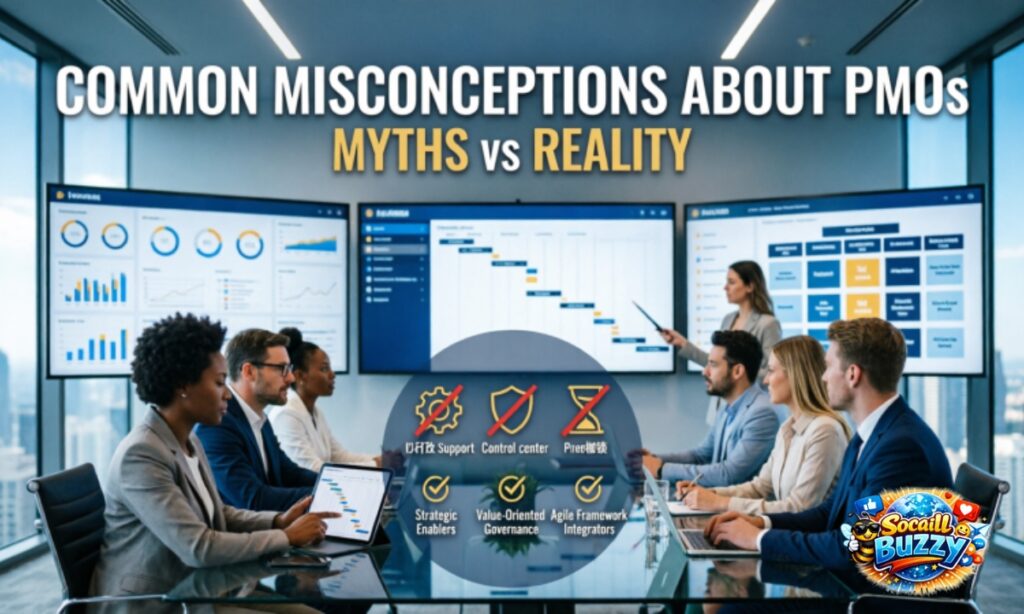
A few myths tend to follow PMOs around, so it is worth clearing them up.
- “A PMO just creates more bureaucracy.” A poorly designed PMO can feel this way, but a well designed one actually removes friction by giving teams reusable tools instead of forcing them to start from scratch every time.
- “Every company needs a PMO.” Not true. Small teams with light project loads often do fine without one.
- “A PMO manages every project directly.” Only directive PMOs do this. Supportive and controlling PMOs guide and enforce standards without taking over day to day execution.
- “PMO and project manager are the same thing.” As covered earlier, these are distinct roles with different scopes and responsibilities.
Key Skills Found in Strong PMO Teams
People working within a PMO typically bring a mix of skills from different disciplines, including:
- Project and program management expertise
- Financial and budget analysis
- Risk assessment and mitigation planning
- Data reporting and dashboard tools
- Change management and stakeholder communication
- Increasingly, familiarity with AI powered planning and forecasting tools
This cross functional mix is why PMOs often pull staff from IT, finance, operations, and planning backgrounds rather than hiring only trained project managers.
Frequently Asked Questions
What does PMO stand for? PMO stands for Project Management Office, a team responsible for standardizing and overseeing project management practices across an organization.
Is a PMO the same as a project manager? No. A project manager runs a single project from start to finish. A PMO oversees standards, governance, and reporting across many projects at once.
Does every company need a PMO? Not necessarily. Smaller organizations with few simultaneous projects often manage well without one. PMOs tend to add the most value once project volume and complexity increase.
What are the three types of PMO? Supportive, controlling, and directive, ranked from the least to the most authority over individual projects.
Can PMO also mean Program Management Office? Yes, though less commonly. Context usually makes clear which meaning is intended, and project management office remains the most widely used definition.
Final Thoughts
At its core, PMO meaning comes down to one idea: consistency. A Project Management Office exists to make sure projects across an organization follow the same standards, report the same way, and stay tied to actual business goals instead of running as isolated efforts.
Whether a company needs a light supportive PMO or a fully directive one depends on its size, industry, and how much project complexity it is dealing with. What matters most is that the PMO is built to genuinely help teams deliver, not just to add extra paperwork.
If you are evaluating whether your organization needs a PMO, start by looking honestly at how your current projects are performing. If delays, budget overruns, and unclear priorities are common, a well structured PMO is one of the most reliable ways to bring that under control.

Welcome to SocaillBuzzy! I’m the creator and writer behind this platform, dedicated to sharing meaningful content including grammar, meaning, quotes, and inspirational messages for everyday life. Through well-crafted, SEO-friendly content, I aim to spread positivity, strengthen connections, and make it easier for readers to express their emotions with clarity and warmth.

