Do you know someone who feels uneasy stepping into a wide-open field or a large empty room? Most people assume fear only works one way with spaces tight rooms, small closets, crowded elevators. But what if the opposite triggers panic? The opposite of claustrophobia is a very real condition, and millions of people live with it without ever knowing its name. Let’s fix that right now.
What Is the Opposite of Claustrophobia?
The opposite of claustrophobia is agoraphobia.
While claustrophobia is the fear of enclosed or confined spaces, agoraphobia is the fear of open, wide, or public spaces where escape feels difficult or help feels far away.
Think of it this way: a person with claustrophobia dreads getting inside a small elevator. A person with agoraphobia dreads stepping into a massive open plaza with no walls around them.
Both are anxiety disorders. Both are real. But they live on completely opposite ends of the spatial fear spectrum.
Breaking Down the Two Words: Claustrophobia vs. Agoraphobia
Understanding these words becomes much easier once you see where they come from.
Claustrophobia comes from the Latin word claustrum (meaning “a closed place” or “lock”) and the Greek word phobos (meaning “fear”). So literally: fear of closed places.
Agoraphobia comes from the Greek word agora (meaning “open marketplace” or “public gathering place”) and phobos (fear). So literally: fear of open marketplaces or public spaces.
The ancient Greeks had a word for the anxiety of standing in a crowded open square. Honestly, that sounds like a Monday morning in Times Square. The point is, this fear has existed long enough to earn a Greek name.
A Quick Comparison: Claustrophobia vs. Agoraphobia
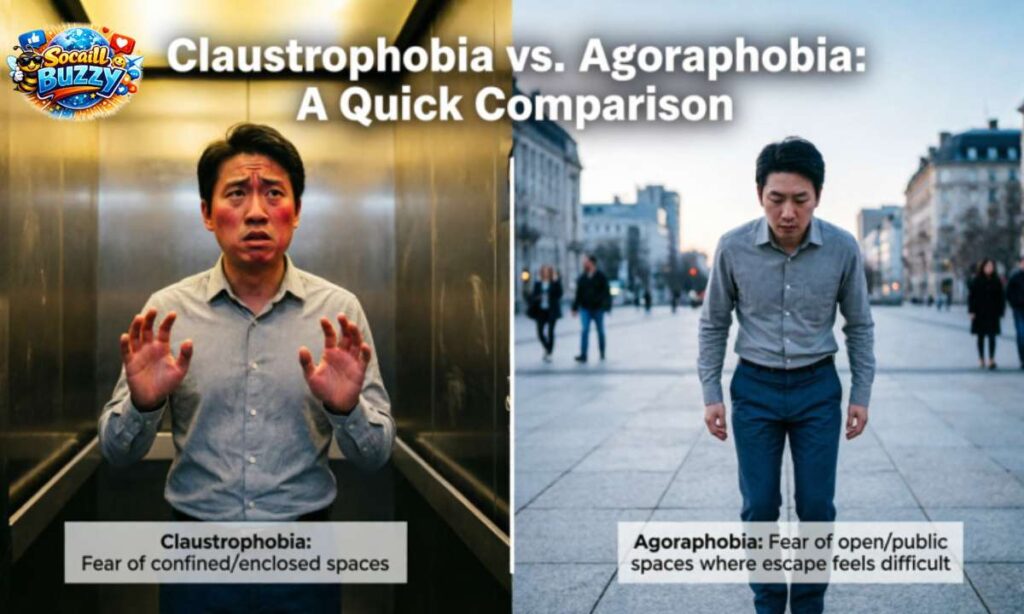
| Feature | Claustrophobia | Agoraphobia |
| Meaning | Fear of closed/confined spaces | Fear of open/public spaces |
| Word Origin | Latin claustrum + Greek phobos | Greek agora + phobos |
| Common Triggers | Elevators, tunnels, small rooms | Open fields, public squares, crowds |
| Core Fear | Being trapped, no escape | Being too exposed, help is too far |
| Where It Happens | Indoors, tight spaces | Outdoors, large venues, public transport |
| Avoidance Behavior | Avoids small spaces | Avoids leaving home or open areas |
| Overlap Possible? | Yes, both can coexist in one person | Yes, both can coexist in one person |
Is Agoraphobia Really Just “Fear of Open Spaces”?
Here is where most people get confused, and even some online sources get it wrong.
Agoraphobia is not simply a fear of wide-open fields. Modern psychology defines it more broadly. It is the fear of any situation where escape might be difficult or where help might not be available during a panic attack.
This includes:
- Open public spaces like parks, parking lots, or large plazas
- Crowded places like shopping malls, concerts, or markets
- Public transportation like buses, trains, or airplanes
- Being outside the home alone, especially far from safety
So while “open space” is the most direct opposite of a “closed space,” agoraphobia covers the full picture of what that fear actually looks like in daily life.
Historical and Biblical Context of Open Space Fear
The fear of open spaces is not a modern invention. It goes back centuries.
The term agoraphobia was first introduced by German psychiatrist Carl Friedrich Otto Westphal in 1871. He observed patients who became severely anxious when crossing open streets or public squares in Berlin.
In biblical history, wide-open wilderness was frequently portrayed as a place of trial, vulnerability, and spiritual exposure. The forty years the Israelites spent wandering in the desert wilderness (Numbers 14) carried a profound sense of being exposed with no shelter, no walls, no protection. The cultural and emotional weight of open, unprotected spaces ran deep in ancient societies.
Even today, the design of sacred spaces across cultures tends to enclose worshippers within walls, domes, and defined boundaries perhaps reflecting our instinct to feel spiritually and physically secure within defined limits.
What Does Agoraphobia Actually Feel Like?
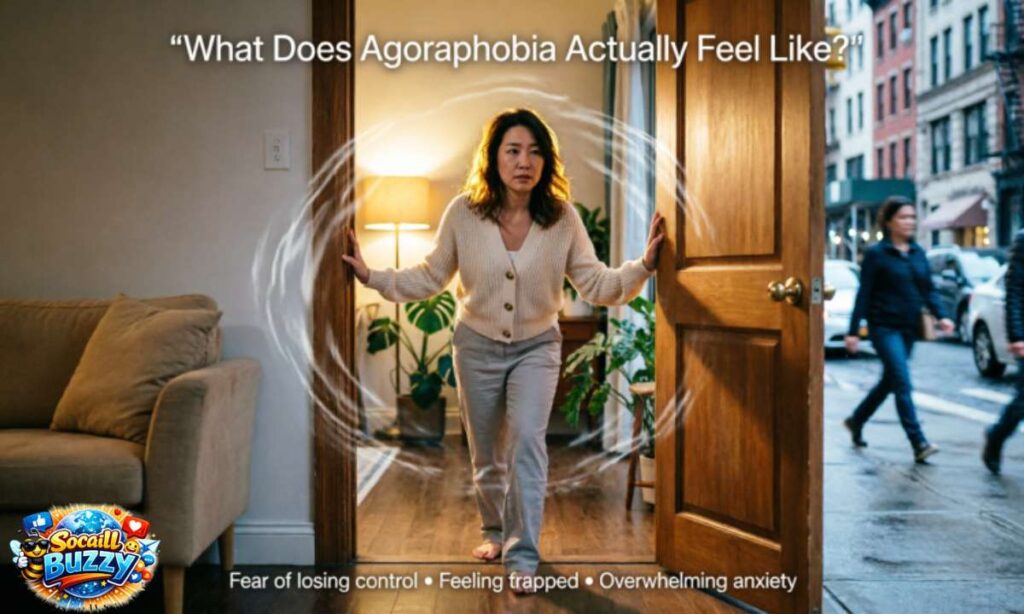
Reading a definition is one thing. Understanding the lived experience is another.
A person with agoraphobia standing in the middle of a wide parking lot might feel:
- A sudden rush of panic with no clear source
- The sensation that the ground is unstable or the sky is too vast
- An overwhelming urge to run back indoors immediately
- Physical symptoms like racing heart, sweating, trembling, or shortness of breath
- A feeling that they are completely exposed and utterly alone, even in a crowd
It is not simply “discomfort.” It can be fully paralyzing. Many people with severe agoraphobia eventually stop leaving their homes altogether.
Other Related Words Worth Knowing
Agoraphobia is the primary and most recognized opposite of claustrophobia, but a few other terms sit in the same neighborhood:
- Kenophobia the fear of empty or void spaces (from Greek kenos, meaning empty). This is more specific than agoraphobia and less commonly diagnosed.
- Spacephobia an informal term sometimes used to describe fear of vast open environments, including outer space.
- Eremophobia the fear of being isolated or alone in open places (from Greek eremos, meaning solitary or lonely).
For clinical and practical use, agoraphobia is the correct and widely recognized answer when someone asks for the opposite of claustrophobia.
Real-Life Examples of Agoraphobia in Action
Sometimes the clearest way to understand a concept is to see it play out in recognizable situations.
Example 1: Sarah feels completely comfortable in her apartment, her office, and any enclosed indoor space. But the moment she steps into a large outdoor festival or an open stadium, her chest tightens, her palms sweat, and she counts every second until she can get back inside. That is agoraphobia.
Example 2: James has not left his house in three months. He orders everything online. The thought of standing at a bus stop in the open air sends him into a full panic attack. His doctor diagnoses him with severe agoraphobia.
Example 3: A soldier returning from combat avoids open fields and large open areas because they feel dangerously exposed. This overlap with PTSD-related agoraphobic symptoms is well-documented in clinical research.
Common Mistakes People Make About These Terms
A few misconceptions float around the internet, and it is worth clearing them up directly.
Mistake 1: Thinking agoraphobia only means fear of going outside. Not quite. Agoraphobia is about fear of situations where escape is difficult, not strictly about outdoors vs. indoors.
Mistake 2: Confusing agoraphobia with social anxiety. They are related but different. Social anxiety is the fear of social judgment. Agoraphobia is the fear of the space itself and the vulnerability it creates.
Mistake 3: Assuming claustrophobia and agoraphobia cannot coexist. They absolutely can. A person can fear being trapped in a small space AND fear being too exposed in a large one. Anxiety disorders do not follow tidy rules.
Mistake 4: Treating these as personality quirks rather than medical conditions. Both are recognized anxiety disorders in the DSM-5. They respond well to therapy, particularly Cognitive Behavioral Therapy (CBT) and gradual exposure techniques.
Which Word Should You Actually Use?
If someone asks you “what is the opposite of claustrophobia?”, the correct answer is agoraphobia.
If you are writing about fear of empty or void spaces specifically, kenophobia is more precise.
If you are describing the fear of being alone and isolated in open places, eremophobia fits better.
For everyday conversation, academic writing, psychology discussions, or SEO content, agoraphobia is the right and recognized term. It is understood universally by mental health professionals, educators, and general readers alike.
How Are Both Conditions Treated?
Since both claustrophobia and agoraphobia are anxiety-based, their treatments share a lot of common ground.
Cognitive Behavioral Therapy (CBT) is the gold standard for both. It helps patients identify the thought patterns driving the fear and gradually challenge them.
Exposure therapy is particularly effective. For claustrophobia, this means slowly spending time in progressively smaller spaces. For agoraphobia, it means carefully stepping into more open environments, starting with manageable ones.
Medication, such as anti-anxiety medications or antidepressants, can support therapy, especially in severe cases.
The encouraging news is that both conditions are highly treatable. Most people who commit to therapy see significant improvement. Neither fear has to define a person’s life permanently.
Frequently Asked Questions
Q: What is the one-word opposite of claustrophobia?
The one-word opposite is agoraphobia. Claustrophobia is fear of confined spaces; agoraphobia is fear of open or public spaces where escape seems difficult.
Q: Can a person have both claustrophobia and agoraphobia at the same time?
Yes, absolutely. It is possible for someone to fear small enclosed spaces AND open exposed environments simultaneously. Anxiety disorders often overlap, and a mental health professional can help identify and treat both.
Q: Is agoraphobia rare?
Not at all. According to the American Psychiatric Association, agoraphobia affects approximately 1.3% of adults at some point in their lives. It is one of the more commonly diagnosed anxiety disorders worldwide.
Read More : Ingrained or Engrained
Conclusion
Claustrophobia and agoraphobia sit at opposite ends of the same human experience: our complicated relationship with space.
One person dreads the walls closing in. Another dreads the walls disappearing entirely. Neither fear is “irrational” to the person experiencing it. Both deserve understanding, not mockery.
The next time someone asks you for the opposite of claustrophobia, you will have a complete, confident answer. And now you understand not just the word but the real human experience behind it.
That is the kind of knowledge worth having.

Welcome to SocaillBuzzy! I’m the creator and writer behind this platform, dedicated to sharing meaningful content including grammar, meaning, quotes, and inspirational messages for everyday life. Through well-crafted, SEO-friendly content, I aim to spread positivity, strengthen connections, and make it easier for readers to express their emotions with clarity and warmth.