

You typed a word, second-guessed yourself, and now you are staring at two spellings that both look right and wrong at the same time. Sound familiar? You are not alone. Ingrained and engrained confuse writers every single day, from students to seasoned professionals. The good news is that one of them is clearly preferred, and once you learn why, you will never hesitate again.
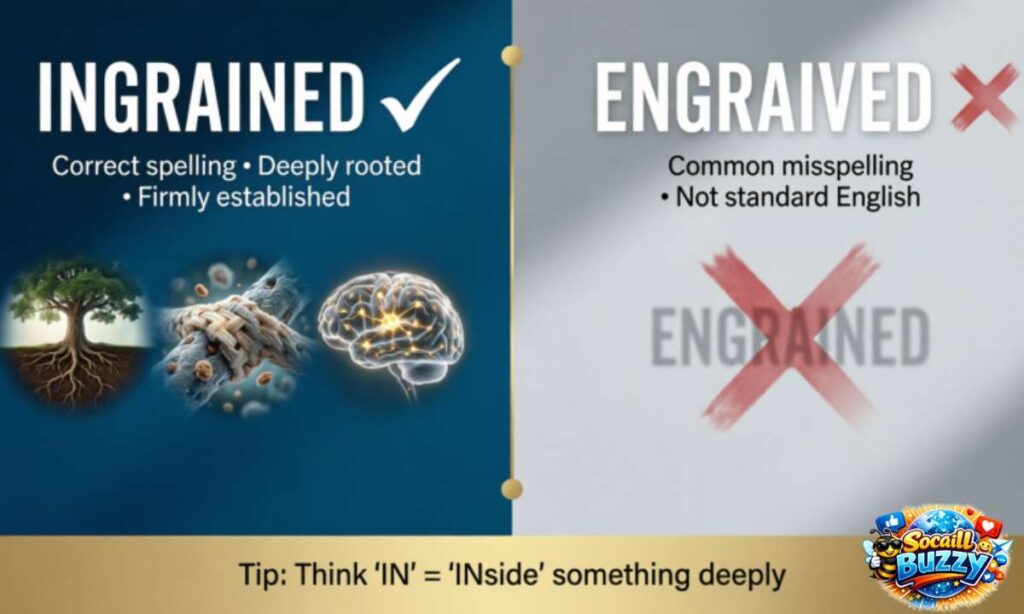
The short answer: Use ingrained. It is the standard, widely accepted spelling in modern English. “Engrained” is a legitimate variant, but it is far less common and may raise eyebrows in formal writing.
What Does “Ingrained” Actually Mean?
Before diving into the spelling debate, it helps to understand what the word means in the first place.
Ingrained describes something so deeply fixed or established that it feels like a permanent part of a person, place, or system. It can refer to habits, beliefs, values, attitudes, or even physical substances that have settled deep into a surface.
Think of it this way: if something is ingrained, it is not sitting on the surface. It has worked its way in. It is part of the structure, not just stuck to the outside.
Here are a few quick examples to make it click:
- A fear of failure ingrained from childhood
- Dirt ingrained into the cracks of old wooden floors
- Prejudice ingrained in a culture over centuries
Each of these examples shares one thing. The thing being described is not new, not shallow, and not easily removed.
Where Did This Word Come From? (The Origin Explains Everything)
Here is where the spelling mystery starts to untangle itself.
The word comes from the old practice of dyeing fabric. Historically, fabric was dyed using a method called “in grain” dyeing. The word “grain” referred to the cochineal dye, which came from a tiny insect. When cloth was dyed “in grain,” the color went deep into the fibers, not just on the surface.
Over time, “in grain” became a single compound word: ingrain. The past participle form, ingrained, described anything that had been colored so deeply it could not be washed out.
By the 17th and 18th centuries, the meaning expanded beyond fabric. Anything fixed deeply into a person’s character or a society’s structure became “ingrained.” The physical metaphor became a psychological and cultural one.
This is also where engrained comes from. Writers who heard the phrase “en grain” (a French-influenced variation) used the “en” prefix instead of “in.” Both versions coexisted for centuries, which is exactly why the confusion exists today.
Ingrained vs. Engrained: A Clear Comparison
| Feature | Ingrained | Engrained |
| Spelling | Standard, preferred | Variant, older |
| Usage frequency | Very common | Much less common |
| Accepted in formal writing | Yes, always | Sometimes, but with caution |
| Found in major dictionaries | Yes, as primary entry | Yes, as secondary variant |
| Origin | “In grain” dyeing process | French-influenced “en grain” |
| Recommended for modern use | Yes | Only if specifically preferred |
The takeaway from this table is clear. Both spellings are technically correct, but ingrained is the one you want to use in professional, academic, or published writing.
How “Ingrained” Is Used in Real Life
Knowing the correct spelling is one thing. Using the word well is another. Here are real-world examples across different contexts so you can see how naturally this word fits into everyday writing.
Personal habits and behavior:
“His tendency to overwork was so ingrained that even vacations felt like a burden.”
Cultural and social context:
“Gender roles remained ingrained in the community despite decades of change.”
Physical description:
“The grease was ingrained into the mechanic’s hands, no matter how hard he scrubbed.”
Education and upbringing:
“A love of reading was ingrained in her from the time she could hold a book.”
Politics and institutions:
“Corruption had become so ingrained in the system that reform felt almost impossible.”
Notice how each sentence carries a sense of depth and permanence. That is the core feeling “ingrained” always brings. If you can replace it with “deeply fixed” or “deeply embedded” and the meaning holds, you are using it correctly.
Does the Bible or Historical Literature Use This Word?

Yes, and this context adds a layer of meaning most people miss.
In older English literature and biblical translations, particularly in the King James era, the idea of something being dyed “in grain” carried strong imagery. The phrase appears in Shakespearean writing as well. In Twelfth Night, Shakespeare uses “ingrain’d” to describe the color of a beard, referencing the deep, fast-dyed quality of the color.
The biblical parallel is even richer. In Isaiah 1:18, the phrase “though your sins be as scarlet, they shall be as white as snow” reflects the same dyeing metaphor. Scarlet dye was among the most permanent, most deeply ingrained colors of the ancient world. The idea that even a color that deep could be changed was meant to be shocking and hopeful.
This historical and spiritual context gives “ingrained” its emotional weight. It does not just mean “habitual.” It means something that has been dyed into the very fabric of who you are.
Common Mistakes People Make With This Word
Now that you know the correct spelling and meaning, here are the most frequent errors writers make, so you can sidestep them entirely.
Mistake 1: Using “engrained” in formal writing. Even though it is technically a valid variant, most editors and style guides prefer “ingrained.” If you are writing a business report, an academic paper, or anything meant to be published, stick with “ingrained” every time.
Mistake 2: Confusing “ingrained” with “inborn” or “innate.” These words are related but not the same. Something “innate” is present from birth, like an instinct. Something “ingrained” was learned or absorbed over time, but it has become so deep it feels natural. An ingrained habit was not always there. It grew in.
Mistake 3: Using “ingrained” for something recent or surface-level. If a behavior only started last week, calling it “ingrained” is an overstatement. The word carries the idea of time and depth. Reserve it for things that have truly settled in over a long period.
Mistake 4: Writing “in-grained” with a hyphen. No hyphen needed. “Ingrained” is one word, no exceptions.
Related Words You Should Know
While you are here, a few related words and phrases are worth keeping in your vocabulary toolkit. They all orbit the same idea and come in handy when you want to say “ingrained” without repeating yourself.
- Deep-seated (describes beliefs or attitudes that are firmly established)
- Entrenched (often used for behaviors, systems, or positions that resist change)
- Rooted (suggests a natural, organic depth, like roots in soil)
- Embedded (common in technical and journalistic writing for things fixed within a larger structure)
- Hardwired (used in modern contexts, especially for mental patterns or instincts)
Each of these carries a slightly different nuance, but all of them share the core idea of depth and resistance to change that makes “ingrained” so powerful.
Which One Should You Use? The Final Word
Here is the simplest possible answer, straight and clean.
If you are writing anything that will be read by others, especially in a formal or professional context, use ingrained. It is the standard form, recognized by every major English dictionary as the primary spelling. It will never be questioned.
If you stumble across engrained in older books or historical texts, do not panic. It is not a typo. It is simply an older variant that has faded from mainstream use over time, much like other “en” versus “in” words in English.
The only situation where “engrained” might be defensible is if you are deliberately using an archaic or stylistic voice, or if you are reproducing older text faithfully. Otherwise, default to ingrained and move on with confidence.
A Quick Memory Trick That Actually Works
If you always want to remember the correct spelling, try this.
Think of the phrase “in the grain.” The dye went in the grain of the fabric. So the correct spelling starts with in, not en.
In the grain > in-grain > ingrained.
That is it. Three steps, and you will never confuse the two again.
Frequently Asked Questions
Q: Is “engrained” wrong?
Not technically. “Engrained” is listed as a variant in most major English dictionaries. However, it is far less common, and in formal writing, “ingrained” is always the safer and more widely accepted choice.
Q: Can “ingrained” describe a physical thing, or is it only used for habits and beliefs?
Both. “Ingrained” works perfectly for physical substances, like dirt or stains that have worked deep into a surface, as well as for mental or cultural patterns. The word was originally physical before it became metaphorical, so both uses are entirely correct.
Q: How do I use “ingrained” in a sentence naturally?
The best way is to pair it with something that has existed or built up over a long time. For example: “The fear was ingrained through years of criticism” or “The tradition was so ingrained that no one questioned it.” If the thing you are describing feels deep, old, and hard to remove, “ingrained” is almost certainly the right word.
Also Read : The Opposite of Growth
Final Thoughts
The word ingrained came from the world of fabric dye, where color worked so deeply into cloth that it became inseparable from the material itself. That original meaning is still alive every time you use the word today.
Whether you are writing about a stubborn habit, a cultural belief, or literal grime in old floorboards, “ingrained” is the spelling that says you know your English. “Engrained” is not a crime, but it is the quiet, faded cousin nobody invites to the party anymore.
So the next time you hesitate between the two, remember the dye, remember the grain, and remember: in the grain. Ingrained. Every time.

Welcome to SocaillBuzzy! I’m the creator and writer behind this platform, dedicated to sharing meaningful content including grammar, meaning, quotes, and inspirational messages for everyday life. Through well-crafted, SEO-friendly content, I aim to spread positivity, strengthen connections, and make it easier for readers to express their emotions with clarity and warmth.