You typed “ola” in a message to your Spanish-speaking friend and now you’re second-guessing yourself. Or maybe you saw both spellings online and thought, “Are these the same thing?” You are not alone. This tiny spelling question trips up millions of learners every year. Here is the short answer: “Hola” is the correct Spanish word for “hello,” and “Ola” means something else entirely. Let’s clear this up once and for all.
What Does “Hola” Actually Mean?
Hola is the standard Spanish greeting. It simply means “hello” or “hi” in English. It is the first word almost every Spanish learner picks up, and for good reason. It is casual, friendly, and works in just about every situation, whether you are greeting a friend, a coworker, or a stranger at a café in Madrid.
Pronunciation tip: the H in Spanish is completely silent. So “ola” sounds like “oh-lah,” not “ho-lah.” If you have been saying the H out loud, your Spanish friends have been quietly smiling about it. Now you know.
What Does “Ola” Mean? (It Is Not a Typo)
Here is where things get interesting. “Ola” is a real word, but it is not a greeting in Spanish. It means “wave” as in an ocean wave or a wave of energy. You might see it in weather reports, poetry, or song lyrics.
“Ola” is also a common greeting in Portuguese and Galician, two languages closely related to Spanish. So if someone texts you “ola” and they are Brazilian or Portuguese, they are saying hello just fine. Context and language matter a lot here.
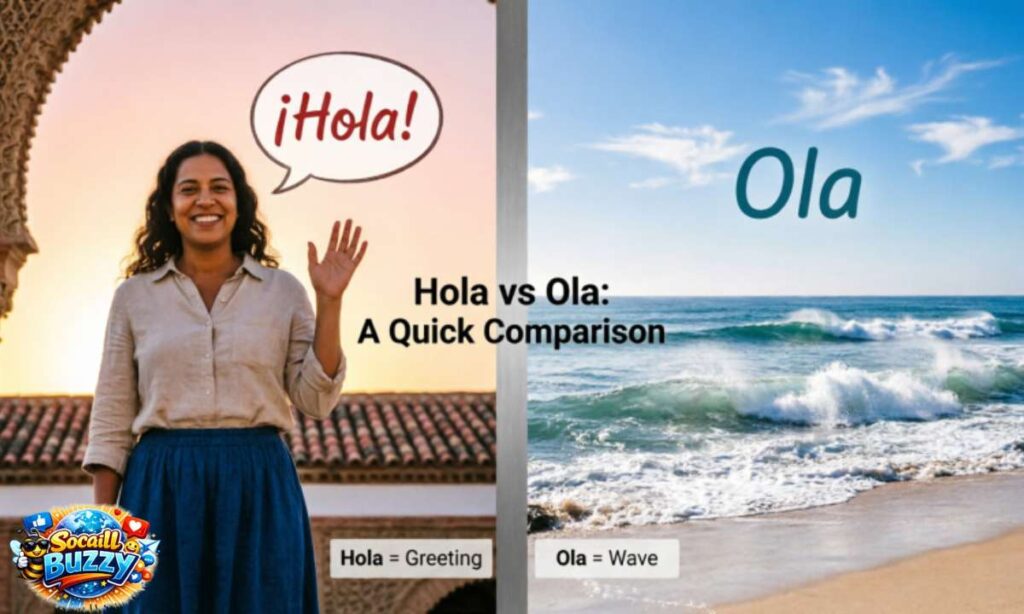
Hola vs Ola: A Quick Comparison
| Feature | Hola | Ola |
| Language | Spanish | Portuguese / Galician / Spanish |
| Meaning | Hello / Hi | Hello (PT) / Wave (ES) |
| Pronunciation | oh-lah | oh-lah |
| Used as a greeting | Yes, always | Only in Portuguese / Galician |
| Common mistake | Spelling it as “Ola” | Using it as Spanish for “hello” |
| Formality | Casual to neutral | Casual |
They sound identical when spoken. The difference only shows up in writing, which is exactly why so many people mix them up.
The History and Origin Behind “Hola”
Hola comes from the Old Spanish exclamation “hola,” which was used to hail someone or call attention. Think of it as the medieval equivalent of yelling “hey!” across a marketplace. Its roots trace back to the Latin “olla” and related Germanic expressions of calling out.
By the time modern Spanish developed, “ola” had settled comfortably into everyday use as the go-to greeting. The silent H stuck around as a spelling convention, even though the sound disappeared centuries ago. The Spanish kept the letter, dropped the sound, and never looked back.
Biblical and Historical Context: Did People Say “Hola” in Ancient Times?

Not exactly. The Bible was written in Hebrew, Aramaic, and Greek, none of which used “ola.” However, the concept of a simple, warm greeting is deeply rooted in ancient culture. Hebrew uses “Shalom” (peace be upon you), and Arabic uses “As-salamu alaykum,” both of which carry a similar spirit of welcoming another person.
When Spanish missionaries and conquistadors traveled to the Americas in the 15th and 16th centuries, “hola” traveled with them. It became one of the most widely spread words in the world, now spoken by over 500 million native Spanish speakers across more than 20 countries.
Real-Life Usage Examples You Can Use Right Now
Seeing a word in action always beats memorizing a definition. Here are natural examples:
Using “Hola” in Spanish:
- “¡Ho.la! ¿Cómo estás?” (Hi! How are you?)
- “Hol.a. a todos” (Hello everyone, used to address a group)
- “Hol.a, buenos días” (Hello, good morning, a slightly warmer opener)
Using “Ola” correctly in Spanish:
- “Una ola gigante golpeó la costa.” (A giant wave hit the coast.)
- “Hay una ola de calor esta semana.” (There is a heat wave this week.)
Using “Ola” in Portuguese:
- “Olá, tudo bem?” (Hello, how are you? Note the accent mark in formal Portuguese)
See how the same sound carries completely different meanings depending on the language and context.
Common Mistakes People Make With These Two Words
The number one mistake is simple: writing “ola” when you mean “h.ola” in Spanish. This happens because the H is silent, so the word sounds exactly like “ola” when spoken. Your ear hears one thing, your hand writes another.
Here are the most frequent slip-ups:
- Writing “ola” in a Spanish WhatsApp message and confusing native speakers
- Assuming “ola” is just an informal or lazy version of “hola” (it is not)
- Forgetting that Portuguese “olá” usually carries an accent mark in formal writing
- Using “hola” in a Portuguese conversation (your Brazilian friends will understand, but it will feel slightly off)
The fix is easy. Just remember: Spanish greeting = hola with an H. Drill it once and you will never mix it up again.
Which One Should You Use?

This depends entirely on what you are trying to say and in which language.
Use “Hola” when:
- You are speaking or writing in Spanish
- You want to greet anyone in a Spanish-speaking country
- You are texting, emailing, or starting a conversation in Spanish
Use “Ola” when:
- You are writing in Spanish and mean “wave” (as in ocean or heat wave)
- You are communicating in Portuguese or Galician and want to say hello
- You are writing a poem, song, or description involving waves
If you are learning Spanish as a second language, the answer is almost always “hola.” Save “ola” for the beach.
Related Words Worth Knowing
Once you have “hola” down, a few related Spanish greetings and expressions are worth adding to your vocabulary:
- “Buenos días” (Good morning)
- “Buenas tardes” (Good afternoon)
- “Buenas noches” (Good evening / Good night)
- “¿Qué tal?” (What’s up? / How’s it going?)
- “Saludos” (Greetings, often used in written communication)
These pair naturally with “hola” in everyday conversation and give your Spanish an immediately more natural feel.
Why This Small Difference Actually Matters
You might be thinking, “It is just one letter, does it really matter?” In casual texting between friends, probably not. Native speakers will understand what you mean. But in professional writing, formal emails, or language exams, spelling “ola” instead of “hola” marks you as someone still learning the basics.
More importantly, getting it right shows respect for the language. Spanish has over half a billion speakers worldwide. Taking a moment to spell “hola” correctly is a small gesture that goes a long way, especially if you are building relationships across cultures or growing a brand with a Spanish-speaking audience.
A Quick Note on the Hola VPN App
You may have also come across “Hola” as the name of a well-known VPN and internet service. The company borrowed the Spanish greeting to signal openness and global access. It has nothing to do with waves or Portuguese. Just a fun bit of branding trivia if you ever wondered why a tech company chose a Spanish hello as its name.
Final Thoughts
The confusion between hola and ola is one of those classic mix-ups that sounds silly once you know the answer but genuinely trips people up before that moment. To recap: “hola” is how you say hello in Spanish, the H is silent, and “ola” means wave in Spanish or hello in Portuguese.
Next time you are about to type that greeting, you will not hesitate for a second. And if someone corrects you, you can confidently explain the whole story. That is the kind of knowledge that makes you sound like you actually know what you are doing, because now you do.
Read Now : Ingrained or Engrained
Frequently Asked Questions (Hola vs Ola)
Q: Is “ola” just an informal way to write “hola”?
No. “Ola” is not a shortcut or slang for “hola.” They are two different words with different meanings in Spanish. Using “ola” as a greeting in Spanish is technically incorrect, even though native speakers will usually understand from context.
Q: Why do some people write “ola” instead of “hola” on social media?
Because the H in “hola” is completely silent, many non-native speakers and even some casual native writers drop it when typing quickly. It is a common phonetic spelling error, not an accepted alternative.
Q: Can I use “hola” when speaking to someone in Brazil or Portugal?
You can, and they will understand you. However, the natural greeting in Brazilian Portuguese is “olá” (with an accent) or simply “oi.” Using “hola” will signal that you speak Spanish, not Portuguese, which is fine but worth knowing.

Welcome to SocaillBuzzy! I’m the creator and writer behind this platform, dedicated to sharing meaningful content including grammar, meaning, quotes, and inspirational messages for everyday life. Through well-crafted, SEO-friendly content, I aim to spread positivity, strengthen connections, and make it easier for readers to express their emotions with clarity and warmth.