You have probably typed one of these three words and then stared at the screen wondering if it sounds right. Maybe you wrote “oncoming event” and something felt off. Or you used “incoming” when you meant “upcoming” and a native speaker gave you that polite but painful smile. These three words look similar, but they do not mean the same thing. Here is the clearest explanation you will find anywhere online.
What Is the Quickest Way to Tell Them Apart?
Here is the short answer, right up front:
- Incoming means something is arriving right now or very soon, often directed at you.
- Upcoming means something is scheduled to happen in the near future, like an event or deadline.
- Oncoming means something is moving toward you, usually in a physical or literal sense.
Think of it this way: incoming is your boss calling you into the office right now, upcoming is the meeting scheduled for Thursday, and oncoming is the truck you just noticed in your lane. All three involve “coming,” but the situation is completely different each time.
What Does “Incoming” Actually Mean?
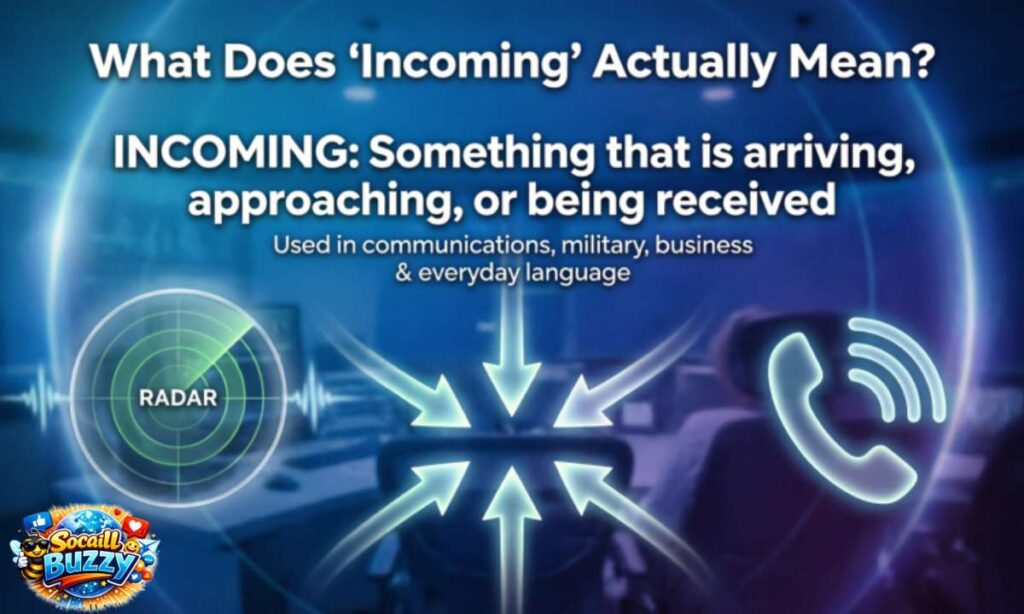
Incoming describes something that is arriving at this moment or is in the process of coming in. It carries a sense of immediacy. The thing is already on its way, and it is usually directed toward a specific person, place, or system.
You will often hear it in fast-paced or high-stakes settings. Soldiers call out “incoming!” when something is flying toward them. Your phone says “incoming call.” A hospital gets an “incoming patient.” An inbox fills with “incoming messages.”
The core idea behind incoming is arrival in progress. It does not just mean something will happen eventually. It means the motion toward you has already started.
Real-life examples:
- “We have three incoming flights delayed due to weather.”
- “Check your incoming messages before the meeting.”
- “Incoming freshmen will register on Monday.” (They are arriving into the system now.)
What Does “Upcoming” Actually Mean?
Upcoming is the calm, organized one in this group. It points to something that is planned, expected, or scheduled to happen in the future. There is no urgency or physical movement attached to it. It simply means “coming up on the calendar.”
You will see upcoming in marketing, announcements, and everyday planning. Events, releases, elections, and deadlines are all “upcoming.” It is the word your email newsletter uses. It is what appears on your calendar app under “upcoming events.”
Unlike incoming, the thing has not started moving toward you yet. It is still sitting neatly in the future, minding its own business.
Real-life examples:
- “Don’t miss our upcoming sale this weekend.”
- “She is preparing for her upcoming job interview.”
- “The upcoming election has everyone talking.”
If you can replace the word with “scheduled” or “planned,” then upcoming is almost always the right choice.
What Does “Oncoming” Actually Mean?
Oncoming is the most physical and directional of the three. It describes something that is moving toward you through space, often at speed. It nearly always involves a literal path or collision course.
You use oncoming when something is traveling in your direction and you are both on the same road, path, or trajectory. The classic pairing is oncoming traffic, meaning vehicles moving toward you from the opposite direction. You will also see oncoming storm or oncoming wave, which are metaphors borrowed from that same idea of physical approach.
Oncoming almost never works with abstract things like events, emails, or appointments. That is the territory of incoming and upcoming.
Real-life examples:
- “She swerved to avoid an oncoming car.”
- “The hikers took shelter from the oncoming storm.”
- “He stood frozen in the path of an oncoming train.”
If something has wheels, legs, or weather behind it and it is heading straight at you, oncoming is your word.
A Quick Comparison Table
| Word | Time Frame | Direction | Used For |
| Incoming | Now or very soon | Toward you or arriving in | Messages, calls, people, data, attacks |
| Upcoming | Near future (scheduled) | No specific direction | Events, releases, deadlines, announcements |
| Oncoming | Right now (in motion) | Physically toward you | Traffic, storms, people walking toward you |
Where Do These Words Come From? A Bit of History
All three words share the same Old English root: “cuman,” meaning “to come.” English speakers have been attaching prefixes to this root for centuries to express subtle differences in how and where something is coming from.
“On” as a prefix often expresses contact or approach in motion, which is why oncoming kept its physical, directional sense. “Up” as a prefix pointed to something rising toward attention or appearing on the horizon, which gave “upcoming” its sense of scheduled arrival. “In” suggests entry or movement into a space, making incoming the word for things entering your world right now.
Interestingly, in older English texts and even some Biblical translations, the concept of something approaching with purpose was often expressed through phrases like “he that cometh” rather than a single compound word. The compressed, efficient forms we use today are a relatively modern development in the language.
How Native Speakers Actually Use These Words
Knowing the definition is one thing. Seeing how real people actually reach for these words is another.
Native speakers almost never pause to analyze which word to use. They rely on pattern recognition built over years. Here is how those patterns break down:
Incoming shows up in professional and technical settings. IT teams talk about incoming data. Receptionists track incoming calls. Military personnel report incoming threats. It always has an active, arrival-based energy.
Upcoming is the most social and marketing-friendly word of the three. It is soft, friendly, and forward-looking. Brands use it. Teachers use it. It carries zero urgency and maximum organization.
Oncoming is the most situational. Outside of traffic and weather, it rarely appears in casual conversation. You would not say “there is an oncoming birthday party.” But you might joke that there is an “oncoming Monday morning,” and people would understand exactly what you mean.
Common Mistakes People Make With These Three Words
Even confident English speakers mix these up. Here are the most frequent errors:
Mistake 1: Using “oncoming” for events ❌ “Please prepare for the oncoming conference.” ✅ “Please prepare for the upcoming conference.”
Oncoming requires physical motion. A conference is not chasing you down the hallway (though it might feel that way).
Mistake 2: Using “incoming” for scheduled events ❌ “The incoming concert is sold out.” ✅ “The upcoming concert is sold out.”
Incoming feels like the concert is already pulling into the parking lot. Use upcoming for anything future and planned.
Mistake 3: Using “upcoming” for something already in motion ❌ “Watch out for upcoming traffic.” ✅ “Watch out for oncoming traffic.”
This one can actually be dangerous in the wrong context. Upcoming traffic sounds like traffic you will encounter later. Oncoming traffic is coming at you right now.
Which One Should You Use?
Here is a simple decision tool:
Ask yourself three questions:
- Is it physical and moving toward me right now? → Oncoming
- Is it arriving into my inbox, life, or space very soon? → Incoming
- Is it scheduled and sitting in the future? → Upcoming
Still not sure? Here is the fastest test: if you could put it on a calendar, use upcoming. If it has wheels or weather, use oncoming. If it is heading directly into your system or hands, use incoming.
Related Words Worth Knowing
While you are here, a few related terms that often come up in the same conversations:
Forthcoming means someone is about to reveal information, or that something is soon to be released. “The forthcoming report will address all concerns.” It has a slightly formal and literary feel compared to upcoming.
Approaching overlaps with all three but focuses purely on physical or time-based nearness. “The approaching deadline” or “the approaching car” both work naturally.
Pending covers things that are waiting to happen or be resolved. It is common in legal, business, and digital contexts. “Pending approval” means the thing has not happened yet but is expected to.
These words are cousins, not twins. Each one occupies slightly different territory, and learning their boundaries makes your writing noticeably sharper.
A Few Sentences to Lock It All In
Reading about words is fine. Seeing them in context is better.
“The hospital prepared for incoming patients after the accident. An oncoming storm threatened to delay emergency vehicles. The head of staff reminded everyone about the upcoming safety drill scheduled for next week.”
Notice how naturally each word fits? Incoming for arrival in progress. Oncoming for physical approach. Upcoming for future planning. Once you see that rhythm, you cannot unsee it.
Frequently Asked Questions
Q: Can “incoming” and “upcoming” ever be used interchangeably?
Almost never. Incoming signals active arrival. Upcoming signals future scheduling. Saying “incoming elections” technically implies the elections are rushing toward you right this second, which is dramatic but not quite right. Use upcoming elections instead.
Q: Is “oncoming” only used for traffic?
No, but traffic is its most common home. It also works for storms, crowds, waves, and any force moving toward you through space. In metaphorical writing, you might see “an oncoming wave of change,” borrowing that same physical energy.
Q: Which of these words is most formal?
All three are standard English and acceptable in formal writing. However, upcoming is the most commonly used in professional announcements and marketing. Oncoming and incoming tend to appear more in operational, emergency, or technical contexts.
Click Here : Hola or Ola
Final Thought
These three words share a common ancestor and a common theme, but they live in very different neighborhoods. Incoming is active and arrival-based. Upcoming is calm and calendar-based. Oncoming is physical and direction-based.
Once you know which lane each word belongs in, you will never mix them up again. And the next time an oncoming deadline feels like incoming chaos, at least you will know exactly which word to use while describing the situation.
That counts for something.

Welcome to SocaillBuzzy! I’m the creator and writer behind this platform, dedicated to sharing meaningful content including grammar, meaning, quotes, and inspirational messages for everyday life. Through well-crafted, SEO-friendly content, I aim to spread positivity, strengthen connections, and make it easier for readers to express their emotions with clarity and warmth.