

You typed “sweety” in a heartfelt text message and suddenly you’re second-guessing yourself. Is it sweetie? Sweety? Or that odd-looking sweatie you once spotted online? You are not alone. This confusion trips up native speakers and English learners alike, every single day.
Here is the short answer: “Sweetie” is the correct, standard spelling. “Sweety” is an informal variant that many people use, especially in texting and on social media. “Sweatie,” on the other hand, is almost always a typo and a potentially embarrassing one at that.
But there is much more to this story. Understanding why these three spellings exist, what each one communicates, and exactly when to use (or avoid) them can genuinely improve your everyday writing and communication. This guide breaks it all down, from etymology to real-world usage examples, so you never have to second-guess yourself again.
What Does “Sweetie” Mean?
“Sweetie” is a term of endearment, a warm, affectionate word used to express fondness, love, or care toward another person. It functions as a noun and can be directed at a romantic partner, a child, a close friend, or even a beloved pet.
Definitions and Uses
- As a pet name or term of address: “Come here, sweetie, and tell me what happened.”
- As a noun describing a kind person: “She’s such a sweetie she remembered my birthday.”
- In British English, as a word for candy: “Would you like a sweetie?” (This usage is especially common in the UK and parts of Ireland.)
- As part of compound terms: “Sweetie-pie” is an even more affectionate extension of the same word, with documented use going back to at least 1928.
The word carries warmth in every context. Its tone is tender, familiar, and inclusive, suitable for close relationships without being overly formal.
The Etymology of “Sweetie”: Where Did It Come From?
Understanding the origins of “sweetie” helps explain why three different spellings even exist in the first place.
The word “sweet” traces back to Old English swēte, meaning pleasing to the senses particularly taste, but also temperament and character. From Middle English onward, “sweet” began to evolve into a broader term of affection, and by the early 14th century, it was already being used to describe a beloved person.
The diminutive suffix “-ie” (also written as “-y”) is a common English suffix used to form affectionate or informal versions of words. Think of words like “auntie,” “doggie,” or “birdie.” When attached to “sweet,” it produced two possible spellings:
- Sweet + -ie = Sweetie
- Sweet + -y = Sweety
Both follow legitimate patterns in English word formation. According to etymology records, “sweetie” in the sense of “lover or sweetheart” dates back to around 1778, while its use as a small candy dates to approximately 1721.
The compound form “sweetie-pie” appeared in written records by 1928, showing how the word has grown and adapted over time.
Sweetie vs Sweety: What Is the Difference?
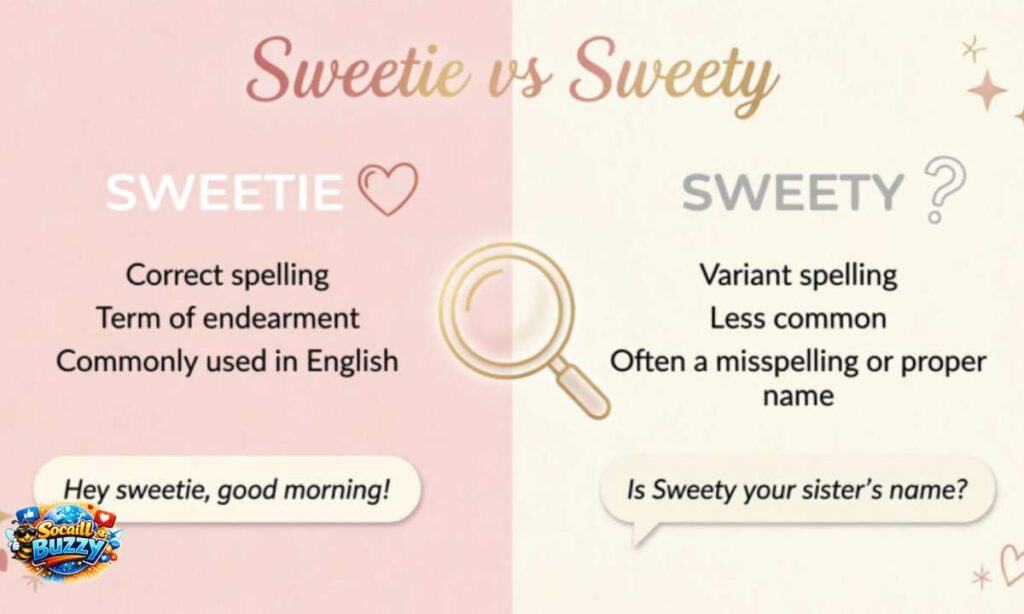
This is the core question most people are searching for. Let’s put them side by side.
Quick Comparison Table
| Feature | Sweetie | Sweety |
| Spelling status | Correct, standard | Informal, non-standard variant |
| Dictionary listing | Yes (Merriam-Webster, Collins, Oxford) | Rarely listed |
| Pronunciation | /ˈswi:ti/ | /ˈswi:ti/ (identical) |
| Formality level | Informal but widely accepted | More casual, text-message tone |
| Usage region | American English, British English, global | South Asian English, social media, texting |
| Part of speech | Noun | Noun |
| Meaning | Term of endearment; British: candy | Same as sweetie |
| Professional writing | Acceptable in personal contexts | Best avoided in formal writing |
Click Here To Read Myself vs My Self
Are They Interchangeable?
In spoken English, yes completely. Both are pronounced identically: /ˈswi:ti/. In written English, they carry the same meaning, but “sweetie” is the spelling that major dictionaries recognize as standard.
Think of it this way: “colour” and “color” mean the same thing and are both correct (depending on whether you follow British or American conventions). Similarly, “sweetie” and “sweety” mean the same thing but “sweetie” is the version that everyone, everywhere, recognizes without hesitation.
When to use “sweetie”:
- In any written communication where clarity and correctness matter
- In formal or semi-formal personal writing (cards, letters, notes)
- When addressing children, partners, or family members
- In British English when referring to candy
When “sweety” might appear:
- Casual text messages and social media posts
- Informal conversations with close friends
- In South Asian English contexts, where this spelling has a slightly wider acceptance
- Creative writing that intentionally mirrors informal speech patterns
What About “Sweatie”? Is It Ever Correct?
Now here’s where things get genuinely tricky and potentially awkward.
“Sweatie” is not a recognized term of endearment in standard English. If you use it intending to say “sweetie,” most readers will either:
- Assume it is a typo of “sweetie”
- Read it as a variant of “sweaty”
That second outcome is the problem. “Sweaty” means covered in perspiration, not exactly the impression you want to give when expressing affection.
The Sweatie–Sweaty Confusion
The visual similarity between “sweatie” and “sweaty” creates real ambiguity. Consider this sentence:
“Good morning, sweatie!”
A reader unfamiliar with the intended meaning might pause, wondering if the writer accidentally called someone perspiring. That moment of confusion, however brief, undermines the warmth of the message entirely.
Does “Sweatie” Have Any Legitimate Use?
There is one narrow, internet-specific context worth mentioning. Urban Dictionary records “sweatie” as a sarcastic or ironic pet name used when someone is being deliberately condescending or mock-affectionate, often in online arguments. The tone here is pointed, not warm.
Outside of that niche use, “sweatie” has no standing in standard English. The overwhelming consensus among linguists and grammar authorities is: avoid it.
Detailed Breakdown: Sweetie vs Sweety vs Sweatie
| Attribute | Sweetie | Sweety | Sweatie |
| Correct spelling? | ✅ Yes | ⚠️ Informal variant | ❌ Generally incorrect |
| In major dictionaries? | ✅ Yes | ❌ Rarely | ❌ No |
| Risk of misreading? | None | Very low | High (confused with “sweaty”) |
| Acceptable in texts/DMs? | ✅ Yes | ✅ Yes | ⚠️ Risky |
| Acceptable in formal writing? | ✅ Yes | ❌ No | ❌ No |
| Used as sarcasm online? | ❌ No | ❌ No | ⚠️ Sometimes |
| British English candy meaning? | ✅ Yes | ❌ No | ❌ No |
Real-World Usage Examples
Seeing these words used in actual sentences helps cement their meaning and appropriate context.
“Sweetie” in Sentences
- “How was school today, sweetie?” A parent speaking to a child
- “Don’t worry about it, sweetie, everything will work out.” Comforting a friend or partner
- “She’s an absolute sweetie. She brought soup when I was sick.” Describing a kind person
- “Would you like a sweetie?” British English offer of candy
- “Goodnight, sweetie-pie.” Affectionate bedtime send-off
“Sweety” in Sentences
- “Miss you already, sweety 💕” Casual text message
- “Thanks sweety, you’re the best!” Social media comment
- “Come here sweety, let me give you a hug.” Informal spoken use
“Sweatie” in Sentences (What to Avoid)
- “Morning sweatie!” Reader may interpret this as referring to sweatiness
- “Sweatie, you forgot your lunch!” Potentially confusing; “sweetie” is far clearer
The lesson is straightforward: when in doubt, go with “sweetie.” It never causes confusion.
Regional and Cultural Variations
Language is never uniform, and the “sweetie” vs “sweety” debate plays out differently depending on where you are in the world.
British English
In the UK, “sweetie” holds a double meaning: it is both a term of endearment and a common word for candy or sweets. British parents routinely offer children “a sweetie” meaning a piece of candy. This dual usage is unique to British (and Irish) English and does not carry over to American usage in the same way.
American English
In the United States, “sweetie” functions primarily as a term of affection. It appears across generations and relationships from parents speaking to toddlers to partners addressing each other. As noted by vocabulary researchers, vocatives like “sweetie” vary considerably in American speech according to region, age, and familiarity. Southern American speakers, in particular, tend to use endearment terms more freely with acquaintances and even strangers.
South Asian English
In South Asian English contexts particularly Indian English the spelling “sweety” enjoys somewhat broader informal acceptance. It appears frequently in everyday written communication, social media, and casual correspondence. This is a genuine regional linguistic variation, not simply an error.
Online and Global English
Social media and texting have blurred regional spelling norms. Both “sweetie” and “sweety” circulate freely in global online communication, though “sweetie” remains dominant in any context where spell-check is active.
Why Spelling Still Matters in the Age of Texting

It might be tempting to shrug off these distinctions. After all, everyone knows what you mean, right? Not always.
The Professional Impression Problem
Using “sweetie” in an inappropriate workplace context, say, addressing a colleague you don’t know well can already come across as presumptuous or condescending. Adding a non-standard spelling on top of that compounds the issue. Correct spelling signals attentiveness and respect for your reader.
The Clarity Problem with “Sweatie”
As established, “sweatie” risks being read as a comment on someone’s perspiration. In written communication where tone is already hard to convey, introducing avoidable ambiguity is never a good idea.
The Trust Problem
Consistent spelling errors in personal writing even in affectionate messages can subtly undermine the reader’s confidence in the writer. A text that reads “morning sweatie, love you!” may prompt more confusion than warmth.
Small spelling choices genuinely shape how your messages land.
Common Mistakes and How to Avoid Them
Here are the most frequent errors people make with these three words, along with simple fixes.
Mistake 1: Using “Sweatie” When You Mean “Sweetie”
Wrong: “You’re the best, sweatie!” Right: “You’re the best, sweetie!” Fix: Remember that “sweatie” looks like “sweaty.” If that image is wrong, change the spelling.
Mistake 2: Using “Sweety” in Formal Writing
Wrong: “Thank you for everything, sweety” (in a heartfelt card to a grandparent) Right: “Thank you for everything, sweetie” Fix: In any writing that you want to feel polished and lasting cards, letters, notes default to “sweetie.”
Mistake 3: Confusing the British Candy Meaning
Wrong (in British context): “Would you like a sweety?” Right: “Would you like a sweetie?” Fix: When referring to British candy, only “sweetie” carries this meaning. “Sweety” and “sweatie” do not.
Mistake 4: Over-thinking It in Casual Conversation
In a quick, affectionate text to someone you love, both “sweetie” and “sweety” communicate warmth perfectly well. Don’t let spelling anxiety drain the joy out of everyday affection. Just avoid “sweatie.”
How to Remember the Correct Spelling: Tips and Tricks
Memory tricks can help these distinctions stick.
- The “-ie” ending is friendlier. Think of other affectionate “-ie” words: auntie, birdie, cookie, dearie. “Sweetie” belongs to this warm, familiar family.
- “Sweaty” has no ‘i’ before the ‘e’. Since “sweaty” (perspiration) has no “-ie,” any spelling that looks like “sweatie” is drifting toward the wrong word.
- The dictionary test. When unsure, mentally ask: would this appear in a dictionary as a term of endearment? Only “sweetie” passes this test with certainty.
- The candy connection. If you remember that British English uses “sweetie” for candy, you have an anchor for the correct spelling. Candy shops don’t sell “sweet drops.”
“Sweetie” in Popular Culture and Language
The word has woven itself into entertainment, literature, and everyday idiom over the decades.
- It appears in classic children’s literature as a gentle address to young characters.
- In British culture, “sweetie” as candy is embedded in childhood memories and has been referenced in countless television programs, books, and advertisements.
- The compound “sweetie-pie” became popularized in American culture during the early-to-mid 20th century and remains in active use today.
- The word has appeared in song lyrics, film dialogue, and television scripts across genres from romantic comedies to family dramas as a reliable shorthand for warmth and affection.
This cultural saturation is one reason “sweetie” feels so natural and instantly understood. It carries decades of positive associations.
Frequently Asked Questions: Sweetie vs Sweety vs Sweatie
Q: Is “sweetie” or “sweety” correct?
“Sweetie” is the correct, dictionary-recognized spelling; “sweety” is an informal variant that is widely used but not standard.
Q: Can “sweety” and “sweetie” be used interchangeably?
In casual speech and informal writing, yes they share identical meaning and pronunciation, though “sweetie” is always the safer choice.
Q: Is “sweatie” a real word?
It is not recognized as a standard term of endearment and is most often a typo; it risks being confused with “sweaty.”
Q: What does “sweetie” mean in British English?
In British English, “sweetie” can mean both a term of endearment and a piece of candy or sweet.
Q: Is “sweety” acceptable in text messages?
Yes, in casual text messages and social media “sweety” is widely used and understood without issue.
Q: Where does the word “sweetie” come from?
It derives from the Old English word swēte (meaning pleasing), with the diminutive suffix “-ie” added, and has been used as a term of endearment since around 1778.
Q: Can I call a stranger “sweetie”?
It depends on cultural context. In Southern American English it can be friendly, but in professional or unfamiliar settings it may come across as patronizing or overly familiar.
Q: Why do some people spell it “sweety”?
The “-y” diminutive suffix is a legitimate English pattern (like “sunny” or “windy”), so “sweety” follows natural spelling logic, even if “sweetie” is the established standard.
Q: Is “sweetie-pie” one word or two?
It is typically hyphenated: sweetie-pie. It functions as an even more affectionate extension of “sweetie.”
Q: Should I use “sweetie” or “sweetheart”?
Both are warm terms of endearment; “sweetie” tends to feel lighter and more casual, while “sweetheart” carries a slightly more earnest, romantic tone.
Conclusion: The Sweet Verdict
When it comes to sweetie vs sweety vs sweatie, the answer is clear:
- Sweetie Use this. It is correct, universally recognized, and works in every context where a term of endearment is appropriate.
- Sweety Fine for casual texts and informal messages, but stick to “sweetie” wherever spelling precision matters.
- Sweatie Avoid this. It is almost always a typo and creates unnecessary confusion with “sweaty.”
The English language is full of small choices that carry real weight. How you spell an affectionate word tells the reader something about how much care you put into writing it. Choosing “sweetie” over “sweatie” is one of those easy, low-effort ways to make sure your warmth lands exactly the way you intended.
So the next time you want to brighten someone’s day with a term of endearment, you can do it with full confidence: it’s “sweetie” always.

Welcome to SocaillBuzzy! I’m the creator and writer behind this platform, dedicated to sharing meaningful content including grammar, meaning, quotes, and inspirational messages for everyday life. Through well-crafted, SEO-friendly content, I aim to spread positivity, strengthen connections, and make it easier for readers to express their emotions with clarity and warmth.