

Have you ever been typing away in an email or essay, stopped mid-sentence, and stared at the word “substain” wondering if it’s actually correct? You’re not alone. This is one of the most quietly persistent spelling errors in written English, and it catches people across skill levels from ESL learners to native speakers who type quickly.
Here’s the short answer: “substain” is not a word. It has never appeared in any recognized English dictionary. There is no meaning attached to it, no accepted usage, and no grammatical role it plays. The word you are looking for every single time is “sustain.”
But short answers rarely stick on their own. This guide goes deeper. You’ll learn exactly what “sustain” means in every context it’s used, where “substain” comes from, why so many people make this mistake, and how to make sure you never mix them up again. By the end, you’ll also understand the closely related confusion with “abstain” another word that feeds this error.
What Does “Sustain” Mean? A Complete Definition
Sustain is a verb with a long history and a wide reach. At its core, it means to support, maintain, or keep something going over a period of time. It can also mean to endure something difficult, to provide nourishment, or in legal settings to uphold or confirm a ruling.
The word entered English in the late 13th century through Old French sustenir, which itself came from the Latin sustinēre, a compound of sub- (“up from below”) and tenēre (“to hold”). In other words, it literally meant “to hold up from underneath.” That physical image of support is baked right into the word’s DNA.
Here’s a breakdown of its key meanings:
| Meaning | Example Sentence |
| To support or provide for | Good nutrition sustains the body. |
| To keep something going | She sustained the conversation for hours. |
| To endure hardship or difficulty | He sustained serious injuries in the crash. |
| To confirm or uphold (legal) | Objection sustained. |
| To nourish or supply | The granola bar sustained her until dinner. |
| To prolong a sound (music) | The guitar’s sustain was rich and full. |
Core Definitions at a Glance
- To maintain: Keep something at a certain level or quality
- To support: Hold something up, physically or emotionally
- To endure: Bear something painful or difficult without giving in
- To uphold: Validate a claim, objection, or argument (especially in law)
- To nourish: Provide what is needed to stay alive or functional
Click Here To Read Appreciate It vs Appreciated It
The Etymology of “Sustain”: Why the Spelling Makes Sense
Understanding where “sustain” comes from makes the correct spelling much easier to remember.
The Latin root sustinēre breaks down into two parts:
- sub- → “up from below, from under”
- tenēre → “to hold”
The word traveled from Latin into Old French as sustenir, then arrived in Middle English around the late 1200s as sustenen. Over centuries it evolved into the modern English “sustain.” There was no “b” inserted anywhere along that journey, and there is no reason to add one now.
This is an important point. The confusion with “substain” likely comes partly from words like substantial, substitute, and substance all of which begin with “sub-” and are genuinely real words. But “sustain” doesn’t follow that pattern. The “su-” in “sustain” is a Latin assimilation of “sub-” when followed by certain consonants, resulting in the “su-” sound. The “b” was absorbed into the word’s history, not retained in its spelling.
Memory trick: Sustain has no “b.” Think of “support” and “sustain” neither has a “b,” and they share the same core meaning.
What Is “Substain”? The Truth About This Non-Word
Let’s be direct: “substain” does not exist in the English language.
You will not find it in:
- Merriam-Webster Dictionary
- Oxford English Dictionary
- Cambridge Dictionary
- Dictionary.com
- Any recognized academic or professional grammar resource
It is not a regional variation. It is not an archaic form of “sustain.” It is not an acceptable informal spelling. It is simply a spelling error a typo that has become common enough that many people assume it might be correct.
Why Do So Many People Write “Substain”?
Several factors cause this mistake to spread so widely:
1. The “sub-” prefix trap English has dozens of common words starting with “sub-“: submarine, substitute, substantial, subtract, subtext, submerge. When you’re familiar with this pattern, your brain can automatically add “sub-” to a word it half-remembers including “sustain.” The result is “substain.”
2. Phonetic overlap with “abstain” The word abstain (meaning to refrain from something) sounds somewhat similar to “substain” in casual speech. Some learners conflate the two, especially when writing quickly. Neither word is “substain” but the sound pattern sticks in memory.
3. Typing speed and autocorrect failures At high typing speeds, fingers can insert extra letters that “feel” correct. Many autocorrect tools also miss this error because “substain” doesn’t look wildly implausible at a glance it has the right number of syllables and a familiar prefix.
4. Non-native English speakers following “sub-” patterns For English learners whose native language uses similar morphology (e.g., Spanish sustentar, French soutenir), the impulse to add “sub-” makes intuitive sense even though the correct English form doesn’t work that way.
5. Copied errors in online content Once a misspelling appears enough times on the internet, it starts to look legitimate. People read “substain,” assume it’s correct, and pass it along. This is one reason the confusion keeps circulating.
Sustain vs Substain: Side-by-Side Comparison
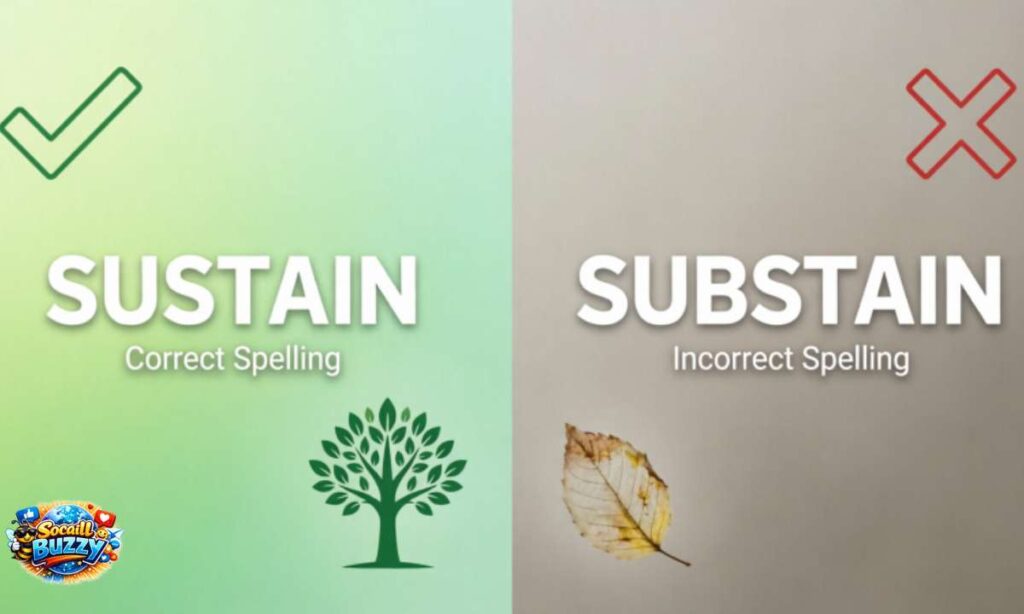
| Feature | Sustain | Substain |
| Real English word? | ✅ Yes | ❌ No |
| Found in dictionaries? | ✅ Yes | ❌ No |
| Grammatical use? | Verb (and occasionally noun) | None |
| Correct in formal writing? | ✅ Always | ❌ Never |
| Correct in informal writing? | ✅ Always | ❌ Never |
| Origin | Latin sustinēre | Spelling error |
| Meaning | Support, maintain, endure, uphold | None |
The verdict couldn’t be clearer. Use “sustain” in every situation. There is no scenario formal, informal, academic, creative where “substain” is appropriate.
“Sustain” in Different Contexts: Real-World Usage
One of the reasons “sustain” is worth understanding deeply is that it’s genuinely versatile. It shows up across many fields, and its meaning shifts slightly depending on context.
Sustain in Everyday Speech
In daily conversation, “sustain” most often means to keep something going or to support something physically or emotionally.
- The energy drink barely sustained her through the afternoon shift.
- It’s hard to sustain a friendship when you live in different cities.
- His faith sustained him during the most difficult period of his life.
- They couldn’t sustain the pace after the first ten miles.
Sustain in Academic and Professional Writing
In formal writing, “sustain” carries weight. It conveys deliberate, ongoing effort a quality that casual words like “keep” or “hold” don’t always capture.
- The organization must develop a strategy to sustain long-term growth.
- This model is difficult to sustain without substantial funding.
- Research findings were not sufficient to sustain the initial hypothesis.
- The project was well-designed but failed to sustain stakeholder engagement.
Sustain in Legal Language
In courtrooms and legal documents, “sustain” has a very specific meaning: a judge sustains an objection when they rule that the objection is valid. This is perhaps the most specialized use of the word, and it’s one most people recognize from legal TV dramas.
- “Objection, leading the witness.” “Sustained.”
- The court sustained the appeal on procedural grounds.
- Her argument was sustained by the evidence presented.
Sustain in Medical Writing
Healthcare professionals use “sustain” frequently, especially in the context of injuries and drug delivery.
- The patient sustained a fractured tibia in the accident.
- Sustained-release medication maintains a steady level of the drug in the bloodstream.
- The athlete sustained a concussion during the second quarter.
Sustain in Music
In music, sustain refers to how long a note continues to sound after being struck or plucked. A piano’s sustain pedal, for example, allows notes to ring out longer. Guitarists often discuss the sustain characteristics of different instruments.
- The Les Paul is prized for its natural sustain.
- Using the sustain pedal creates a wash of overlapping notes.
- He held the final note with impressive sustain.
Sustain in Environmental and Sustainability Contexts
With the rise of environmental awareness, “sustain” has become a cornerstone of discussions around sustainable development, resource management, and climate responsibility.
- We need to find ways to sustain the planet’s biodiversity.
- These farming practices can sustain soil quality over generations.
- The goal is to sustain economic development without environmental degradation.
Sustain vs Abstain: A Confusion Worth Addressing
A significant number of people write “substain” because they’re unconsciously mixing up “sustain” with “abstain.” These are two completely different words, and it’s worth knowing exactly how they differ.
| Word | Meaning | Example |
| Sustain | To support, maintain, or keep something going | She sustained her focus throughout the exam. |
| Abstain | To deliberately refrain from doing something | He chose to abstain from voting. |
Abstain comes from the Latin abstinēre, which means “to hold back” notice it uses abs- (away from) rather than sub- (up from below). The two words are etymologically related through the shared root tenēre (to hold), but their meanings point in opposite directions.
- Sustain = hold something up and keep it going
- Abstain = hold yourself back from doing something
They are never interchangeable. You sustain your energy; you abstain from eating junk food. You sustain a relationship; you abstain from gossip.
Grammatical Forms of “Sustain”
Understanding how “sustain” behaves grammatically helps you use it with confidence in any tense or form.
| Form | Example |
| Base form | sustain “We need to sustain this effort.” |
| Third-person singular | sustains “She sustains the whole team.” |
| Present participle | sustaining “He is sustaining the conversation.” |
| Simple past | sustained “They sustained heavy losses.” |
| Past participle | sustained “The objection was sustained.” |
| Adjective | sustainable “A sustainable approach is needed.” |
| Noun | sustainability “We must focus on sustainability.” |
Key related vocabulary (LSI keywords) worth knowing:
- sustainable capable of being sustained
- sustainability the quality of being sustainable
- sustenance food, nourishment, or support that sustains life
- sustained continued over a period without interruption
- sustaining currently maintaining or supporting something
Common Mistakes to Avoid When Using “Sustain”
Now that the sustain vs substain debate is settled, here are additional mistakes writers make with the word “sustain” itself.
Mistake 1: Using “substain” at all
Wrong: The company struggled to substain its market share. Right: The company struggled to sustain its market share.
Mistake 2: Confusing “sustain” with “abstain”
Wrong: The athlete decided to sustain from training for a week. Right: The athlete decided to abstain from training for a week.
Mistake 3: Using “sustain” when you mean “maintain”
These words overlap significantly, but “maintain” is often better when talking about keeping something in its current state, while “sustain” implies active effort to prevent deterioration.
- Maintain the temperature at 20°C. (keep it steady)
- Sustain the team’s morale during a difficult quarter. (active support over time)
Mistake 4: Misusing the legal form
Wrong: The lawyer sustained that the contract was invalid. Right: The lawyer argued that the contract was invalid. The judge sustained the objection. Only judges sustain objections in legal settings it’s not something a lawyer does to an argument.
Mistake 5: Forgetting “sustained” as an adjective
“Sustained” works powerfully as an adjective and is often underused.
- A sustained effort is required.
- The city faced a sustained period of economic decline.
- Her sustained focus was remarkable.
Quick Reference: Synonyms for “Sustain” by Context
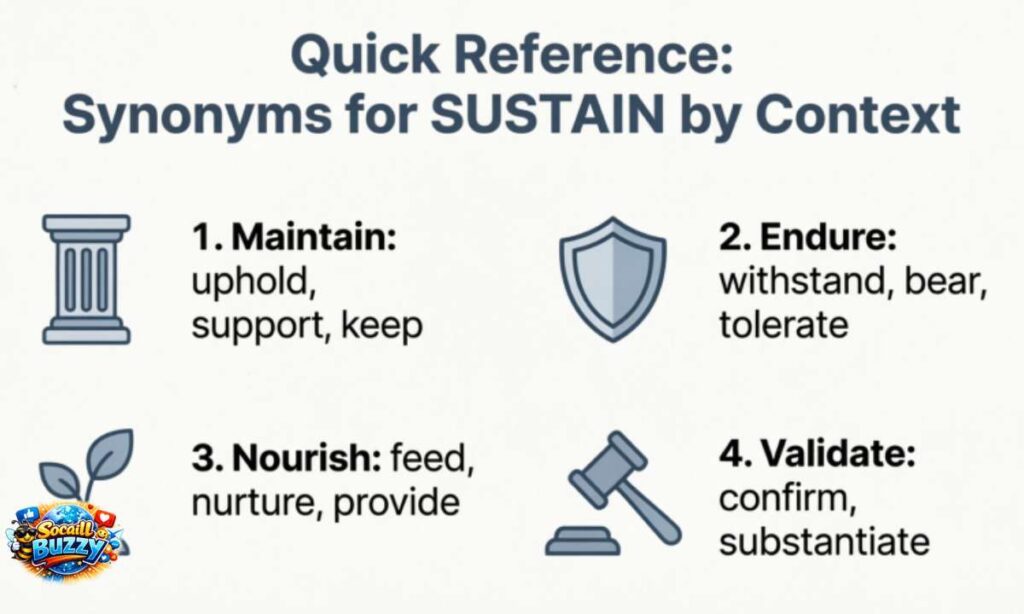
Using the right synonym for “sustain” in different contexts improves your writing clarity.
| Context | Better synonyms to consider |
| Maintaining something | maintain, uphold, preserve, continue |
| Providing support | support, nourish, bolster, reinforce |
| Enduring hardship | endure, withstand, bear, weather |
| Legal validation | uphold, validate, affirm, confirm |
| Musical note length | prolong, extend, hold |
| Emotional resilience | fortify, strengthen, buoy |
None of these synonyms can be replaced with “substain” because “substain” doesn’t mean anything at all.
How to Remember the Correct Spelling Forever
Here are three quick memory anchors:
- No “b” rule: Sustain has no “b.” Say it out loud “suh-STANE.” There’s no “b” sound anywhere. Don’t add what you can’t hear.
- Think of “sustenance”: Sustenance comes from the same Latin root and means food or nourishment. Both words share the “sust-” start. If you know how to spell sustenance, you know how to spell sustain.
- Sub- doesn’t belong here: The “sub-” prefix means “under” and appears in words like submarine and subtract. But “sustain” doesn’t use “sub-” in its visible form the Latin prefix assimilated centuries ago. There’s no sub- in sustain.
Frequently Asked Questions (FAQs)
Is “substain” ever correct in English?
No. “Substain” is not a recognized word in any English dictionary and is always incorrect.
What is the correct word sustain or substain?
Always “sustain.” It is the only valid form.
Why do people write “substain” instead of “sustain”?
Mainly because of the familiar “sub-” prefix in English and phonetic confusion with words like “abstain.”
What does “sustain” mean in simple terms?
It means to support or keep something going over time like sustaining effort, life, or a musical note.
What is the difference between sustain and abstain?
“Sustain” means to maintain or support something; “abstain” means to deliberately refrain from doing something.
Can “sustain” be used as a noun?
Yes, in musical contexts “sustain” functions as a noun, referring to how long a note rings after being played.
What does “objection sustained” mean in court?
It means the judge agrees with the objection and the question or evidence is disallowed.
What are good synonyms for “sustain”?
Depending on context: maintain, uphold, support, endure, nourish, or prolong.
Is “sustainable” related to “sustain”?
Yes “sustainable” comes directly from “sustain” and means capable of being maintained over time.
Can you sustain an injury?
Yes. “Sustaining an injury” is a standard phrase meaning to suffer or experience an injury.
Conclusion
The question of sustain vs substain has one clean, permanent answer: only “sustain” exists. It is a word with eight centuries of documented use, a clear Latin origin, and a rich presence across law, medicine, music, environmental science, and everyday conversation. “Substain,” by contrast, has no history, no meaning, and no place in any piece of writing you produce.
The mistake happens for understandable reasons: a familiar-sounding prefix, fast typing, phonetic similarity to “abstain” but now that you understand exactly where the confusion comes from, it should be easy to catch and correct going forward.
Every time you write “sustain” correctly, you’re using a word that has been doing real linguistic work since the 1200s. That’s a word worth knowing well. Use it with confidence, spell it correctly, and your writing will be clearer, more professional, and more credible for it.

Welcome to SocaillBuzzy! I’m the creator and writer behind this platform, dedicated to sharing meaningful content including grammar, meaning, quotes, and inspirational messages for everyday life. Through well-crafted, SEO-friendly content, I aim to spread positivity, strengthen connections, and make it easier for readers to express their emotions with clarity and warmth.