
Have you ever typed “Please respond to my email” and felt something was slightly off but couldn’t quite put your finger on it? You’re not alone. The words respond vs. response trip up millions of English writers every day, from students writing assignments to professionals drafting client emails.
They look similar. They mean related things. And yet, they are grammatically worlds apart.
Here’s the core truth: respond is a verb it names the action of replying. Response is a noun it names the result of that action. Use one where the other belongs, and your sentence falls apart, often without you even realizing it.
This guide breaks down the full difference between respond vs. response. You’ll find clear definitions, grammar rules, comparison tables, real-world examples across business and everyday writing, common mistakes to avoid, and simple mental tests to pick the right word every single time.
Whether you’re preparing for an exam, polishing a professional email, or simply wanting to write with more confidence, this is the only grammar guide on this topic you’ll ever need.
What Does “Respond” Mean? (Definition + Grammar Role)
Respond is a verb. It describes the act of replying, reacting, or answering whether to a question, a situation, a message, or an event.
Key Grammar Facts About “Respond”
- Part of speech: Verb
- Root origin: Latin respondere “to answer back”
- It shows action something a subject does
- It can be conjugated across all tenses
- It is typically followed by the preposition “to”
How “Respond” Changes Across Tenses
| Tense | Form | Example |
| Base (infinitive) | respond | Please respond to the email. |
| Present (1st/2nd/plural) | respond | I respond quickly to messages. |
| Present (3rd person singular) | responds | She responds promptly. |
| Past simple | responded | He responded within the hour. |
| Present continuous | responding | They are responding to the complaint. |
| Future | will respond | I will respond tomorrow morning. |
| Present perfect | have/has responded | She has responded to all queries. |
Example Sentences Using “Respond”
- The manager will respond to your inquiry by end of day.
- How did the team respond when they heard the news?
- It is important to respond calmly during a crisis.
- The patient responded well to the new treatment.
- They did not respond to multiple attempts at contact.
Notice that in every example above, respond is doing the work of showing action someone or something is doing the replying.
What Does “Response” Mean? (Definition + Grammar Role)
Response is a noun. It refers to the actual answer, reaction, or reply the thing produced by the act of responding.
Key Grammar Facts About “Response”
- Part of speech: Noun
- Root origin: Same Latin root respondere
- It names a thing the result of the action
- It can be preceded by articles: a response, the response, my response
- It can be pluralized: responses
- It can be modified by adjectives: quick response, positive response, detailed response
Common Collocations With “Response”
| Collocation | Example |
| a quick response | We appreciate your quick response. |
| in response to | In response to your question, here is our update. |
| positive response | The campaign received a positive response. |
| emergency response | The emergency response team arrived immediately. |
| no response | There was no response from the department. |
| response rate | The survey had a 70% response rate. |
| awaiting a response | I am still awaiting a response from HR. |
Example Sentences Using “Response”
- Her response was thoughtful and well-articulated.
- The company issued an official response to the allegations.
- We received an overwhelming response to the job posting.
- In response to growing demand, the store extended its hours.
- A single-word response is not always sufficient.
Here, response works like an object something you can give, receive, await, or read.
Click Here To Read Appreciate It vs Appreciated It
Respond vs. Response: Side-by-Side Comparison
Understanding both words together is the fastest way to lock in the difference. Here is a direct comparison:
| Feature | Respond | Response |
| Part of speech | Verb | Noun |
| Grammar role | Shows action | Names a thing/result |
| Article use | ❌ Never “a respond” | ✅ “a response,” “the response” |
| Plural form | N/A (verb, not pluralized) | responses |
| Tense changes? | ✅ Yes (responded, responding) | ❌ No tense changes |
| Follows “to” (preposition)? | ✅ respond to something | ✅ in response to something |
| Can be modified by adjective? | ❌ Not directly | ✅ “quick response,” “detailed response” |
| Correct usage example | Please respond by Friday. | I’m waiting for your response. |
| Incorrect usage example | ❌ Please response by Friday. | ❌ I’m waiting for your respond. |
4 Quick Tests to Pick the Right Word Every Time Respond vs. Response
When you’re unsure which word to use, run through one of these four tests. They work in under five seconds.
Test 1: The Article Test Respond vs. Response
Try putting “a” or “the” in front of the word.
- “a response” → ✅ Makes sense → Use response (noun)
- “a respond” → ❌ Doesn’t make sense → Use respond (verb)
Test 2: The Auxiliary Verb Test Respond vs. Response
Try pairing the word with do, does, did, will, should, can.
- “Does she respond?” → ✅ Makes sense → Use respond
- “Does she response?” → ❌ Broken sentence → Use respond
Test 3: The Tense Test Respond vs. Response
Try adding -ed or -ing to make a past or ongoing form.
- “responded” / “responding” → ✅ Works → Use respond
- “responsed” / “responsing” → ❌ Not a word → Use response (noun doesn’t conjugate)
Test 4: The Substitution Test Respond vs. Response
Replace the word with “answer” or “reply” both of which can function as either noun or verb.
- “Please reply soon.” → ✅ Same role as “respond” → Use respond
- “I liked your answer.” → ✅ Same role as “response” → Use response
Common Mistakes People Make Respond vs. Response (And How to Fix Them)
These errors appear in emails, reports, text messages, and social media every day. Recognizing them is the first step to avoiding them.
Mistake 1: Using “Response” as a Verb
❌ Wrong: “Please response to my message.” ✅ Right: “Please respond to my message.”
Why it’s wrong: Response is a noun. It cannot carry the action of a sentence on its own.
Mistake 2: Using “Respond” as a Noun
❌ Wrong: “I’m waiting for your respond.” ✅ Right: “I’m waiting for your response.”
Why it’s wrong: Respond is a verb. It cannot be used as the object of a preposition like “your.”
Mistake 3: Using “Respond” After an Article
❌ Wrong: “I gave a respond to his email.” ✅ Right: “I gave a response to his email.”
Why it’s wrong: Articles (a, an, the) must be followed by nouns. Respond is a verb never a noun.
Mistake 4: Treating “Responds” as a Noun Plural
❌ Wrong: “I need multiple responds from the team.” ✅ Right: “I need multiple responses from the team.”
Why it’s wrong: Responds is the third-person singular present tense form of the verb. It is not a plural noun. Responses is the correct plural.
Mistake 5: Omitting “to” After “Respond”
❌ Wrong: “She did not respond my question.” ✅ Right: “She did not respond to my question.”
Why it’s wrong: The verb respond typically requires the preposition to before its object. Without it, the sentence is grammatically incomplete.
Mistake 6: Writing “Response” as a Verb in Formal Emails
This is one of the most common professional writing errors:
❌ Wrong: “Kindly response at your earliest convenience.” ✅ Right: “Kindly respond at your earliest convenience.”
Getting this wrong in a business email immediately signals weak grammar skills and can undermine your professional credibility.
Real-World Examples: How Respond vs. Response Work in Context
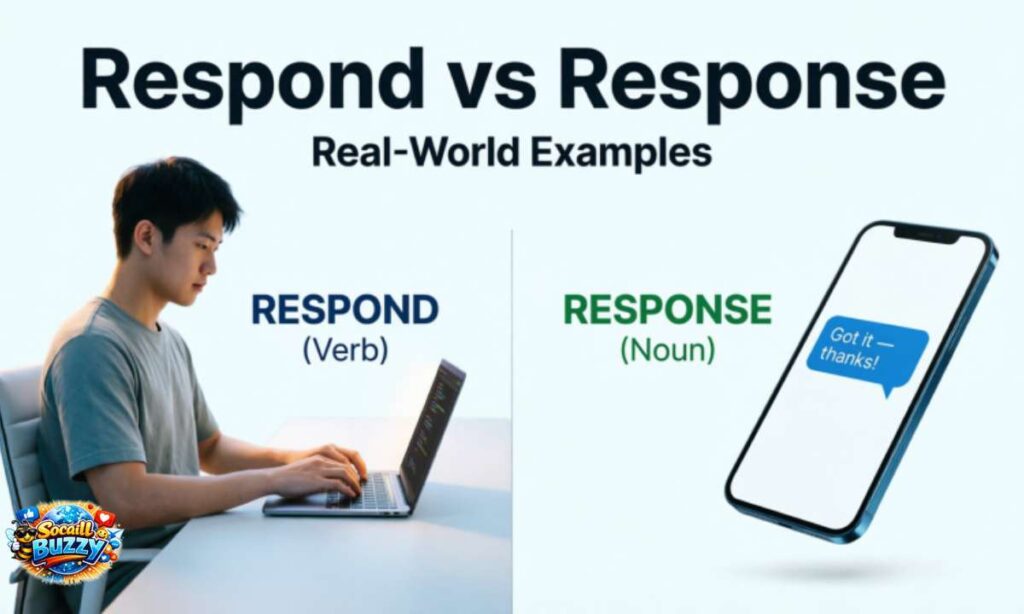
Understanding grammar rules is one thing. Seeing those rules in action across real scenarios makes them stick.
In Business and Professional Email
| Situation | Correct Sentence |
| Asking someone to reply | Please respond to this email by Thursday. |
| Acknowledging a reply received | Thank you for your response. |
| Describing reply speed | The client responded within minutes. |
| Formal letter writing | In response to your inquiry, we are pleased to inform you… |
| Following up | I am yet to receive a response regarding my application. |
In Customer Service and Business Communication Respond vs. Response
Customer service teams live by these words daily. Mixing them up in public-facing communication damages brand image:
- “Our team will respond to your complaint within 24 hours.” ✅
- “We value your response to our recent survey.” ✅
- “Please respond to the verification email before logging in.” ✅
- “The brand’s response to the crisis was swift and transparent.” ✅
In Academic and Formal Writing Respond vs. Response
In essays, research papers, and academic writing, precise language is essential:
- “Participants were asked to respond to a series of statements.” ✅
- “The government’s response to the public health emergency was analyzed.” ✅
- “Several themes emerged in response to the interview questions.” ✅
- “Students were required to respond in writing within the allotted time.” ✅
In Medical and Scientific Contexts Respond vs. Response
In medicine and science, both words appear frequently and the distinction matters clinically:
- “The patient did not respond to the initial round of antibiotics.” ✅
- “A positive response to the treatment was observed within 48 hours.” ✅
- “The immune system responds by producing antibodies.” ✅
- “Researchers measured the body’s response to the new compound.” ✅
Here, respond describes what the body does; response is the measurable outcome of that action.
In Everyday Conversation and Text Messages Respond vs. Response
Even in casual communication, the difference holds:
- “Did he respond to your text?” ✅
- “Her response was hilarious.” ✅
- “I don’t know how to respond to that.” ✅
- “Still waiting on a response from them.” ✅
“Respond” vs. “Response” vs. “Reply” vs. “Answer” What’s the Difference?
People often use these four words interchangeably. They are close in meaning but carry distinct nuances worth knowing.
| Word | Part of Speech | Nuance | Best Used When… |
| Respond | Verb only | Formal, broad includes words, actions, emotions | Reacting to a question, situation, or stimulus |
| Response | Noun only | Formal, broad the result of responding | Referring to the reply as a thing |
| Reply | Verb & Noun | More conversational, usually about communication | Answering a message, email, or statement |
| Answer | Verb & Noun | Specific usually to a direct question | Providing a solution or correct information |
Key insight: All replies and answers are responses, but not all responses are replies or answers. A physical reaction a smile, a nod, a bodily reaction to medication is a response, not a reply or answer.
“Response” as a Noun: All the Ways It Can Function in a Sentence
Because response is a noun, it can occupy several grammatical positions:
As the Subject of a Sentence
“Her response surprised everyone in the room.”
As the Object of a Verb
“We received a detailed response from the committee.”
As the Object of a Preposition
“He acted in response to the escalating tension.”
As a Modified Noun (with adjective)
“The company issued a formal, well-prepared response.”
As Part of a Compound Noun
“The city improved its emergency response system after the floods.”
“Respond” as a Verb: All the Forms and Structures
Because respond is a verb, it follows standard English verb patterns:
Intransitive Use (no direct object)
“She did not respond.” ✅
With Preposition “To”
“Please respond to the notification.” ✅
With Adverb
“He responded angrily.” ✅
In Passive Voice
“The complaint was responded to within hours.” ✅ (though this structure is awkward and often rephrased)
In Modal Constructions
“You should respond before the deadline.” ✅ “We must respond carefully to this situation.” ✅
British English vs. American English: Is There Any Difference Respond vs. Response?
No. Both respond and response are spelled and used identically in British and American English. There are no regional variations in spelling, pronunciation, or grammar rules.
The only minor difference is in frequency of use in writing style:
- American business writing tends to favor shorter, more direct constructions using respond.
- British formal writing may slightly favor noun-heavy constructions using response.
But grammatically, the rules are identical worldwide.
Pronunciation Guide Respond vs. Response
Getting pronunciation right adds to overall communication clarity:
| Word | Phonetic | Stress | Sounds Like |
| Respond | /rɪˈspɒnd/ | Second syllable | reh-SPOND |
| Response | /rɪˈspɒns/ | Second syllable | reh-SPONS |
| Responds | /rɪˈspɒndz/ | Second syllable | reh-SPONDZ |
| Responded | /rɪˈspɒndɪd/ | Second syllable | reh-SPON-did |
| Responses | /rɪˈspɒnsɪz/ | Second syllable | reh-SPON-siz |
Both words stress the second syllable. Respond ends with a hard “d” sound; response ends with a soft “s” sound.
LSI Keywords & Related Grammar Concepts to Know Respond vs. Response
Understanding response vs. response connects to broader grammar literacy. Here are related concepts worth exploring:
- Verb vs. noun distinction the grammatical foundation of this difference
- Parts of speech verb, noun, adjective, adverb
- Word forms (morphology) how one root produces multiple word classes
- Collocations which adjectives, prepositions, and verbs pair naturally with each word
- Register (formal vs. informal) when each word is more appropriate
- Subject-verb agreement relevant to correct use of responds vs. respond
- Transitive vs. intransitive verbs understanding why “respond” needs “to”
- Nominalizations turning verb forms into nouns (respond → response)
Advanced Usage: When “Response” Appears in Compound Nouns
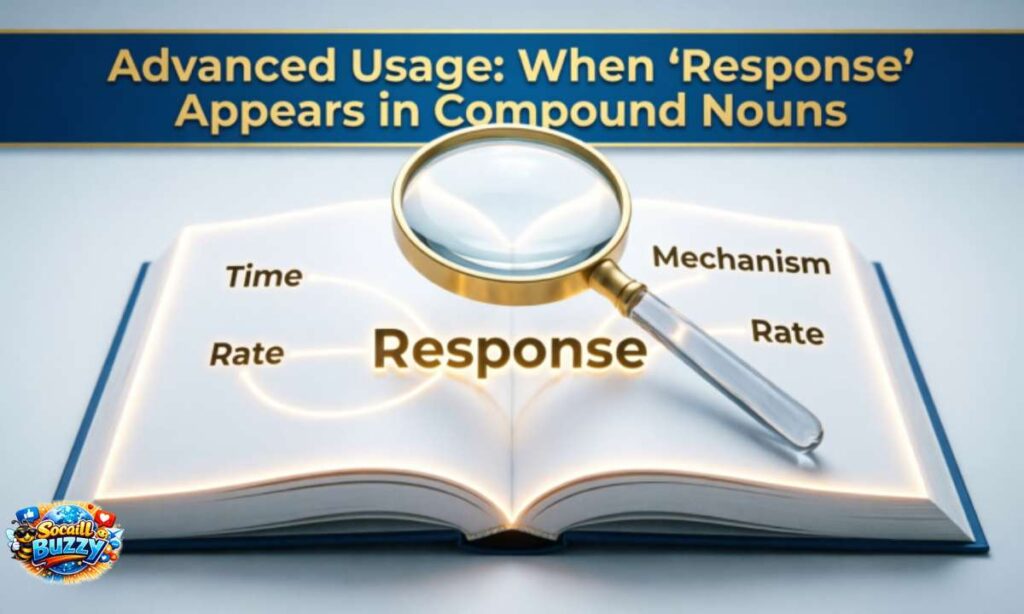
Response appears in many widely-used compound nouns and phrases in English:
| Compound/Phrase | Meaning |
| Emergency response | Organized reaction to a crisis or disaster |
| Response time | How long it takes to reply or react |
| Response rate | Percentage of people who respond to a survey or campaign |
| Immune response | The body’s biological reaction to pathogens |
| Fight-or-flight response | Physiological reaction to perceived threat |
| Frequency response | Audio/engineering term for output vs. input signals |
| Call and response | A musical or rhetorical pattern of dialogue |
These compound forms always use response never respond because the noun form is required in compound constructions.
Summary: The Golden Rules of Respond vs. Response
Before you write, ask yourself one question: Am I talking about an action or a thing?
If it’s an action → use respond If it’s a thing (result, outcome, answer) → use response
Here’s the master cheat sheet:
| Situation | Use This Word | Example |
| Asking someone to reply | respond | Please respond by Monday. |
| Referring to a received reply | response | I received your response. |
| After articles (a, the, my, your) | response | Her response was helpful. |
| After modal verbs (should, will, must) | respond | You should respond quickly. |
| In compound phrases | response | Emergency response, response rate |
| Describing an action with tense | respond | He responded immediately. |
| As the subject of a sentence | response | The response was unexpected. |
Frequently Asked Questions (FAQs)
Q: Is it “please respond” or “please response”?
“Please respond” is correct respond is the verb here; response cannot be used as a command.
Q: Can “response” and “respond” be used interchangeably?
No. One is a noun and the other is a verb they occupy different grammatical roles and cannot swap positions.
Q: What is the plural of “response”?
The plural of response is responses. There is no noun plural form of respond.
Q: Is “awaiting your respond” correct?
No. The correct phrase is “awaiting your response” a noun is needed after the possessive “your.”
Q: Why do people confuse respond and response?
Both words share the same Latin root (respondere) and relate to answering, making them easy to mix up especially for non-native English speakers or those unfamiliar with noun/verb distinctions.
Q: Is “in respond to” correct?
No. The correct prepositional phrase is “in response to” a noun is required after the preposition “in.”
Q: Is “respond” formal or informal?
Respond works in both formal and informal writing. It is widely used in professional emails, academic writing, and everyday conversation alike.
Q: What’s the difference between “respond” and “reply”?
Both are verbs, but respond is broader (covers actions, reactions, and verbal answers) while reply is more specific to verbal or written communication.
Q: Can I say “give a respond”?
No. The correct phrase is “give a response” respond cannot follow an article like “a.”
Q: Is there a British vs. American spelling difference?
No. Both words are spelled and used identically in British and American English.
Conclusion: Respond vs. Response
The difference between Respond vs. Response comes down to a single, memorable rule: respond is what you do; response is what you give.
One shows action. The other names the result of that action. Together, they form a complete picture of communication but they cannot replace each other without breaking the grammar of your sentence.
The next time you’re writing an email and reach for either word, pause for just a moment. Ask yourself: “Am I describing the act of replying, or the reply itself?” That one question will guide you to the right word, every time.
Strong, precise writing builds trust in professional settings, academic work, and everyday communication. Getting small distinctions like this right signals that you think carefully about language, and that kind of attention always shows.
Now that you understand the full story behind respond vs. response, go ahead respond with confidence, and let every response you craft reflect the clarity you’ve built.

Welcome to SocaillBuzzy! I’m the creator and writer behind this platform, dedicated to sharing meaningful content including grammar, meaning, quotes, and inspirational messages for everyday life. Through well-crafted, SEO-friendly content, I aim to spread positivity, strengthen connections, and make it easier for readers to express their emotions with clarity and warmth.