
Have you ever typed the word “smoothe” and paused, wondering if that extra “e” belongs there? You are not alone. This is one of those small spelling questions that trips up even confident writers. The confusion is real, and it happens more often than you think.
Here is the short answer: smooth is always correct. Smoothe is not a recognized word in any modern dictionary. But knowing the rule is only half the battle. Understanding why the confusion exists and how to use “smooth” correctly in every situation is what this guide is here for.
By the end of this article, you will know exactly when and how to use smooth, why smoothe keeps appearing online, how smooth works as both an adjective and a verb, and how it compares to similar words. Let’s get into it.
What Does “Smooth” Mean?
The word smooth is one of those versatile English words that does more than one job. It works as an adjective, a verb, and even an adverb in some contexts.
Smooth as an Adjective
As an adjective, smooth describes something that is even, flat, and free from roughness, bumps, or irregularities. It can describe physical textures, sounds, movements, personalities, and processes.
Examples of smooth as an adjective:
- 🟢 The baby’s skin was perfectly smooth.
- 🟢 We enjoyed a smooth flight from London to New York.
- 🟢 The jazz singer had a deep, smooth voice.
- 🟢 The transition between departments was surprisingly smooth.
- 🟢 She ran her fingers along the smooth marble countertop.
Notice how “smooth” here is describing a noun. That is its classic adjective role.
Smooth as a Verb
As a verb, smooth means to make something flat, even, or free of difficulty. It is a transitive verb, meaning it takes an object.
Examples of smooth as a verb:
- 🟢 She smoothed the wrinkles out of her dress before the interview.
- 🟢 He used sandpaper to smooth the rough edges of the wood.
- 🟢 The manager worked hard to smooth over the conflict between team members.
- 🟢 She smoothed her hair before walking into the meeting.
- 🟢 The new policy helped smooth the hiring process considerably.
Grammar tip: When using smooth as a verb, it behaves like a regular verb. Just add -ed, -ing, or -s depending on the tense. No extra “e” is needed.
What Is “Smoothe”? Is It a Real Word?
Here is the truth: smoothe is not a recognized word in modern standard English.
It does not appear in Merriam-Webster, the Oxford English Dictionary, Cambridge Dictionary, or any major grammar authority. If your spell-checker flags it, that is a sign it is wrong. If you see it on a website, it is likely a typo, a branding choice, or a stylistic error.
Where Did “Smoothe” Come From?
Interestingly, “smoothe” was occasionally seen in older English texts, particularly between the 1500s and 1700s. As English spelling became more standardized during the 18th century, the word simply faded out and was never recognized as the correct form.
Today, it pops up in a few places:
- 🔴 Branding and product names (where unusual spelling is a creative choice, not grammar)
- 🔴 Typos in blogs, social media, and casual writing
- 🔴 Non-native English learners applying spelling patterns from other words
None of these make “smoothe” grammatically correct. It remains a misspelling in every professional and academic context.
Smooth vs Smoothe: Side-by-Side Comparison
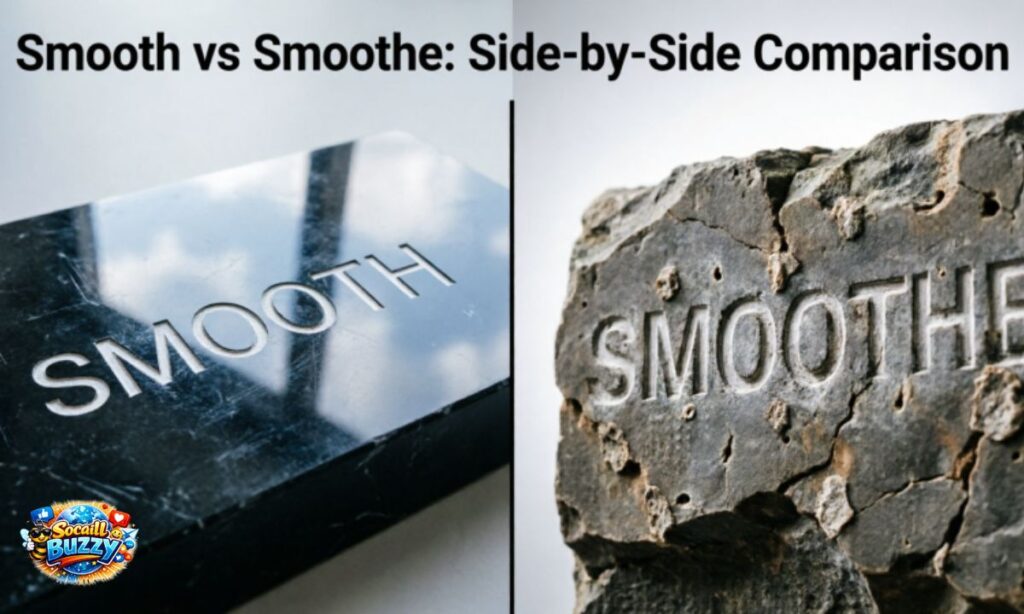
| Feature | Smooth | Smoothe |
| Correct spelling | ✅ Yes | ❌ No |
| Dictionary recognized | ✅ Yes (all major dictionaries) | ❌ No |
| Used as adjective | ✅ Yes | ❌ No |
| Used as verb | ✅ Yes | ❌ No |
| Appears in professional writing | ✅ Yes | ❌ No |
| Historical usage | ✅ Modern standard form | ⚠️ Archaic, pre-18th century only |
| Grammatical status | ✅ Accepted | ❌ Misspelling |
The verdict: Always use smooth. In every context, every sentence, and every tense, smooth is the word you want.
Why Do People Write “Smoothe” Anyway?
This is a fair question. If smoothe is wrong, why does it keep appearing?
The answer comes down to spelling patterns in English. English has plenty of words where adding an “e” to the end changes how the verb sounds or works. Think about:
- Breathe (from breath)
- Bathe (from bath)
- Loathe (from loath)
These words add an “e” to signal a voiced “th” sound, which is the soft, buzzing sound you make in words like “the” or “there.”
Here is where the confusion happens: smooth already has a voiced “th” sound. You can hear it when you say the word out loud. The “th” in “smooth” is already soft, just like in “breathe.” So adding an “e” does not change the pronunciation and does not follow any grammatical purpose.
In other words, people add an “e” because they think it is needed to signal the sound, but it is not. Smooth already sounds exactly right without it.
Click Here To Read Brief vs Debrief
Verb Conjugations of “Smooth” (Quick Reference)
Since smooth works as a regular verb, conjugating it is simple. Here is a complete reference chart:
| Tense | Form | Example |
| Present (base) | smooth | I smooth the fabric every morning. |
| Present (3rd person) | smooths | She smooths her hair before meetings. |
| Present continuous | smoothing | He is smoothing out the rough patch. |
| Past tense | smoothed | They smoothed the surface yesterday. |
| Past participle | smoothed | The wood had been smoothed carefully. |
| Future | will smooth | We will smooth out any issues. |
| Infinitive | to smooth | She wants to smooth the relationship. |
Key rule: Notice that none of these forms ever use “smoothe.” Not even the -ing form becomes “smootheing.” It is simply smoothing.
Common Phrases and Idioms Using “Smooth”
The word smooth appears in many everyday expressions. Knowing these will help you write more naturally and confidently.
“Smooth over”
This phrase means to make a tense or difficult situation seem less serious or to resolve a conflict diplomatically.
- 🟢 The CEO tried to smooth over the controversy during the press conference.
- 🟢 She called her friend to smooth over the misunderstanding.
“Smooth out”
This means to remove problems, difficulties, or rough patches from a process or relationship.
- 🟢 The new software update helped smooth out the login issues.
- 🟢 We need to smooth out the onboarding process for new employees.
“Smooth sailing”
This idiom means that something is progressing without any problems or difficulties.
- 🟢 Once the contract was signed, it was smooth sailing from there.
“Smooth operator”
This informal phrase describes someone who is effortlessly charming, stylish, or skilled at handling social situations.
- 🟢 With his calm tone and quick thinking, Marcus was a real smooth operator in negotiations.
“Smooth talker”
Someone who speaks in a persuasive, charming, or flattering way, sometimes with hidden motives.
- 🟢 Be careful around him. He is a classic smooth talker.
Smooth vs Similar Words: What Is the Difference?
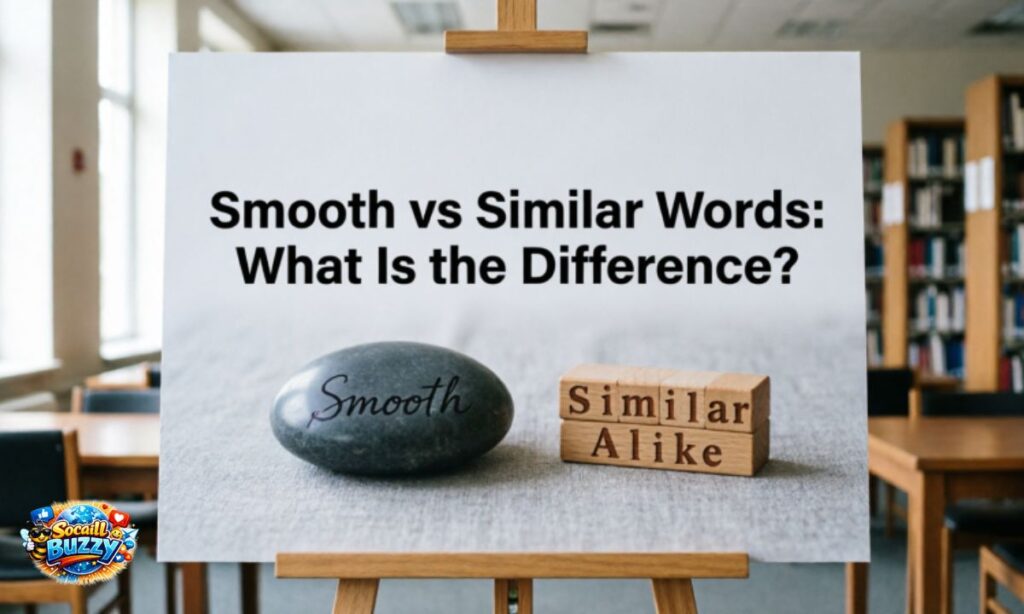
Smooth is often confused or compared with other words that carry a similar meaning. Here is how they differ:
| Word | Primary Meaning | Best Used When… |
| Smooth | Even, without bumps; to make level | Describing texture, ease, or flow |
| Sleek | Glossy, stylish, visually polished | Emphasizing appearance and design |
| Silky | Soft and flowing, like silk | Describing fabrics, hair, or liquids |
| Even | Flat, uniform, consistent | Talking about surfaces or distributions |
| Polished | Refined, practiced, shiny | Describing skills, speech, or materials |
| Velvety | Smooth and soft like velvet | Describing textures, tones, or flavors |
| Smoothen | To make smooth (rare, informal) | Acceptable but awkward; prefer “smooth” |
A Note on “Smoothen”
You may also come across smoothen, which is technically a real word in some modern dictionaries. It means the same thing as the verb “smooth.” However, most grammar experts and style guides consider it unnecessary and slightly awkward. When you can just say “smooth,” there is no good reason to say “smoothen.”
Real-World Sentence Examples: Smooth in Action
Let’s see smooth used correctly across a variety of real-life contexts:
In skincare and beauty writing:
- 🟢 Apply the serum evenly to achieve smooth, hydrated skin.
- 🟢 This moisturizer will smooth fine lines over time with consistent use.
In woodworking and crafts:
- 🟢 Use a fine-grit sandpaper to smooth the surface before applying any stain.
- 🟢 The carpenter created a smooth finish that looked almost like glass.
In business and professional writing:
- 🟢 The new onboarding program was designed to ensure a smooth transition for all new hires.
- 🟢 The project manager worked hard to smooth over tensions between the two departments.
In cooking and food writing:
- 🟢 Blend until the mixture reaches a completely smooth consistency.
- 🟢 Use a spatula to smooth the frosting across the top of the cake.
In technology and UX writing:
- 🟢 The latest update delivers a smoother user experience across all devices.
- 🟢 Our platform was built to ensure smooth data transfers with no lag.
In travel and lifestyle writing:
- 🟢 We had an incredibly smooth drive across the coastal highway.
- 🟢 The airline’s boarding process was refreshingly smooth and efficient.
Common Mistakes to Avoid
Here are the most frequent errors people make with this word and how to correct them:
❌ Mistake 1: Writing “smoothe” as a verb
Wrong: I need to smoothe the table before painting it. ✅ Right: I need to smooth the table before painting it.
❌ Mistake 2: Writing “smoothe” as an adjective
Wrong: Her skin felt smoothe and soft. ✅ Right: Her skin felt smooth and soft.
❌ Mistake 3: Writing “smootheing” in continuous tense
Wrong: He was smootheing out the edges. ✅ Right: He was smoothing out the edges.
❌ Mistake 4: Using “smoothen” in formal writing
Awkward: She smoothened the surface carefully. ✅ Better: She smoothed the surface carefully.
❌ Mistake 5: Confusing “smooth” with “sleek”
These two are not interchangeable. Smooth describes texture or ease. Sleek describes visual elegance and design. 🟢 The phone has a smooth back panel. (texture) 🟢 The phone has a sleek design. (visual appearance)
Memory Trick: How to Always Remember the Correct Spelling
Need a quick way to lock this in your memory?
“Smoothe” has an extra E. So does ERROR. That extra E is always an error.
Another way to remember it: Think of how you say the word out loud. “Smooth” already sounds complete and correct. It does not need an extra letter. If it sounds right without the “e,” write it without the “e.”
Quick-Reference Summary Table
| Question | Answer |
| Is “smoothe” a real word? | No. It is not recognized in modern English. |
| Is “smooth” an adjective? | Yes. It describes texture, feel, and ease. |
| Is “smooth” a verb? | Yes. It means to make something even or flat. |
| What is the past tense of smooth? | Smoothed |
| What is the -ing form? | Smoothing |
| Is “smoothen” correct? | Technically yes, but uncommon and awkward. |
| What does “smooth over” mean? | To reduce tension or resolve a conflict. |
| Can “smooth” be an adverb? | Rarely. “Smoothly” is the adverb form. |
Conclusion
The smooth vs smoothe question has a clean, simple answer: smooth wins every time. It works as an adjective, a verb, and even in common idioms. It is recognized by every dictionary. It fits in professional writing, casual conversation, creative content, and technical copy.
Smoothe, on the other hand, is a spelling error. It may feel right because of how English patterns work with similar words, but no grammar rule supports it and no dictionary recognizes it. The moment you see it in your writing, treat it as a typo and fix it.
Good writing is clear writing. Choosing the right word and spelling it correctly builds trust with your reader. Stick with smooth, and your writing will always feel polished, professional, and precise
Frequently Asked Questions (FAQs)
Q: Is “smoothe” ever acceptable in English writing?
No. It is not recognized by any major dictionary and is treated as a misspelling in all professional contexts.
Q: Can smooth be used as both an adjective and a verb?
Yes. Smooth works as an adjective (smooth surface) and a verb (to smooth the edges) in standard English.
Q: What is the correct past tense of smooth?
The past tense is “smoothed,” not “smoothed” with any extra letters.
Q: Is “smoothen” correct?
It appears in some dictionaries but is considered unnecessary and awkward. Use “smooth” instead.
Q: What is the adverb form of smooth?
The adverb form is “smoothly,” as in “The process ran smoothly.”
Q: Why do some brands use “smoothe” in their name?
Brand names often use creative or intentional misspellings for uniqueness. That is a marketing choice, not a grammar endorsement.
Q: What does “smooth over” mean?
It means to reduce tension or make a difficult situation less serious.
Q: What is the difference between smooth and sleek?
Smooth describes texture or ease of process. Sleek describes visual elegance or stylish design.
Q: Can I use “smoothe” in historical writing?
Only if you are quoting from pre-18th century texts. In all other writing, avoid it.
Q: How do I remember the correct spelling?
Remember: “Smoothe” has an extra E. So does ERROR. That extra E is always a mistake.

Welcome to SocaillBuzzy! I’m the creator and writer behind this platform, dedicated to sharing meaningful content including grammar, meaning, quotes, and inspirational messages for everyday life. Through well-crafted, SEO-friendly content, I aim to spread positivity, strengthen connections, and make it easier for readers to express their emotions with clarity and warmth.