
Have you ever typed a sentence and paused, fingers hovering, wondering if it’s “says” or “sais”? You’re not alone.
This is one of those English spelling confusions that trips up learners and native speakers alike, mostly because the word sounds nothing like it looks. By the end of this guide, you’ll know exactly which form is correct, why the other doesn’t exist in standard English, and how to use it confidently every single time.
What Does “Says” Mean
Says is the third-person singular simple present form of the verb say. That might sound technical but it’s actually straightforward. When the subject of your sentence is he, she, it, or any singular noun, it is the word you need.
It covers speech, opinion, instruction, and declaration. Think about how often it appears in everyday American life. The weather app says rain is coming. Your doctor says rest for a week. The recipe says add two cups of flour. It’s everywhere.
Examples of “Says” in Simple Sentences
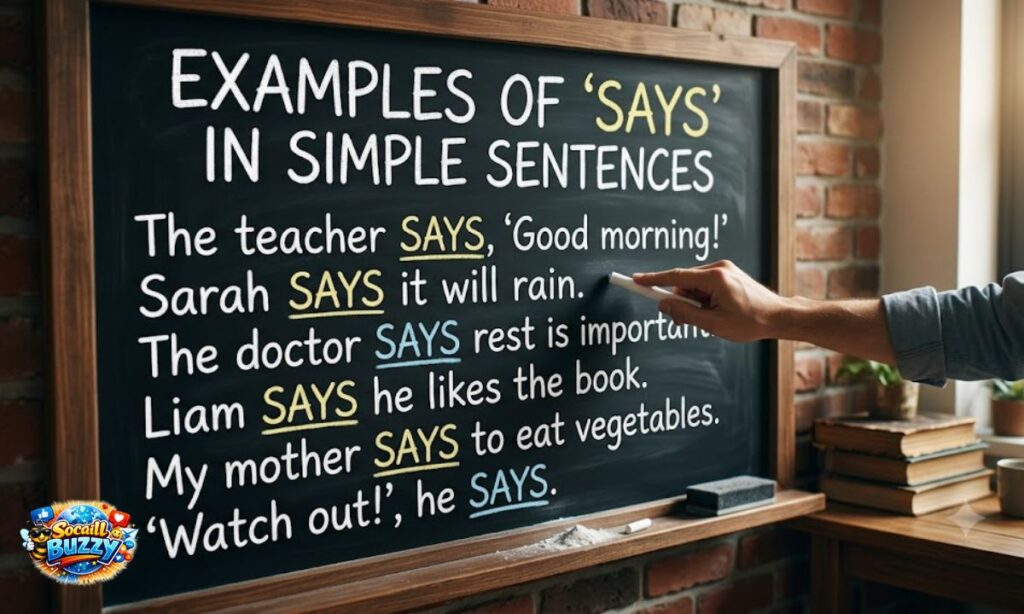
Seeing says in action makes the grammar rule click faster than any explanation. Here are clear examples across different everyday contexts:
| Context | Example Sentence |
| News | The report says inflation is slowing down. |
| Conversation | She says dinner will be ready at seven. |
| Instruction | The label says wash in cold water. |
| Opinion | He says New York pizza beats everything. |
| Technology | The GPS says turn right in 500 feet. |
| Family | My dad says patience is a superpower. |
Notice how every sentence uses a singular subject. That pattern matters and we’ll come back to it shortly.
Click Here To Read Company-Wide or Companywide
Grammar Rule Behind “Says”
The Rule
When your subject is third-person singular, add an “s” to the base verb. Simple as that.
Here’s the full conjugation of the verb say in present tense:
| Subject | Correct Form |
| I | say |
| You | say |
| He, She, It | says |
| We | say |
| They | say |
So “he say” is wrong. “She say” is wrong. The moment your subject is he, she, it, or a singular noun like “the teacher” or “my boss,” the verb becomes says. This is basic subject-verb agreement in action and it applies to hundreds of English verbs, not just say.
What Does “Sais” Mean
Here’s the straight answer: sais is not a standard English word. It has no grammatical function in the English language as a verb.
The only legitimate context where “sais” appears in English is as the plural of “sai,” a traditional Okinawan weapon with three prongs. Sai is the singular and sais is the plural. That’s a niche noun used mostly in martial arts discussions. If you weren’t writing about weapons, you almost certainly meant says.
So if someone searches “is sais a word” or “is sais correct in English,” the honest answer is: not in any grammatical sense that matters for everyday writing.
Why “Sais” Is Incorrect
English verbs don’t add an “ais” ending. That pattern belongs to French, where verb conjugations like “je faisais” or “il allais” use that exact suffix. It’s possible that bilingual speakers or language learners who’ve studied French carry that pattern into English without realizing it.
There’s also the autocorrect factor. Some keyboards don’t flag “sais” because it resembles words from other languages. So the error slips through unnoticed, which makes it feel normal. But it isn’t. No English grammar rule, past or present, supports “sais” as a verb form.
Why People Confuse Sais vs Says
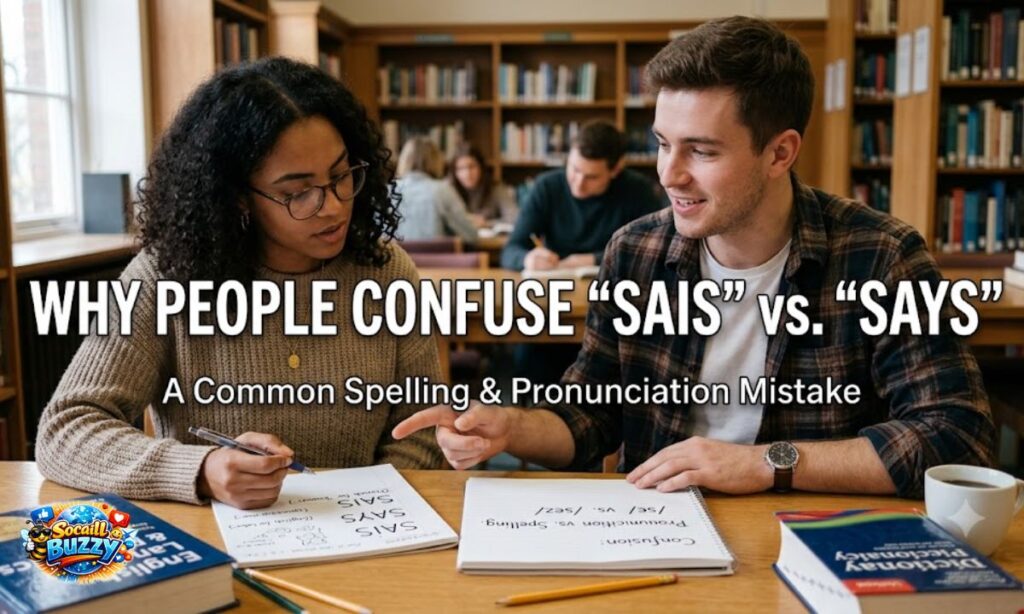
This confusion has a few real roots. Understanding them helps you avoid the mistake going forward.
Phonetic spelling is the biggest culprit. Says is pronounced “sez,” not “sayz.” So when someone writes what they hear, they might reach for a spelling that feels closer to the sound, and “sais” feels vaguely phonetic to some people.
Fast typing creates errors too. In informal texting or social media, people type quickly and muscle memory isn’t always accurate. Autocomplete fills in the gap and sometimes gets it wrong.
Foreign language interference plays a role as well. Spanish and French both use verb endings that don’t exist in English. Learners sometimes transfer those patterns unconsciously.
Here’s a quick scenario: You’re emailing your supervisor about a meeting and write “She sais the deadline moved to Friday.” Spellcheck doesn’t catch it. Your supervisor reads it. That one misspelling quietly chips away at your professional image. That’s why the difference between sais and says genuinely matters.
Pronunciation of “Says”
This is where English gets cheeky. The word says looks like it should rhyme with “days” or “rays” but it doesn’t. It rhymes with “fez,” “pez,” and “Lez.”
| Word | Pronunciation | Rhymes With |
| Say | SAY | day, play, way |
| Says | SEZ | fez, pez, Lez |
The vowel sound shifts completely between say and says. Historically, English pronunciation drifted over centuries while the spelling stayed frozen. So the disconnect isn’t a mistake in the language; it’s just how English evolved.
A practical tip: if you hear “sez” in a sentence, the correct spelling is always s-a-y-s. No exceptions.
Correct Usage of “Says” in Writing
The correct spelling of says works across virtually every writing context. Journalism relies on it. “The senator says new legislation is coming.” Academic writing uses it. “The study says results were inconclusive.” Fiction leans on it constantly for dialogue attribution.
What changes isn’t whether to use says but what surrounds it. In formal writing, you might swap it for “states,” “notes,” or “asserts” to add variety. But says itself is never wrong or too casual. It’s reliable, clear, and universally understood in both American English and British English.
Verb Tense and “Says”
Says lives in the simple present tense. It describes what’s happening now or what is generally true. Here’s how the full tense range looks for the verb say:
| Tense | Form | Example |
| Simple Present | says | She says it’s ready. |
| Simple Past | said | She said it was ready. |
| Present Perfect | has said | She has said it before. |
| Future | will say | She will say hello. |
| Present Continuous | is saying | She is saying goodbye. |
The most common tense mix-up is swapping says and said mid-paragraph. Pick a tense and stay there. Present tense narration uses says. Past tense narration uses said. Mixing them creates a choppy, inconsistent read.
Common Mistakes with Sais vs Says
Mixing Tense Forms
Writers sometimes drift between present and past tense without noticing.
Wrong: “He says he was exhausted and said he needed a break.”
Right: “He says he’s exhausted and needs a break.”
Consistency keeps your writing clean and your reader focused.
Forgetting Subject-Verb Agreement
This is the other big one. Using “say” when the subject is singular is a common grammar mistake, especially for English learners.
Wrong: “The manager say the project is delayed.”
Right: “The manager says the project is delayed.”
Singular subject, singular verb. That rule never bends.
Subject-Verb Agreement with “Say”
Some subjects feel singular but need a closer look. Here’s a quick reference for tricky cases:
| Subject | Correct Form | Example |
| He, She, It | says | She says yes. |
| The team | says | The team says it’s ready. |
| Everyone | says | Everyone says it’s great. |
| Nobody | says | Nobody says that anymore. |
| John and Sara | say | John and Sara say hello. |
| They, We, You | say | They say it all the time. |
Collective nouns like “the committee” or “the team” are treated as singular in American English. So they take it. Two people joined by “and” become plural and take say.
“Says” in Questions and Negatives
Here’s a rule that surprises a lot of people. When you form a question or negative using “does” or “doesn’t,” the main verb drops back to the base form.
Wrong: “Does she says anything?”
Right: “Does she say anything?”
Wrong: “She doesn’t says much.”
Right: “She doesn’t say much.”
The “s” that makes it says shifts to the auxiliary verb “does.” English can’t put it in two places at once. Think of it like a baton in a relay race: the “-s” passes from “says” to “does” in questions and negatives.
American vs British English Usage
Good news here. It is identical in American English and British English. No spelling variation. No alternative form. Both use say for third-person singular present tense. The word is stable across all dialects of the English language.
Slight differences exist in how formally each dialect structures reported speech, but the word itself stays the same. American writers don’t need to worry about regional variations with this one.
Formal and Informal Use of “Says”
Says works in both formal and informal contexts, which makes it one of the most versatile verbs in English writing.
In formal writing: “The report says unemployment dropped by two percent.”
In casual speech: “My sister says that the coffee place on Main Street is incredible.”
For highly academic or legal writing, you might choose “states,” “argues,” or “contends” to add rhetorical weight. But it always fits. It’s clear, direct, and never out of place.
“Says” in Reported Speech
Reported speech is where what is said and said often get confused. The rule is clean though.
Direct speech: She says, “I’m running late.”
Indirect, present: She says she’s running late.
Indirect, past: She said she was running late.
In journalism, present tense is preferred for recent quotes. “The mayor says the budget is under review.” That feels immediate and current. For older quotes or past events, said is the natural choice.
Idiomatic and Natural Usage of “Says”
English is full of expressions built around say and say. Knowing them makes your communication feel natural and fluent.
Common American idioms:
“Says who?” — challenging someone’s claim
“That goes without saying” — something universally obvious
“You can say that again” — strong agreement
“Say no more” — complete understanding
“What do you say?” — asking for a decision
These phrases show up constantly in American conversation. Using them correctly signals genuine English language proficiency, not just textbook knowledge.
Why Correct Spelling Matters
One misspelled word can quietly undermine your credibility. In professional emails, academic papers, or published content, spelling mistakes in English signal carelessness to readers. Correct spelling of says specifically matters because it’s such a high-frequency word. You use it constantly. Getting it wrong repeatedly leaves a lasting impression for all the wrong reasons.
Writing accuracy builds trust. Whether you’re communicating with a client, a professor, or an audience of thousands, every correctly spelled word adds a small brick to your credibility wall.
Simple Tricks to Remember the Correct Form
Four tricks that actually stick:
- The rhyme trick: Says rhymes with “fez.” Remember fez, remember says.
- The pronoun test: Swap the subject for “she.” If “she says” sounds right, you’re good.
- The pronunciation anchor: If it sounds like “sez,” spell it s-a-y-s.
- The proofread habit: Always read your draft aloud before sending. Your ear catches what your eyes miss.
Practice Sentences
Fill in the blank with say or says:
- The weather app __ rain is coming tomorrow. (says)
- My teachers always __ effort matters more than talent. (say)
- She __ the new restaurant downtown is worth trying. (says)
- Does he __ anything about the deadline? (say)
- The committee __ the vote will happen Friday. (says)
- They __ practice makes perfect. (say)
- Nobody __ it better than she does. (says)
Reflection on Grammar Rules Used
This article covered a lot of ground without feeling like a textbook. Subject-verb agreement, present tense conjugation, reported speech, auxiliary verbs in questions, and idiomatic usage all showed up naturally through the lens of one small but important word. That’s the beauty of English grammar learning. One word can unlock an entire system.
How This Topic Improves Writing Skills
Nailing small distinctions like sais vs says builds a bigger skill: attention to language. Writers who sweat the details produce cleaner, more trustworthy content. Each grammar rule you absorb frees up mental space during writing. You stop second-guessing and start communicating.
That confidence compounds. Better grammar leads to clearer sentences. Clearer sentences lead to stronger communication. Stronger communication opens doors, professionally and personally.
Everyday Situations Where “Says” Is Used
Says shows up constantly in American daily life. Your GPS says turn left. The doctor says drink more water. The news anchor says a storm is on the way. Your coach says hustle harder. A recipe says to bake for thirty minutes. These aren’t textbook sentences. They’re Tuesday. Recognizing words in your natural environment reinforces the correct form without any formal studying.
Final Review of Sais vs Says
Quick recap before you go:
“Says” is always correct as the third-person singular present form of say.
“Sais” has no grammatical role in English as a verb.
Singular subjects like he, she, it, or “the teacher” always pair with says.
In questions and negatives, the auxiliary “does” carries the “s” and the main verb returns to say.
It is identical in American English and British English.
The pronunciation is “sez,” not “sayz.”
When in doubt, it’s always said.
Conclusion
Sais vs says is one of those small English spelling confusions that carries real weight in everyday writing. Understanding why “sais” doesn’t exist as a verb, how subject-verb agreement works with say and says, and when to use each tense form gives you a sharper foundation in English grammar.
These aren’t just rules for tests. They’re tools for clearer, more confident communication in every area of your life.
FAQS
Is it a word in English?
Not as a verb. “Sais” only appears in English as the plural of “sai,” a type of martial arts weapon. In grammar, it has no role. The correct spelling is always said.
What does it mean?
Says is the third-person singular present tense of the verb say. It expresses speech, opinion, instruction, or declaration when the subject is he, she, it, or a singular noun.
Why does it sound like “sez”?
English pronunciation drifted over centuries while spelling remained unchanged. The vowel sound shifted from “ay” to “eh,” giving us the modern pronunciation “sez” even though the spelling stayed as it is.
What tense is it?
Say is a simple present tense. It describes current actions or general truths. The past tense form is said.
Can you use sayings in formal writing?
Absolutely. He works in formal writing, journalism, academic writing, and casual conversation. In highly formal contexts, you might substitute “states” or “asserts” for stylistic variety, but “says” is never wrong.

Welcome to SocaillBuzzy! I’m the creator and writer behind this platform, dedicated to sharing meaningful content including grammar, meaning, quotes, and inspirational messages for everyday life. Through well-crafted, SEO-friendly content, I aim to spread positivity, strengthen connections, and make it easier for readers to express their emotions with clarity and warmth.