

If you’ve ever paused mid-conversation, unsure whether to say “so do I” or “so am I,” you’re not alone. These two short phrases look almost identical, but they follow completely different grammar rules and mixing them up is one of the most common mistakes English learners make.
The good news? Once you understand the one rule behind them, you’ll never confuse them again. In this guide, you’ll learn exactly when to use each phrase, see plenty of real examples, explore how they shift across tenses, and pick up simple tricks to keep them straight for good.
What Does “So Do I” Mean?
“So do I” is a short way of agreeing with someone when their sentence uses an action verb something a person does, rather than something they are.
Simple Meaning of “So Do I”
In plain terms, “so do I” means “I do that too.” It’s a quick, natural way to show that you share the same habit, action, or preference as the speaker, without repeating their entire sentence.
For example, if a friend says, “I drink coffee every morning,” you don’t need to say, “I also drink coffee every morning.” You can simply reply, “So do I.”
Click Here To Read Sais vs Says
Examples of “So Do I” in Sentences
Here are several everyday examples showing how natural this phrase sounds in real conversation:
- A: I enjoy hiking on weekends. B: So do I.
- A: I read before bed every night. B: So do I.
- A: I love spicy food. B: So do I.
- A: I take the train to work. B: So do I.
- A: I watch a lot of documentaries. B: So do I.
Notice that each original sentence uses an action verb enjoy, read, love, take, watch never a form of “be.”
Grammar Rule Behind “So Do I”
The structure behind this phrase is simple once you see the pattern.
Rule
Use this formula: So + auxiliary verb (do/does/did) + subject
The auxiliary verb must match the tense of the original sentence. If the first sentence is in present tense, use “do.” If it’s in the past tense, use “did.” This rule applies because every action verb sentence has a hidden helping verb behind it “I like music” really means “I do like music,” so the agreement simply brings that hidden “do” to the surface.
Examples
| Original Sentence | Tense | Correct Response |
| I like music. | Present | So do I. |
| She plays tennis. | Present | So does she. |
| I liked the movie. | Past | So did I. |
| They visited Paris. | Past | So did they. |
| He will join us. | Future | So will he. |
What Does “So Am I” Mean?
“So am I” is used to agree with a sentence that describes a state, feeling, or condition in other words, a sentence built on the verb “to be” (am, is, are, was, were).
Simple Meaning of “So Am I”
This phrase simply means “I am also.” It’s used when someone describes how they feel, what they are, or what condition they’re in, not something they actively do.
If someone says, “I’m exhausted today,” you can respond with “So am I” to show that you feel the same way.
Examples of “So Am I” in Sentences
- A: I’m really tired today. B: So am I.
- A: She is excited about the trip. B: So is she.
- A: I am nervous about the interview. B: So am I.
- A: We are ready to leave. B: So are we.
- A: I was confused during the lecture. B: So was I.
Each of these examples centers on a state of being, not an action.
Grammar Rule Behind “So Am I”
This rule is just as direct as the one for “so do I,” but it depends entirely on forms of “be.”
Rule
Use this formula: So + form of “be” (am/is/are/was/were) + subject
The form of “be” must match both the subject and the tense of the original statement.
Examples
| Original Sentence | Tense | Correct Response |
| I am happy. | Present | So am I. |
| She is tired. | Present | So is she. |
| They are ready. | Present | So are they. |
| I was nervous. | Past | So was I. |
| We were late. | Past | So were we. |
Main Difference Between So Do I vs So Am I
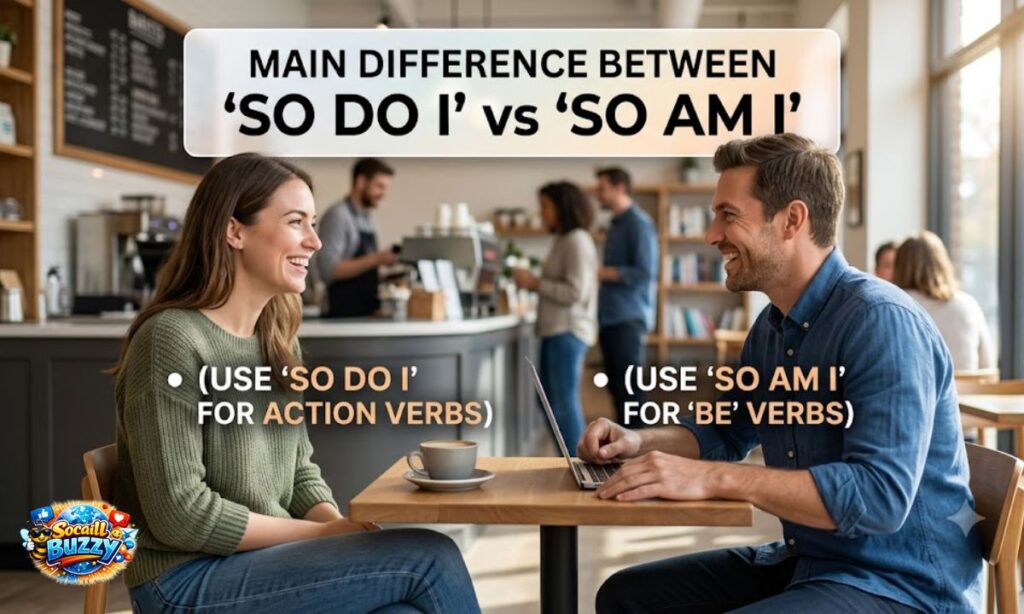
The entire distinction comes down to one question: does the original sentence describe an action, or a state of being?
Key Difference
| Feature | So Do I | So Am I |
| Verb type | Action verbs (like, play, work, eat) | “To be” verbs (am, is, are, was, were) |
| Meaning | “I do that too” | “I am that too” |
| Example trigger | I like coffee. | I am tired. |
| Correct response | So do I. | So am I. |
| Tense flexibility | do → does → did | am/is/are → was/were |
If the sentence has an action verb, reach for “do.” If it has “be,” reach for “am/is/are.” That’s the whole rule.
Side-by-Side Meaning Explained in Simple Words
Sometimes a grammar rule sticks better with a simple mental image rather than a technical explanation.
Think Like This
- Doing something? → Use “so do I.” (I jog every morning. → So do I.)
- Being something? → Use “so am I.” (I am exhausted. → So am I.)
Picture the original sentence as either an action (something happening) or a description (something true about a state). Actions pair with “do.” Descriptions pair with “am/is/are.”
Using So Do I with Different Tenses
“So do I” isn’t locked to one tense; it adapts depending on when the action happens.
Present Tense
- I cook dinner every night. → So do I.
- She enjoys yoga. → So does she.
Past Tense
- I visited my grandparents last week. → So did I.
- They watched the game yesterday. → So did they.
Future Tense
- I will travel to Spain next year. → So will I.
- He will start a new job soon. → So will he.
Using So Am I with Different Tenses
The same flexibility applies to “so am I,” shifting form to match the state described.
Present Tense
- I am thrilled about the news. → So am I.
- She is confident about the exam. → So is she.
Past Tense
- I was surprised by the result. → So was I.
- We were proud of the team. → So were we.
Future Meaning
There isn’t a true future form of “be” in this structure on its own, but future meaning is usually expressed with “will be”:
- I will be ready by noon. → So will I.
Common Mistakes with So Do I vs So Am I
Even confident English speakers slip up here. Below are the three mistakes that show up most often.
Using “So Am I” with Action Verbs
❌ I play football. → So am I. ✅ I play football. → So do I.
This error happens because “so am I” feels more familiar to some learners, but it only works with “be” verbs, never with actions like play, eat, or run.
Using “So Do I” with Be Verbs
❌ I am hungry. → So do I. ✅ I am hungry. → So am I.
Since “hungry” describes a state, not an action, “do” doesn’t belong in the response at all.
Forgetting Tense Matching
❌ I liked the show. → So do I. ✅ I liked the show. → So did I.
The auxiliary verb has to match the tense of the original sentence, not just the verb category.
Why These Mistakes Happen
These mix-ups aren’t a sign of weak English skills they happen for predictable reasons:
- Both phrases sound similar and start with the same word, “so.”
- Learners memorize the phrase as a whole instead of learning the underlying rule.
- Quick conversations don’t leave time to consciously check the verb type.
Once you train yourself to glance at the main verb before responding, these mistakes fade quickly.
American vs British English Usage
A common question learners ask is whether this rule changes depending on the variety of English they’re learning.
Key Points
- Both American and British English follow the exact same grammar rule for “so do I” and “so am I.”
- There is no regional difference in which verb form to use.
- Minor differences exist only in tone and formality, not grammar.
- This makes the rule reliable no matter which English-speaking country you’re communicating with.
Using These Phrases in Spoken English
In daily conversation, “so do I” and “so am I” function as quick, natural agreement tools that keep dialogue flowing smoothly.
Spoken Examples
- A: I love this song! B: So do I!
- A: I’m starving. B: So am I.
- A: I usually skip breakfast. B: So do I.
- A: I’m running late. B: So am I.
These short responses prevent awkward repetition and make spoken English sound more fluent and natural.
Using These Phrases in Written English
In writing, these phrases often appear mid-sentence rather than as standalone replies, helping connect two related ideas smoothly.
Written Examples
- She enjoys painting, and so do I.
- He is passionate about music, and so am I.
- My colleague prefers remote work, and so do I.
- The manager was impressed by the proposal, and so was the client.
Used this way, the phrases help writers avoid clunky repetition while keeping sentences concise and connected.
Negative Forms: Neither Do I vs Neither Am I
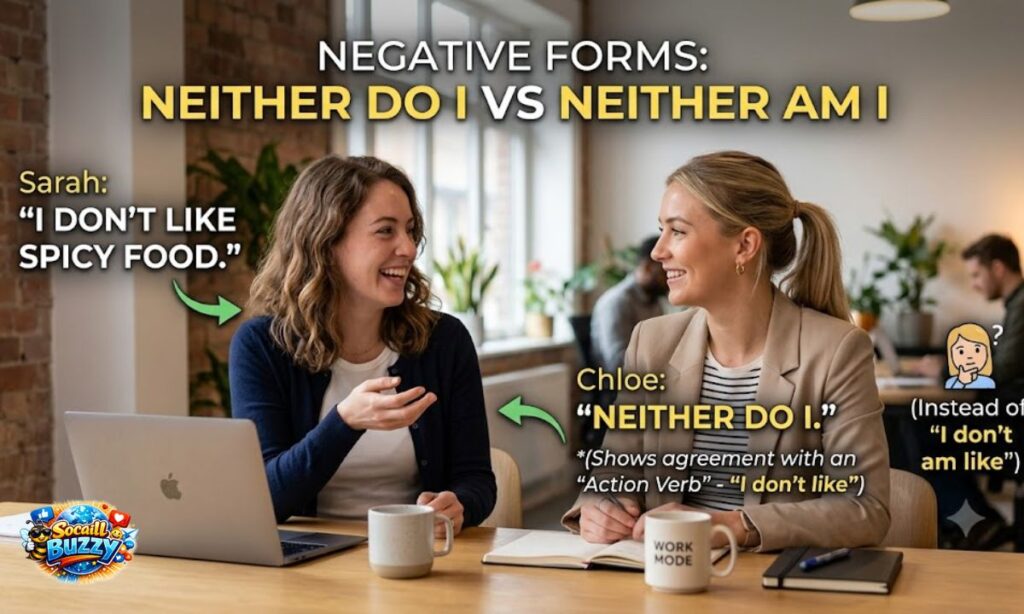
When the original statement is negative, “so” is replaced with “neither” but the same verb-matching rule still applies.
Negative with Action Verbs
- I don’t like spicy food. → Neither do I.
- She doesn’t enjoy crowded places. → Neither does she.
- They didn’t attend the meeting. → Neither did they.
Negative with Be Verbs
- I’m not ready yet. → Neither am I.
- He isn’t satisfied with the result. → Neither is he.
- We weren’t aware of the change. → Neither were we.
The logic stays identical to the positive form: action verbs pair with “do/does/did,” and “be” verbs pair with “am/is/are/was/were.”
Short Answers vs Full Sentences
These agreement phrases can appear either as quick standalone replies or woven into longer, fuller sentences.
Full Sentence Example
“My sister loves traveling to new countries every summer, and so do I.”
Short Answer Example
A: I love traveling to new countries. B: So do I.
Both versions are grammatically correct; the choice simply depends on context, tone, and whether you’re speaking or writing.
Idiomatic and Natural Use
Beyond strict grammar, these phrases carry a conversational, idiomatic flavor that native speakers use instinctively.
Natural Examples
- “So do I, honestly I can never resist dessert.”
- “So am I, which is why I booked the ticket early.”
- “Same here” and “Me too” are casual alternatives, but “so do I”/”so am I” sound slightly more polished.
Tone and Politeness
These short agreement phrases also carry a social function: they signal that you’re actively listening and connecting with the speaker.
Tone
- They sound warm, engaged, and friendly without requiring extra effort.
- They work well in both casual chats and professional conversations.
- Compared to simply saying “me too,” they tend to feel slightly more polished.
Sentence Structure and Flow
Good writers use these phrases deliberately to control rhythm and avoid repetition.
Techniques Used
- Inversion: The subject and verb swap places after “so,” similar to how questions are formed (so do I, not so I do).
- Ellipsis: The rest of the sentence is omitted because it’s already understood from context.
- Parallelism: The structure mirrors the original sentence’s verb form, creating a balanced, rhythmic connection between two ideas.
Grammar Rules Applied in This Topic
This single grammar point actually pulls together several broader English rules at once.
Rules Applied
- Subject-verb inversion after “so” and “neither.”
- Auxiliary verb agreement, matching do/does/did or am/is/are/was/were.
- Tense consistency between the original statement and the response.
- Subject-verb agreement, adjusting the verb based on who or what the subject is (I, she, they, we).
How This Topic Improves Writing Skills
Mastering this small grammar point has a bigger payoff than it might seem.
Benefits
- It sharpens your ability to identify verb types quickly, strengthening overall grammar accuracy.
- It helps you avoid repetitive sentence structures in both speech and writing.
- It improves fluency and confidence in real-time conversations.
- It builds a foundation for understanding other inversion structures in English.
Practical Tips to Remember the Difference
If the rule still feels tricky, these simple habits make it second nature over time.
Look at the Main Verb
Before responding, ask: is this an action (do) or a state (am/is/are)? That one check resolves almost every case.
Change the Tense First
Identify whether the original sentence is present, past, or future before choosing your auxiliary verb. This avoids the common mistake of matching verb type but missing the tense.
Practice with Short Sentences
Start by practicing with simple, short statements like “I like tea” or “I am cold,” and respond out loud. Repetition builds instinct faster than memorizing rules.
Practice Sentences
Test yourself with the sentences below before checking your answers.
Correct Sentences
- I enjoy reading mystery novels. → So do I.
- She is worried about the test. → So is she.
- We watched the sunset together. → So did we.
- They are planning a trip. → So are they.
- I was thrilled about the news. → So was I.
Incorrect Sentences
- I love pizza. → So am I. ❌ (should be “So do I.”)
- I am exhausted. → So do I. ❌ (should be “So am I.”)
- She walked to school. → So is she. ❌ (should be “So did she.”)
- They are happy. → So do they. ❌ (should be “So are they.”)
Reflection on Writing and Grammar Practice
Grammar points like this one are a useful reminder that fluency isn’t about memorizing endless rules, it’s about recognizing patterns. Once you train your eye to spot whether a sentence is built on an action or a state, the correct response becomes almost automatic. This kind of focused practice, applied to small details, is exactly what separates hesitant English learners from confident, natural speakers.
Conclusion
The difference between “so do I” and “so am I” comes down to a single, reliable question: is the original sentence about an action or a state of being? Action verbs call for “so do I” (with its tense variations like “so did I” or “so will I”), while “be” verbs call for “so am I” (and its related forms, “so is she,” “so was I,” and so on).
With a bit of practice checking the verb, matching the tense, and trying out real sentences this grammar point quickly becomes second nature. The next time someone shares how they feel or what they do, you’ll know exactly how to respond, naturally and correctly.
Frequently Asked Questions
Is it correct to say “so am I” after an action verb sentence?
No. “So am I” only follows sentences using a form of “be” (am/is/are). Action verb sentences need “so do I” instead.
What’s the difference between “so do I” and “me too”?
Both express agreement, but “so do I” matches the verb tense precisely and sounds slightly more formal, while “me too” is casual and doesn’t change form.
How do I respond to a negative sentence like “I don’t like coffee”?
Use “neither do I” for action verbs or “neither am I” for “be” verbs, following the same matching rule as the positive forms.
Does “so do I” change with different tenses?
Yes. It becomes “so did I” for past tense and “so will I” for future tense, always mirroring the original sentence’s tense.
Is there a difference between American and British English here?
No, both varieties follow the identical grammar rule for these phrases.
Can “so am I” be used with “-ing” verbs like “I am working”?
Yes, because “-ing” verbs follow “am/is/are,” the structure still depends on the “be” verb, so “so am I” is correct.
Why do people often confuse these two phrases?
They sound similar, both start with “so,” and many learners memorize the phrase instead of the underlying verb-matching rule.
Are these phrases used in formal writing?
They appear in semi-formal writing to avoid repetition, but full sentences are usually preferred in strictly formal documents like academic papers.

Welcome to SocaillBuzzy! I’m the creator and writer behind this platform, dedicated to sharing meaningful content including grammar, meaning, quotes, and inspirational messages for everyday life. Through well-crafted, SEO-friendly content, I aim to spread positivity, strengthen connections, and make it easier for readers to express their emotions with clarity and warmth.