You typed the word, paused, and suddenly questioned everything. Is it hassle or hastle? Your brain says one thing, your autocorrect says another, and Google just silently judges you. Here is the short answer: hassle is the correct spelling. “Hastle” is a misspelling that does not exist in any standard dictionary. Now that the confusion is settled, let us dig deeper so you never mix it up again.
What Does Hassle Actually Mean?
Hassle refers to something that causes unnecessary difficulty, irritation, or inconvenience. It can be a noun or a verb, and it fits naturally into everyday conversation.
As a noun, it describes an annoying situation or experience. As a verb, it means to bother or repeatedly pester someone.
Here is the simplest way to think about it: anything that makes a simple task feel more complicated than it should be is a hassle. Filling out a 12-page form just to return a shirt? Total hassle.
Why Do So Many People Write “Hastle” Instead?
This is actually a very fair question, and you are not alone in making this mistake.
The word hassle sounds like it ends in a sharp “l” sound, which tricks many writers into spelling it “hastle” the same way words like “castle,” “hustle,” or “whistle” are spelled. Those words all have a silent letter pattern, so the brain naturally applies the same rule here.
But hassle follows a different pattern entirely through hastle. It ends in “le” without any silent consonant before it. The double “s” in the middle is what trips people up most, because it sounds like a single soft sound when spoken aloud.
In short, the “hustle/castle” pattern in your memory is doing you dirty. Do not trust it for this word.
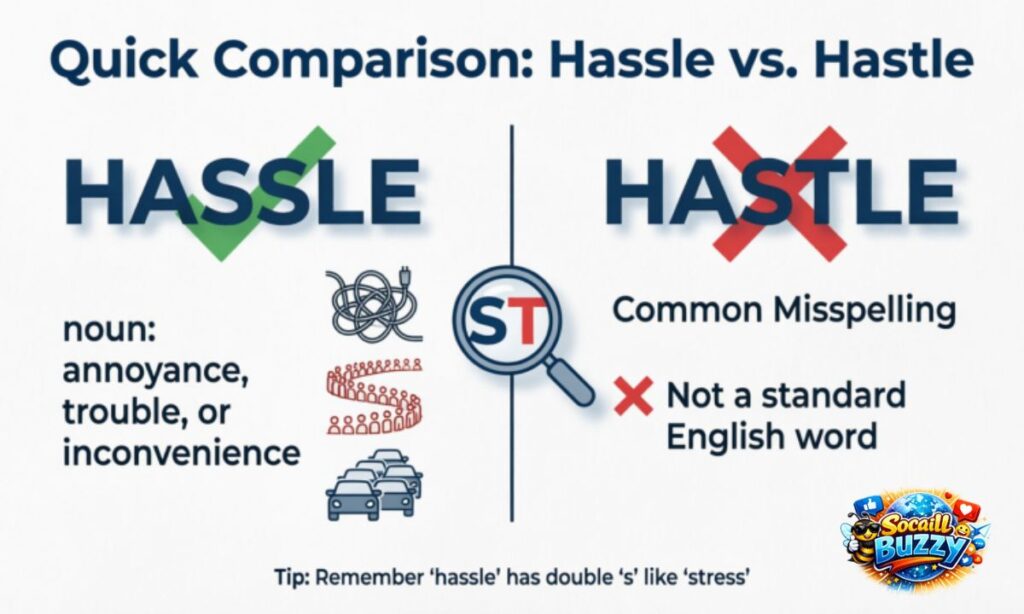
Quick Comparison: Hassle vs. Hastle
| Hassle | Hastle | |
| Correct Spelling | Yes | No (Hastle) |
| Found in Dictionary | Yes | No (Hastle) |
| Used in Formal Writing | Yes | Never (Hastle) |
| Used in Casual Speech | Yes | Sometimes (as a mistake) |
| Autocorrect Friendly | Yes | Gets flagged red |
The table makes it clear: one of these words exists, and the other is just a confident typo.
The Origin and History of the Word Hassle
Words have stories, and hassle has a genuinely interesting one.
The word began appearing in American English around the 1940s, primarily in informal and slang usage. Its exact origin is debated among etymologists, but two main theories exist.
The first theory suggests it comes from a Southern American dialect term meaning to breathe noisily or argue heatedly. The second connects it to a blend of “haggle” and “tussle,” two words that both carry the idea of conflict and friction. Whether it was born from Southern speech or a creative word collision, the result is a word that perfectly captures petty, draining annoyance.
By the 1960s and 1970s, hassle became widely used in counterculture language. It was the word people reached for when describing unnecessary bureaucracy, difficult people, or anything that made life harder than it needed to be. That spirit carried it right into modern everyday English.
How to Use Hassle Correctly in a Sentence?
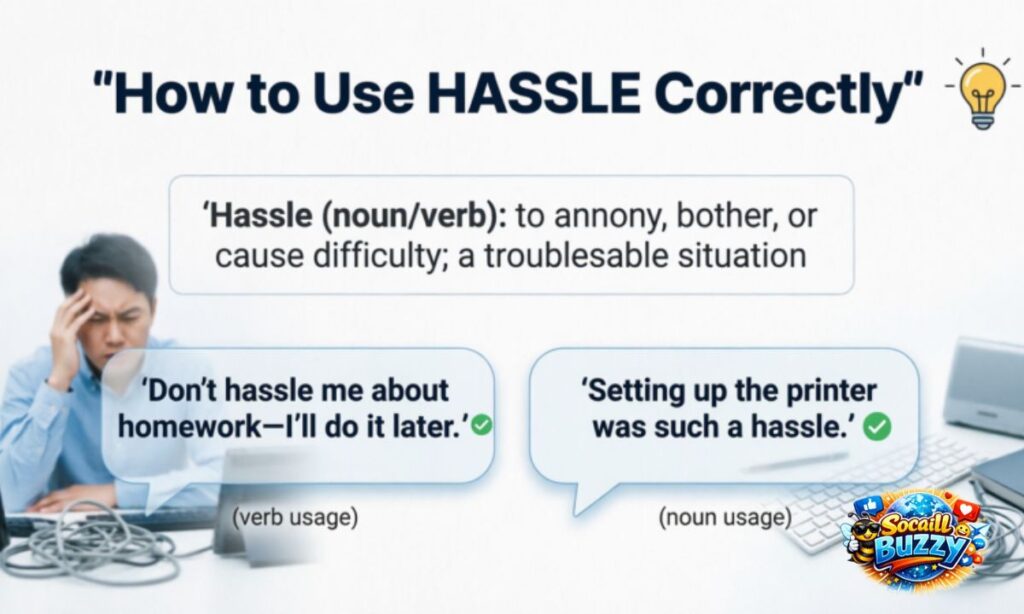
Seeing a word in action is often the fastest way to lock in the spelling and meaning.
As a noun:
- Renewing a passport can be a real hassle if you wait until the last week.
- “Is parking downtown a hassle on weekends?” “Absolute nightmare.”
- The entire check-in process was a hassle from start to finish.
As a verb:
- Please stop hassling me about the dishes. I will get to them.
- The salesperson kept hassling customers who were just browsing.
- She did not want to hassle her doctor with what felt like a small concern.
Notice that when used as a verb, the word changes to “hassling” or “hassled” depending on the tense. The root stays the same: h-a-s-s-l-e.
Biblical and Historical Context: The Concept Behind the Word
While the word hassle itself is modern, the idea it captures is ancient.
In the Bible, the book of Exodus is essentially one long account of hassle at a civilizational scale. The Israelites face layers of difficulty, obstruction, and frustrating setbacks on a journey that should have taken weeks but stretched into decades. Bureaucratic resistance (Pharaoh saying no repeatedly), logistical chaos, and constant complaints from the crowd are all forms of what we would today call a massive hassle.
Even in ancient Roman life, the word “molestia” was used to describe bothersome, tiresome, or unnecessarily burdensome situations. It is where the English word “molest” (to disturb or bother) partially originates, and it carried the same emotional weight as hassle does today.
Human beings across every era have needed a word for needless difficulty. Hassle is simply the version that is stuck in modern English.
Common Mistakes People Make Beyond the Spelling
Spelling is not the only place people go wrong with this word.
Mistake 1:
Using “hastle” in formal writing. Some people use it thinking it looks more formal or technical. It does not exist, so it just looks like an error.
Mistake 2:
Confusing hassle with hustle. These sound similar but mean very different things. Hustle means to work energetically and fast. A hassle is something that slows you down. One is motivation, the other is an obstacle.
Mistake 3:
Overusing it. When everything becomes a “hassle,” the word loses its weight. Save it for situations that genuinely involve frustrating inconvenience, not just mild effort.
Mistake 4:
Incorrect tense formation. Some people write “hasseled” when the correct past tense is hassled. Drop the “e” before adding “-ed” or “-ing.”
Hassle vs. Hustle: A Word People Often Confuse
Because these two words sound so similar, they deserve their own head-to-head comparison.
Hassle = unnecessary difficulty, frustration, or pestering Hustle = energetic, fast-moving effort or work
They are practically opposites in spirit. A hustle gets you somewhere. A hassle is what gets in the way. If someone says “keep hustling,” that is a compliment. If someone says “stop hassling me,” that is a complaint.
The spelling also differs significantly once you look closely. Hassle uses a double “s” and ends in “le.” Hustle uses “st” in the middle and ends in “le.” The sound overlap is a false alarm.
Related Words and Phrases Worth Knowing
Once you know the hassle, a few related expressions expand your vocabulary naturally.
No hassle means something is easy, smooth, or free of complications. “The return was completely no hassle” means the process was easy.
Hassle-free is used commonly in marketing and everyday speech to describe services or products that cause no inconvenience. “Hassle-free returns.” “Hassle-free booking.”
Without any hassle signals that a task was surprisingly straightforward.
These phrases appear constantly in customer service language, product descriptions, and casual conversation. Knowing the correct spelling of the root word means you will never misspell these expressions either.
Which One Should You Use? (The Simple Rule)
This one is easy.
Use hassle. Always. In every situation. Because hastle is not a word.
If you are writing formally or informally, in an email, a text message, a blog post, or a school paper, the correct word is h-a-s-s-l-e. Two s letters in the middle, ending in “le.”
A simple memory trick: think of the double “s” as two snakes hissing at each other. That image captures the irritated, friction-filled nature of the word perfectly, and it will keep the spelling locked in your memory.
Final Thought
Hassle is one of those words that sounds deceptively simple but catches writers off guard because of how familiar other “-stle” words feel. The answer has always been straightforward: two s letters, no “t,” ends in “le.”
Now you know the correct spelling, the meaning, the origin, the proper usage, and even a memory trick to keep it straight. The next time autocorrect tries to flag your spelling, you will know you already had it right.
No more second-guessing. No more red squiggly lines. And honestly, figuring all this out was way less of a hassle than you expected.
Read More : Admitted vs Accepted
FAQ
Q: Is “hastle” ever acceptable in any context?
No. “Hastle” does not appear in any standard English dictionary, including British, American, or Australian editions. It is considered a misspelling in all formal and informal contexts. Always use “hassle.”
Q: Can “hassle” be used as both a noun and a verb?
Yes. As a noun: “That was such a hassle.” As a verb: “Stop hassling me.” Both uses are correct and widely accepted in standard English.
Q: What is the difference between a hassle and a problem?
A problem is a serious difficulty that requires a solution. A hassle is more of an annoying inconvenience that wastes time or energy but is not necessarily critical. Problems can be urgent. Hassles are just irritating.

Welcome to SocaillBuzzy! I’m the creator and writer behind this platform, dedicated to sharing meaningful content including grammar, meaning, quotes, and inspirational messages for everyday life. Through well-crafted, SEO-friendly content, I aim to spread positivity, strengthen connections, and make it easier for readers to express their emotions with clarity and warmth.