
People mix up apposed and opposed all the time, and honestly, it makes sense why. They sound almost identical. But using the wrong one in a sentence can flip your meaning completely, or worse, make you look like you skipped English class. Apposed means placed side by side in close contact. Opposeds means against something or in conflict with it. One word is about closeness. The other is about conflict. That is the entire difference, and everything flows from there.
What Does “Apposed” Actually Mean?
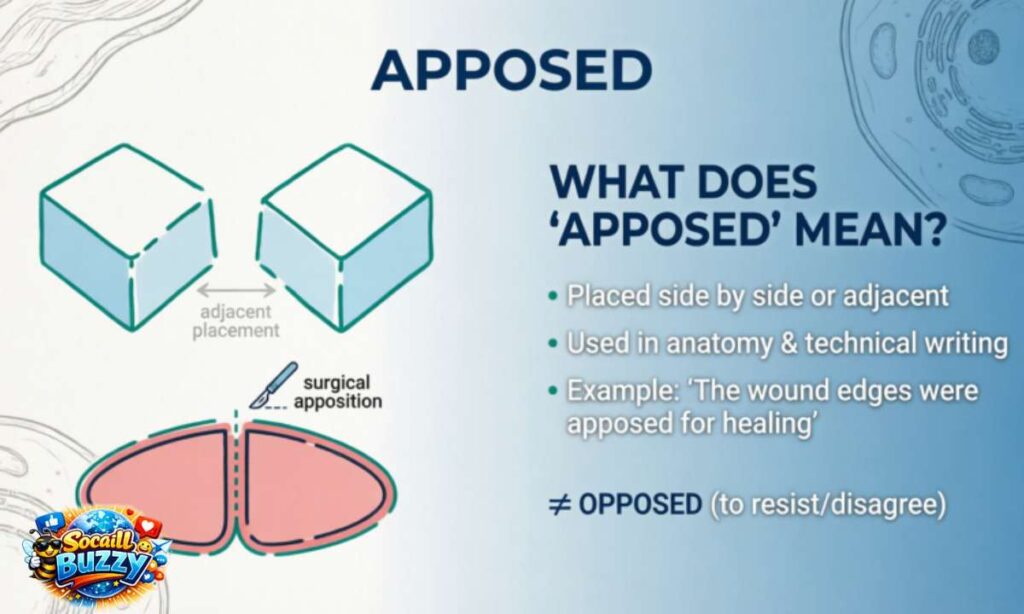
Apposed is the past tense of the verb “appose,” which means to place two things directly next to each other or in contact with each other. It carries a sense of physical closeness, alignment, or juxtaposition.
You will mostly find this word in scientific, medical, or technical writing. Surgeons use it when describing wound edges brought together. Biologists use it when describing how cell layers sit against each other. It is a precise, professional word for a specific idea: two things touching or placed side by side.
Think of it this way. When a doctor closes a wound, the two sides of skin are apposed so they can heal. Nothing about that is confrontational. It is literally about bringing things together.
What Does “Opposed” Actually Mean?
Opposed comes from the verb “oppose,” and it means to be against something, to resist it, or to stand in conflict with it. This is the word you already know and use in everyday life.
When you are opposed to a new policy at work, you disagree with it. When two armies face each other on a battlefield, they are opposeds forces. When a politician votes against a bill, she is opposeds to it.
The word carries energy of resistance, disagreement, and conflict. Where apposed brings things together, opposed pushes them apart.
Apposed vs Opposed: A Quick Comparison Table
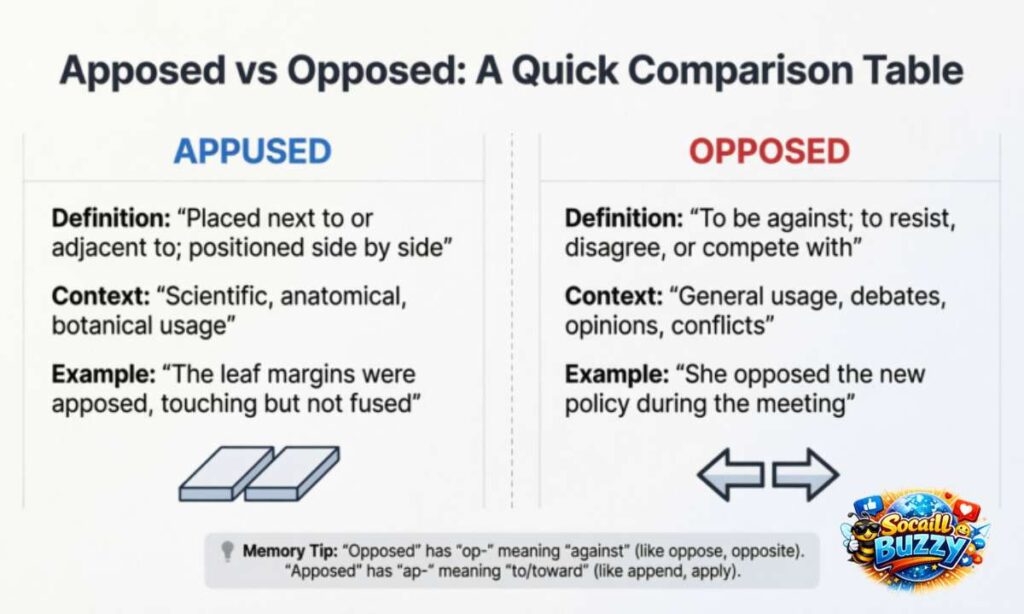
| Feature | Apposed | Opposed |
| Core Meaning | Placed side by side or in contact | Against, in conflict, or resistant |
| Tone | Neutral, technical | Confrontational, adversarial |
| Common Fields | Medicine, biology, anatomy | Politics, debate, everyday speech |
| Root Verb | Appose | Oppose |
| Everyday Use | Rare | Very common |
| Example | The wound edges were apposed carefully | She was opposed to the new rule |
Where Did These Words Come From?
Both words share Latin roots, which is exactly why they cause confusion. The prefix “ap” (from Latin ad, meaning “toward”) and “op” (from Latin ob, meaning “against”) are the only things separating these two words etymologically. One prefix says “move toward.” The other says “stand against.” Two tiny letters carry enormous meaning.
“Oppose” has been part of the English language since the late 14th century, used in religious, philosophical, and political writing. “Appose,” on the other hand, is far less common in everyday use and arrived in English primarily through scientific and medical Latin texts.
So the confusion is not a sign of laziness. It is a perfectly logical trap set by the Latin language itself, centuries before anyone reading this article was born.
Biblical and Historical Context
The concept behind opposed appears throughout ancient texts. In the Bible, the phrase “be not opposed to the truth” appears in various forms across different translations, warning believers against resisting divine wisdom. The idea of being against something, of resistance and conflict, is ancient and universal.
Apposed, by contrast, rarely appears in sacred or historical texts because it belongs to a more technical vocabulary that developed alongside modern medicine and biology. The surgical use of the word became common only in the 18th and 19th centuries as anatomical science grew more precise.
Historically, the word “oppose” shaped political language. During the English Civil War, Parliamentary forces were described as opposeds to the Crown. The word carried weight in courtrooms, councils, and constitutions. Apposed was quietly doing its work in operating theaters and laboratories.
Real-Life Usage Examples
Seeing both words in context is the fastest way to lock the difference in your memory.
Apposed in use:
- The surgeon carefully apposed the tissue layers before closing the incision.
- The two bone surfaces were apposed to allow proper healing.
- In the lab, the membranes were apposed during the experiment to observe interaction.
Opposed in use:
- The committee was opposed to the proposed budget cuts.
- He stood firmly opposed to the merger from the beginning.
- Two opposed forces met at the center of the field.
- She remained opposed to changing the original plan.
Notice how apposed stays calm and clinical. Opposed always shows up where there is tension, disagreement, or conflict.
The Most Common Mistakes People Make
The most frequent mistake is simple: writers type “apposed” when they mean “opposed.” This usually happens because the spell-checker accepts both words since both are real English words. Your spell-checker will not save you here.
A second mistake is using “apposed” in casual writing where it sounds strange and out of place. Saying “I am apposed to that idea” is technically using a real word, but it is the wrong word, and it changes your meaning entirely. You would be saying you are placed next to the idea, not that you disagree with it.
The third mistake is simply not knowing “appose” exists at all, which leads writers to search for a fancy-sounding word and accidentally land on this one.
A helpful mental rule: if you are writing about anatomy, surgery, or biology and mean “placed together,” use apposed. If you are writing about anything else and mean “against,” use opposed.
Which One Should You Use?
Nine times out of ten, “opposed” is the word you need. It is the everyday word, the common word, the one that belongs in emails, essays, arguments, and conversations.
“Apposed” belongs in a much smaller, more specific world. Unless you are writing a medical report, a biology paper, or a scientific study where you need to describe things placed in physical contact, you probably do not need “apposed” at all.
A simple test: ask yourself, “Am I describing conflict or contact?” If it is conflict, resistance, or disagreement, write opposed. If it is physical placement side by side or in contact, write apposed.
When in doubt, opposed is almost certainly correct.
How These Words Interact With Related Terms
Understanding a word fully means knowing its neighbors. Opposed connects naturally to words like contrary, resistant, against, conflicting, and adversarial. These all share the same energy of pushback and disagreement.
Apposed connects to words like juxtaposed, adjacent, contiguous, and abutting. These are all words that describe closeness, placement, and contact without any suggestion of conflict.
Interestingly, juxtaposed is probably the closest everyday synonym for apposed in non-medical writing. If you want to describe two things placed side by side for comparison, juxtaposed is the more familiar and readable choice for general audiences.
Why This Confusion Matters in Professional Writing
In casual conversation, mixing these two words might just get a raised eyebrow. In professional writing, it can cause real problems.
Imagine a legal document where a clause reads “the two parties were apposed in their interests.” The writer meant opposed, as in conflicting. But apposed technically means placed in contact. A sharp reader or opposing counsel could exploit that ambiguity.
In medical writing, the stakes are even higher. Apposed is a precise technical term. Using opposed where apposed is correct could confuse a clinical report and, in rare edge cases, cause real miscommunication in patient care documentation.
Precision in word choice is not pedantry. It is professionalism.
A Note on “As Opposed To”
There is one phrase worth mentioning because it trips people up differently: “as opposed to.” This is a common expression meaning “rather than” or “in contrast with.”
“She chose the salad as opposed to the burger.”
This phrase uses opposed correctly and naturally. Some writers mistakenly write “as apposed to,” which is both wrong and, frankly, a little amusing. If you ever see “as apposed to” in a professional document, you have found a typo that no spell-checker caught.
Keep this in mind as a quick memory hook: the phrase is always “as opposed to,” never “as apposed to.”
FAQ: Apposed vs Opposed
Q: Is “apposed” a real word or just a misspelling of “opposed”?
Apposed is absolutely a real English word. It is the past tense of “appose,” meaning to place in contact or side by side. It is not a misspelling. It is simply a rare, technical word that most people never encounter outside of medical or scientific writing.
Q: Can I use “apposed” in everyday writing?
Technically, yes. Practically, no. Using apposed in casual writing will confuse most readers, who will assume you meant opposed and mistyped it. Save apposed for technical or scientific contexts where its precise meaning is needed and your audience will recognize it.
Q: What is the noun form of “oppose”?
The noun form of oppose is opposition. You can be in opposition to something, or something can face opposition. There is no commonly used noun form of appose in everyday English. In technical writing, the noun apposition refers to the state of being placed side by side, and it also has a separate grammatical meaning in linguistics.
Read More : Wich or Which
Conclusion
Apposed and opposed are two real English words with roots that share the same Latin family tree but mean entirely different things. Apposed is calm, clinical, and rare. It means two things placed in close contact. Opposed is energetic, common, and confrontational. It means against, resistant, or in conflict.
For almost every situation you will ever encounter, opposed is the word you need. Apposed belongs in the vocabulary of surgeons, biologists, and scientists describing physical contact between structures.
Now you know exactly which word to reach for, and more importantly, you know why. That is the kind of clarity that turns a good writer into a precise one.

Welcome to SocaillBuzzy! I’m the creator and writer behind this platform, dedicated to sharing meaningful content including grammar, meaning, quotes, and inspirational messages for everyday life. Through well-crafted, SEO-friendly content, I aim to spread positivity, strengthen connections, and make it easier for readers to express their emotions with clarity and warmth.