You already know what growth means. But when things go in reverse, finding the exact right word feels oddly tricky. Is it declining? Decay? Regression? They all point in the same direction, but they do not mean the same thing. This article gives you the clearest answer available, covers every important opposite of growth, shows you how to use each one correctly, and saves you from the most common mistakes people make when choosing between them.
What Is the Direct Opposite of Growth?
The most direct opposite of growth is decline. When something grows, it increases in size, strength, or quality. When it declines, it moves in the opposite direction. Simple.
But depending on context, other strong opposites include:
- Decline (general decrease in size or quality)
- Decay (gradual breakdown, often biological or structural)
- Regression (moving backward to an earlier, worse state)
- Shrinkage (reduction in physical size or scale)
- Stagnation (no movement at all, neither up nor down)
- Deterioration (gradual worsening over time)
- Atrophy (loss of strength or function from disuse)
Each of these earns its own section below because picking the wrong one in a sentence can completely change your meaning.
Why “Decline” Is the Most Widely Used Opposite of Growth
Decline works across almost every field. You can use it for economies, populations, businesses, health, and relationships. It carries a sense of gradual movement downward rather than a sudden crash.
Think of it this way: a company does not collapse overnight. It declines quarter by quarter until someone finally notices the numbers going the wrong way.
Common usage examples:
- “The population showed a sharp decline after the drought.”
- “His interest in the project began to decline after the third failed attempt.”
- “Economic decline affected every sector of the industry.”
It is the go-to word when you want something clear, professional, and widely understood.
When “Decay” Fits Better Than Decline
Decay carries a stronger, more visual meaning. It suggests something is not just shrinking but actually breaking apart or rotting. You will see it used in biology, chemistry, architecture, and sometimes in social commentary.
The key difference is this: decline is about numbers or progress going down. Decay is about the structure itself falling apart.
Examples:
- “Years of neglect led to the decay of the old bridge.”
- “The decay of civic institutions worried historians.”
- “Urban decay became the central theme of the documentary.”
If decline is a falling stock price, decay is a crumbling building wall. Both are bad. One just looks worse at a glance.
The Subtle Power of “Regression”
Regression is the opposite of progression. It means going backward, not just downward. This word is especially popular in psychology, medicine, statistics, and personal development conversations.
A child who starts wetting the bed again after being toilet trained is showing regression. A patient who returns to old, harmful habits after therapy has regressed. A machine learning model that performs worse on new data than expected has hit regression issues.
The important thing about regression is the direction: it implies a return to a previous, less developed state. Decline just means things got worse. Regression means things went back.
Examples:
- “Therapy helped him avoid emotional regression during stressful periods.”
- “The statistical regression analysis revealed unexpected patterns.”
- “Childhood regression is a normal response to major life changes.”
Stagnation: When Nothing Grows and Nothing Falls Either
Here is a word that does not quite get the attention it deserves. Stagnation is not exactly the opposite of growth in a directional sense. It is the absence of growth without the comfort of stability.
Think of a pond with no inflow or outflow. The water sits. It does not go anywhere. It just… sits. And eventually, it starts to smell.
Stagnation is what happens to businesses that refuse to adapt, economies that stop innovating, and people who get comfortable doing the same thing year after year. Growth stops. But decline has not officially started yet either. It is dangerous in-between.
Examples:
- “Years of stagnation left the company vulnerable to newer competitors.”
- “Economic stagnation can be just as damaging as a recession.”
- “Personal stagnation often feels comfortable until it suddenly does not.”
Atrophy: The Opposite of Growth Through Disuse
Atrophy is a fascinating word. It specifically describes loss of size, strength, or function because something is not being used. Muscles atrophy when you stop exercising. Skills atrophy when you stop practicing. Relationships atrophy when you stop investing in them.
The origin is Greek: a (without) and trophē (nourishment). Atrophy is literally what happens when something stops being fed.
This makes it different from decline or decay. Atrophy is passive. Nobody is causing active damage. The damage happens through absence.
Examples:
- “His once-sharp memory began to atrophy in retirement.”
- “Unused pathways in the brain can atrophy over time.”
- “The department suffered atrophy after its budget was quietly cut.”
Biblical and Historical Context of Growth’s Opposite
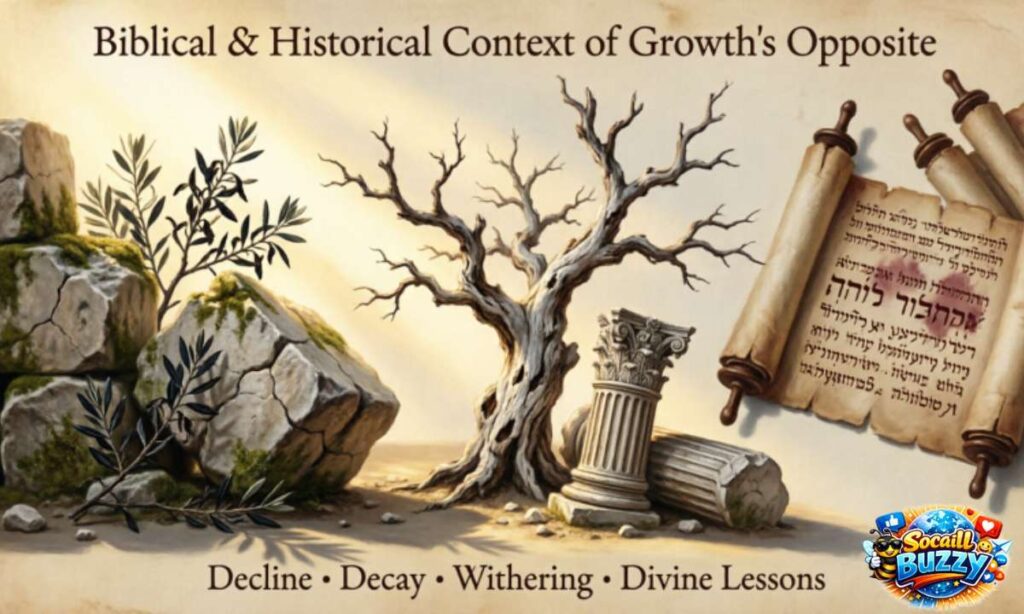
The idea of decline and decay appears throughout ancient literature and philosophy. In the Bible, the concept of withering serves as a recurring opposite to growth and flourishing. Psalm 1 describes the righteous as a tree planted by water that bears fruit, while the wicked are like chaff that the wind blows away.
Ecclesiastes explores the idea that all things have a season, including the season of decline after the season of growth.
In ancient Greek philosophy, Aristotle discussed phthora (decay or perishing) as the natural opposite of genesis (coming into being or growth). Nothing that comes into being avoids eventually going out of it.
Roman historians used decadence and decline to describe the fall of empires. Edward Gibbon’s famous work on the Roman Empire literally put the word decline in its title. The idea that great things grow and then fall apart is as old as human civilization itself.
Quick Comparison Table: Opposites of Growth at a Glance
| Word | Best Used For | Key Feeling | Example Context |
| Decline | Economy, health, performance | Gradual decrease | “Sales declined by 20%.” |
| Decay | Physical structures, society | Breakdown, rot | “The city faced urban decay.” |
| Regression | Psychology, statistics, development | Moving backward | “Emotional regression under stress.” |
| Stagnation | Business, economy, personal growth | No movement | “Years of market stagnation.” |
| Atrophy | Muscles, skills, relationships | Wasting from disuse | “Skills atrophy without practice.” |
| Deterioration | Quality, conditions, health | Progressive worsening | “A deterioration in road conditions.” |
| Shrinkage | Size, scale, retail | Physical reduction | “Inventory shrinkage costs millions.” |
| Contraction | Economy, muscles, business | Pulling inward | “GDP contraction in Q2.” |
Deterioration vs. Decline: A Common Confusion Cleared Up
People often use deterioration and decline interchangeably, but there is a real difference worth knowing.
Decline is usually about quantity or position. Things get smaller, fewer, or lower ranked.
Deterioration is about quality. Things get worse in condition or standard, even if the quantity stays the same.
So a building’s value might decline while its physical structure deteriorates. A student’s grades might decline while their enthusiasm for learning deteriorates. Both words point downward, but one measures how much and the other measures how good.
Use decline for numbers, rankings, and amounts. Use deterioration for conditions, quality, and standards. Getting this right will make your writing noticeably more precise.
Real-Life Usage Examples Across Different Fields
Knowing the words is step one. Seeing them in actual context is step two.
Business and Economics:
- “The brand experienced a steady decline in market share over three years.”
- “Economic contraction forced companies to freeze hiring.”
Health and Medicine:
- “Cognitive deterioration in older adults can be slowed with regular mental activity.”
- “Muscle atrophy is a serious concern for patients on bed rest.”
Personal Development:
- “Without consistent practice, any skill will face regression or atrophy.”
- “Emotional stagnation often disguises itself as comfort.”
Environment:
- “Soil degradation reduces agricultural productivity year after year.”
- “Biodiversity decline threatens entire ecosystems.”
Relationships:
- “A lack of communication leads to gradual deterioration of trust.”
Common Mistakes People Make When Using These Words
Here is where most writers go wrong.
Mistake 1: Using “decay” for abstract concepts too casually. Saying “the decay of the company’s profits” sounds unnatural. Say “the decline of profits” instead. Decay works better for physical or cultural things.
Mistake 2: Confusing “stagnation” with “stability.” Stability is a healthy balance. Stagnation is unhealthy stillness. A stable business is doing well. A stagnant business is slowly becoming irrelevant. Do not let these two sound like compliments for each other.
Mistake 3: Using “regression” in everyday speech where “decline” fits better. Regression is a specific term. Not every bad trend is a regression. If sales dropped, say they declined. If a healed patient returned to their worst state, that is regression.
Mistake 4: Treating “atrophy” as dramatic language only. Atrophy is precise and clinical. Do not be shy about using it in professional or scientific writing. It is not an exaggeration. It is an accurate description.
Which Word Should You Actually Use?
Here is a simple decision guide to end the confusion once and for all.
Use DECLINE when you are talking about something getting smaller, lower, or less powerful over time. Best for business, economics, health metrics, and general writing.
Use DECAY when something is physically or structurally breaking down, or when a culture or institution is losing its core integrity.
Use REGRESSION when something or someone has moved backward to a previous, less advanced state. Best for psychology, medicine, and data science.
Use STAGNATION when growth has simply stopped and nothing is improving, even if nothing is visibly falling apart yet.
Use ATROPHY when a function, ability, or strength is being lost specifically because it is not being used or maintained.
Use DETERIORATION when you are focusing on worsening quality or condition rather than shrinking size or quantity.
If you are ever unsure, decline is your safe default. It communicates clearly, works in almost every setting, and never sounds out of place.
Read More : Apposed vs Opposed
Frequently Asked Questions
What is the single best opposite of growth?
The single best and most widely accepted opposite of growth is decline. It covers the broadest range of contexts and is immediately understood in business, health, economics, and everyday conversation.
Is stagnation the same as decline?
No. Decline means things are actively getting worse or smaller. Stagnation means things have stopped moving or improving. Stagnation can eventually lead to decline, but they are not the same state.
Can a person experience atrophy without any injury?
Absolutely. Atrophy does not require injury. It happens through disuse. A person who stops using a skill, exercising a muscle, or engaging in a relationship will experience atrophy naturally over time. No dramatic event is needed for that kind of slow, quiet loss.
Final Thoughts
The opposite of growth is not a single word. It is a family of words, each pointing in a slightly different direction and carrying its own weight and meaning. Decline is the most direct. Decay is the most visual. Regression is the most precise for backward movement. Stagnation captures the dangerous stillness. Atrophy names the quiet loss that comes from neglect.
Understanding these distinctions does not just make you a better writer. It makes you a clearer thinker. Because the moment you can name exactly what kind of opposite-of-growth you are dealing with, you are already one step closer to doing something about it.

Welcome to SocaillBuzzy! I’m the creator and writer behind this platform, dedicated to sharing meaningful content including grammar, meaning, quotes, and inspirational messages for everyday life. Through well-crafted, SEO-friendly content, I aim to spread positivity, strengthen connections, and make it easier for readers to express their emotions with clarity and warmth.