
You are halfway through writing an important email or essay, and suddenly your fingers freeze over the keyboard. Is it wich or which? You second-guess yourself, open three browser tabs, and still feel unsure. The good news is that this confusion has a very clear answer, and you will never mix them up again after reading this.
The correct spelling is always “which.” The word “wich” does not exist as a standalone English word. It is simply a misspelling, and one that happens to millions of people every single day.
What Does “Which” Actually Mean?
Which is a pronoun and a determiner used in English to ask about or refer to one or more items from a defined group. You use it when there is a choice involved or when you want to identify something specific.
Think of it this way: whenever you are pointing at options and asking someone to pick, “which” is your word. It narrows things down.
Here are a few clear examples:
- Which shirt should I wear today?
- She could not decide which road to take.
- Tell me which one you prefer.
It is one of the most common words in the English language, appearing in everyday speech, formal writing, academic papers, and yes, even the Bible.
So what exactly is “Wich”?
Here is the short version: “wich” is not a real English word. It is a spelling error, plain and simple.
However, “wich” does appear in a different context that confuses people. It is an old English suffix, not a word on its own. You will spot it hiding at the end of place names, especially in Britain. Think of Norwich, Greenwich, or Ipswich. In those names, “wich” (or “wich”) means a settlement, dwelling, or place, often near salt works or a trading post.
So if someone asks you about “wich,” the honest answer is: it belongs in a map of England, not in your sentence.
The Old English and Historical Roots of “Which”
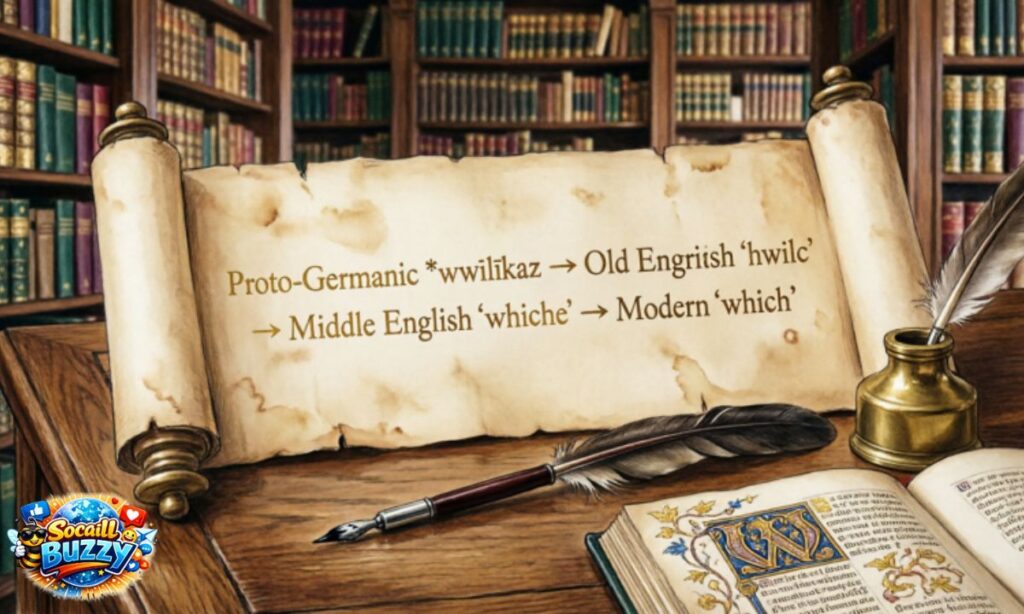
This is where things get genuinely interesting. The word which goes back over a thousand years. It comes from the Old English word hwilc, which itself came from the Proto-Germanic roots meaning “who” and “like” or “body.” Over centuries, the “hw” sound softened into the familiar “wh” we use today.
In Middle English, around the 12th to 15th centuries, people spelled it in various ways: whilk, whiche, and even quilk in some northern dialects. The spelling gradually settled into the modern form we use now.
As for the Bible, “which” appears thousands of times across the King James Version. For example, Genesis 1:11 reads: “Let the earth bring forth grass, the herb yielding seed, and the fruit tree yielding fruit after his kind, whose seed is in itself, upon the earth: and it was so.” The word “which” was a cornerstone of Biblical English, used to connect clauses and describe things with precision.
Knowing this history makes it easier to respect the word and spell it correctly.
Wich vs. Which: A Quick Comparison Table
| Feature | Which | Wich |
| Is it a real English word? | Yes | No |
| Used in sentences? | Always | Never |
| Appears in the dictionary? | Yes | No |
| Seen in place names? | Rarely | Yes (as a suffix) |
| Correct spelling? | Yes | No |
| Part of speech | Pronoun / Determiner | N/A |
This table should settle the debate once and for all. Use which in your writing. Save wich for your next trivia night about British place names.
How and When to Use “Which” Correctly
Now that you know which is the only correct choice, let us look at how to use it well. There are two main ways this word shows up in sentences.
1. In questions:
Use “which” when asking someone to choose from a specific set of options.
- Which color do you want, red or blue?
- Which movie are we watching tonight?
2. In relative clauses:
Use “which” to add extra information about a noun, usually after a comma. This is sometimes called a non-restrictive clause.
- The book, which I bought last week, is already finished.
- Her car, which was brand new, broke down on the highway.
Notice the comma before “which” in these examples. That comma is a helpful signal that “which” is adding bonus information, not defining the noun.
“Which” vs. “That”: The Mix-Up Nobody Talks About
Here is a bonus confusion that trips up even experienced writers. People often swap which and that, but they serve different purposes.
Use that for a restrictive clause, meaning the information is essential to identify the noun.
- The car that she drives is electric.
Use which for a non-restrictive clause, meaning the information is extra and could be removed without changing the core meaning.
- Her car, which is electric, won a design award.
A helpful trick: if you can remove the clause and the sentence still makes complete sense, use which and add a comma. If removing it breaks the meaning, use that with no comma.
Common Mistakes People Make With “Which”
Even people who know the correct spelling sometimes use which in the wrong way. Here are the mistakes worth watching:
- Spelling it as “wich” the most common error, usually a typo or phonetic mistake.
- Using “which” instead of “who” “which” refers to things, not people. Say “the man who called” not “the man which called.”
- Dropping the comma when using “which” to add extra information, always put a comma before it.
- Confusing “which” with “witch” these sound the same but mean completely different things. One is a grammatical tool. The other flies on a broomstick.
Real-Life Usage Examples to Make It Stick
Seeing a word in context is always more useful than a definition alone. Here are ten everyday examples using which correctly:
- I cannot decide which restaurant to choose.
- The report, which was due Monday, arrived on Wednesday.
- Which of these options suits you best?
- The bridge, which was built in 1902, still stands today.
- She asked which train goes to the city center.
- Tell me which answer you think is correct.
- The policy, which affects all employees, was updated last month.
- Which came first, the chicken or the egg?
- He returned the jacket, which was two sizes too small.
- Do you know which keys open this door?
Each of these shows “which” doing its job, whether asking a question or adding information to a sentence.
Which One Should You Use? The Final Word
Since “wich” is not a real word, this section practically answers itself. But let us make it crystal clear.
Always use “which.”
Whether you are writing a text message, a business report, an academic essay, or a creative story, the correct spelling is which. There is no situation in modern English writing where “wich” is correct as a standalone word.
If you are writing about British place names in a historical or geographical context, you might reference the suffix “wich” when discussing words like Norwich or Greenwich. But even then, it only exists as part of a larger word.
So the next time your brain hesitates, remember: one word exists, and it has a “wh” at the start.
A Simple Memory Trick That Actually Works

Want a way to never misspell this word again? Here it is.
“Which” starts with “wh,” just like all the other question words: who, what, when, where, why.”
All five classic question words share that “wh” opening. So if you are writing a question or connecting a clause, and it feels like a question-style word, go with “wh.” That means which, not wich.
One more visual trick: think of the “wh” as standing for “word here.” If a question word belongs here, spell it with “wh.”
Simple, right?
Read More : Unenroll vs Disenroll
Frequently Asked Questions
Q: Is “wich” ever correct in English?
No, “wich” is not a correct standalone English word. It appears only as a suffix in certain British place names like Norwich and Greenwich, where it means a settlement or dwelling from Old English. In any other context, the correct spelling is always “which.”
Q: What is the difference between “which” and “that”?
Both introduce clauses, but they serve different functions. “That” introduces essential information you cannot remove from the sentence without losing its meaning. “Which” introduces extra, non-essential information and is usually preceded by a comma. For example: “The car that I bought is red” vs. “My car, which I bought in 2022, is red.”
Q: Why do so many people misspell “which” as “wich”?
The most common reason is typing speed. When writing quickly, people often drop the “h” from the “wh” cluster, especially on mobile keyboards. It is a phonetic shortcut the brain makes under pressure. The fix is simple awareness and a quick proofread.
Final Thought
Language confusion is frustrating, but this one is genuinely easy to resolve. Wich is not a word you will ever use in a sentence. Which is the word you need, every single time, without exception.
It has over a thousand years of history behind it, it shows up in the Bible, in classic literature, in legal documents, and in your everyday texts. It is one of the most useful and reliable words in the English language.

Welcome to SocaillBuzzy! I’m the creator and writer behind this platform, dedicated to sharing meaningful content including grammar, meaning, quotes, and inspirational messages for everyday life. Through well-crafted, SEO-friendly content, I aim to spread positivity, strengthen connections, and make it easier for readers to express their emotions with clarity and warmth.