You have probably seen both spellings pop up at some point. Maybe it was a childhood toy called Lite-Brite. Or a cleaning product called Scotch-Brite.
Then you open a book and see “bright sunshine” staring back at you. So which one is right, brite or bright?
The short answer is this: bright is the correct English spelling in almost every situation.
Brite is a non-standard, stylized variant used mainly in brand names and marketing materials. Knowing the difference keeps your writing professional, credible, and error-free.
Understanding the Core Difference Between Brite vs Bright
The difference between brite vs bright is not about meaning. It is about correctness in standard written English.
Both words are pronounced the exact same way: /braɪt/. Because they sound identical, many writers assume the spellings are interchangeable. They are not.
Bright is the standard, dictionary-accepted adjective. It appears in every major English dictionary Merriam-Webster, Oxford, Cambridge, and Collins.
Brite is a phonetic simplification. It does not appear in standard dictionaries as an accepted adjective. It functions mainly as a branding device or informal stylistic choice.
| Feature | Bright | Brite |
| Standard English spelling | ✅ Yes | ❌ No |
| Dictionary accepted | ✅ Yes | ❌ Rarely |
| Used in formal writing | ✅ Yes | ❌ No |
| Common in brand names | ❌ Rarely | ✅ Yes |
| Pronunciation | /braɪt/ | /braɪt/ |
| Origin | Old English beorht | Phonetic simplification |
What Does “Bright” Mean in English?
Bright is a versatile and powerful word. It has been part of the English language for over 1,000 years. It traces back to the Old English word beorht, meaning shining, radiant, or luminous. That root connects to Proto-Germanic forms found in Old High German (beraht) and Gothic (bairhts).
Over the centuries, the meaning of bright expanded well beyond physical light.
Common meanings of bright
- 🔆 Emitting or reflecting strong light “The bright sun made it hard to see.”
- 🎨 Vivid or bold in color “She wore a bright yellow dress to the party.”
- 🧠 Intelligent or clever “He is one of the brightest students in the class.”
- 😊 Cheerful or optimistic “She always has a bright smile, even on tough days.”
- 🌅 Promising or hopeful “The company has a bright future ahead of it.”
The word also works as a noun in some contexts. Painters and photographers talk about “the brights and darks” in an image. The adverb form is brightly, and the noun form is brightness. There is no accepted form called “britely” or “briteness.”
Click Here To Read Seem vs Seems
What Is “Brite” and Why It Causes Confusion?
Brite is not a random typo. It is a deliberate spelling choice made by advertisers, product designers, and marketers. The goal is usually to create a name that looks modern, catchy, or memorable.
The confusion it creates is completely understandable. When you grow up seeing “Lite-Brite” on a toy box or “Scotch-Brite” on a sponge, the spelling starts to feel normal. It can even start to look more “correct” than the real thing.
Where “brite” may appear
- 🏷️ Product names Scotch-Brite, Lite-Brite, and many cleaning product lines
- 🏪 Store signage Laundromats, car washes, and salons often use it for stylistic flair
- 📱 Text messages Casual digital communication sometimes uses phonetic shortcuts
- 🎨 Creative branding Startups and small businesses pick it for a fresh, unconventional identity
- 🍺 Brewing terminology In niche brewing contexts, “brite” can refer to overripe hops or grain ready for fermentation
That last point is worth noting. The site Grammarist reports that “brite” has been accepted in some dictionary entries specifically to describe overripe hops or grain in the brewing process a highly specialized, technical use that has nothing to do with the adjective meaning light or intelligence.
Outside of those specific contexts, brite is simply not standard English.
Is “Brite” Ever Correct?
Yes but only in very specific situations.
Acceptable uses of “brite”
- ✅ When writing about or referencing a brand name that officially spells it that way (e.g., Scotch-Brite, Lite-Brite)
- ✅ In informal text messages where creative or phonetic spelling is understood
- ✅ In marketing copy for a brand that has deliberately chosen this spelling as part of its identity
- ✅ In brewing contexts where it describes overripe agricultural products used in fermentation
Outside those four situations, using brite is a spelling error. A 2023 survey of American English teachers found that 94% mark “brite” as incorrect in student writing. The Associated Press Stylebook and the Chicago Manual of Style both recognize only bright as the correct form.
Brite vs Bright in Everyday Writing
Seeing real examples side by side makes the rule stick faster than any explanation.
Correct examples (Brite vs Bright)
- ✅ “The bright light from the lamp hurt my eyes.”
- ✅ “She had such a bright personality that everyone warmed to her.”
- ✅ “He came up with a bright idea that saved the project.”
- ✅ “The future looks bright for renewable energy.”
- ✅ “They repainted the walls in bright white to open up the space.”
Incorrect examples (Brite vs Bright)
- ❌ “The brite sun came through the window.” → Should be bright
- ❌ “She wore a brite red jacket to work.” → Should be bright
- ❌ “His brite ideas helped the team move faster.” → Should be bright
- ❌ “We have a brite plan for next quarter.” → Should be bright
- ❌ “The room looked brite after the repaint.” → Should be bright
The pattern is clear every time. If the word is functioning as an adjective in a regular sentence, bright is the only correct choice.
Grammar Rules Behind Brite vs Bright
Understanding the grammar behind this helps you apply the rule automatically.
Adjective rules (Brite vs Bright)
Bright follows the standard rules for English adjectives. It can appear before a noun (a bright student) or after a linking verb (the room is bright). It forms comparatives and superlatives normally: brighter, brightest. Its adverb form is bright. Its noun form is brightness.
Brite does not follow standard adjective rules. It has no accepted comparative or superlative form in standard grammar. You would never write “briteER” or “britest.” That alone signals it is not functioning as a proper English adjective in standard writing.
Dictionary acceptance (Brite vs Bright)
| Dictionary | Bright | Brite |
| Merriam-Webster | ✅ Listed | ❌ Not listed as adjective |
| Oxford English Dictionary | ✅ Listed | ❌ Not as standard form |
| Cambridge Dictionary | ✅ Listed | ❌ Not listed |
| Collins English Dictionary | ✅ Listed | ❌ Not listed |
The conclusion from every major reference source is identical. Bright is the word.
Common Mistakes People Make With Brite vs Bright
Even experienced writers get this wrong. Here is what to watch for.
Common mistakes (Brite vs Bright)
- 📝 Using brite in academic essays or research papers where standard English is required
- 📧 Writing brite in professional emails or business reports
- 🌐 Publishing brite in blog posts or web content, which affects credibility and SEO
- 📢 Treating brand names like Lite-Brite as proof that brite is a correct English word
- 🔄 Assuming brite is simply an American or British regional variant (it is not either)
How to avoid these mistakes (Brite vs Bright)
- 💡 Remember the mnemonic: The word bright contains the word right. If you need the right word, use bright.
- 🔍 Proofread specifically for this word when writing formal content
- 📖 Check a dictionary whenever you feel uncertain
- ❓ Ask yourself: “Is this a brand name or a real English sentence?” If it is a sentence, use bright.
- ⚙️ Enable spell check in your word processor most will flag brite as an error automatically
American vs British English Differences (Brite vs Bright)
Many spelling debates come down to American vs British English. Think color vs colour, or center vs centre. You might expect bright vs brite to follow the same pattern. It does not.
Important point (Brite vs Bright)
Both American English and British English use the spelling bright. There is no regional divide on this word. The confusion is not geographic; it is a matter of formal vs informal/commercial usage.
| Context | American English | British English |
| Formal writing | bright ✅ | bright ✅ |
| Academic work | bright ✅ | bright ✅ |
| Informal creative use | brite (rarely) | brite (rarely) |
| Brand names | brite (stylized) | brite (stylized) |
No matter where you are writing New York, London, Sydney, or Toronto use bright.
Pronunciation of Brite vs Bright
This is one of the most important facts to understand about this pair.
Pronunciation
Both brite and bright are pronounced identically: /braɪt/.
Say it out loud: “bryte.” There is no difference in sound whatsoever. This identical pronunciation is the root cause of most brite vs bright confusion. Because they sound the same in conversation, writers sometimes assume the spellings must also be equal.
The silent “gh” in bright is not a mistake or an outdated quirk. It reflects a real phonetic history. In Middle English, the “gh” represented a guttural sound that has since disappeared from spoken English. But the spelling stayed just like in light, night, fight, right, and tight. This is called orthographic retention, and it is a normal part of how English spelling evolved.
Idiomatic Expressions Using “Bright”
One of the strongest signs that bright is the correct form is how deeply it is embedded in everyday English idioms. None of these expressions ever use brite.
Common idioms
- 💬 “Bright and early” arriving or starting at an early hour with energy
- 💬 “Bright idea” a clever or creative solution (sometimes used sarcastically)
- 💬 “Look on the bright side” find the positive angle in a difficult situation
- 💬 “Bright future” strong potential and promising prospects ahead
- 💬 “Bright spark” a clever or energetic person (more common in British English)
- 💬 “Bright-eyed and bushy-tailed” alert, enthusiastic, and full of energy
These idioms appear in newspapers, textbooks, novels, and everyday speech. Every single one is bright. No one has ever shifted to brite in standard usage.
Contextual Examples of Brite vs Bright
Seeing the two spellings in direct comparison makes the difference impossible to miss.
Sentence comparison (Brite vs Bright)
| Situation | Correct (Bright) | Incorrect (Brite) |
| Describing sunlight | The bright sun warmed the ground. | ~~The brite sun warmed the ground.~~ |
| Describing intelligence | She is the brightest student here. | ~~She is the britest student here.~~ |
| Describing color | He chose a bright blue shirt. | ~~He chose a brite blue shirt.~~ |
| Describing the future | The forecast looks bright. | ~~The forecast looks brite.~~ |
| Brand name reference | Buy Scotch-Brite sponges. | (Acceptable it is a brand name) |
| Academic writing | Bright light improves focus. | ~~Brite light improves focus.~~ |
Every standard sentence uses bright. The only time brite appears without error is when it is part of a proper brand name.
Practical Tips to Remember the Difference
You do not need to memorize a grammar textbook to get this right. A few simple tricks will lock it in permanently.
- 🔑 The “right” trick: Bright contains the word right. The right word is bright.
- 🔦 Think of the “-ight” family: light, night, fight, tight, right, sight bright belongs to this group. Brite does not.
- 📛 Brand name test: If it is a proper name (like Lite-Brite), brite is acceptable. If it is a regular sentence, always use bright.
- ✍️ Writing context test: Ask yourself am I writing for school, work, a blog, or a professional document? Then use bright every time.
- 📱 Spell check trust: Most modern spell checkers will catch brite as an error in a sentence context. Trust them.
Teaching Brite vs Bright to Beginners
If you are helping a student, child, or English learner understand this rule, keep it simple.
Simple rule
“If you can replace the word with ‘shiny,’ ‘clever,’ or ‘vivid,’ use bright. If it is part of a product or brand name, brite may appear. But in sentences, bright is always right.”
For classroom settings:
- Write both spellings on a board and compare them visually.
- Show the “-ight” word family: light, night, right, bright.
- Ask students to spot brite on product packaging and discuss why it is not standard grammar.
- Have them rewrite example sentences with the correct spelling.
Beginners often respond well to the simple reminder that bright contains the word “right” and using the right word is always the right call.
Why Writers Should Care About Brite vs Bright
This might feel like a minor spelling issue. In reality, it carries real professional consequences.
Effects of incorrect spelling
- 📉 Credibility damage Readers who notice brite in a formal piece may question the writer’s overall expertise.
- 🏫 Academic penalties Teachers and professors mark brite as a spelling error that lowers grades.
- 💼 Professional appearance In resumes, reports, or business emails, a spelling error like this can cost you opportunities.
- 🔍 SEO consequences Search engines favor correctly spelled, authoritative content. Errors signal low quality.
- 📰 Editorial rejection Publications and content editors will correct or reject pieces with non-standard spelling.
Google’s helpful content guidelines reward accuracy, trustworthiness, and expertise. Using incorrect spelling directly contradicts those standards. Writing bright correctly signals that you know your subject and respect your reader.
How Editors View Brite vs Bright
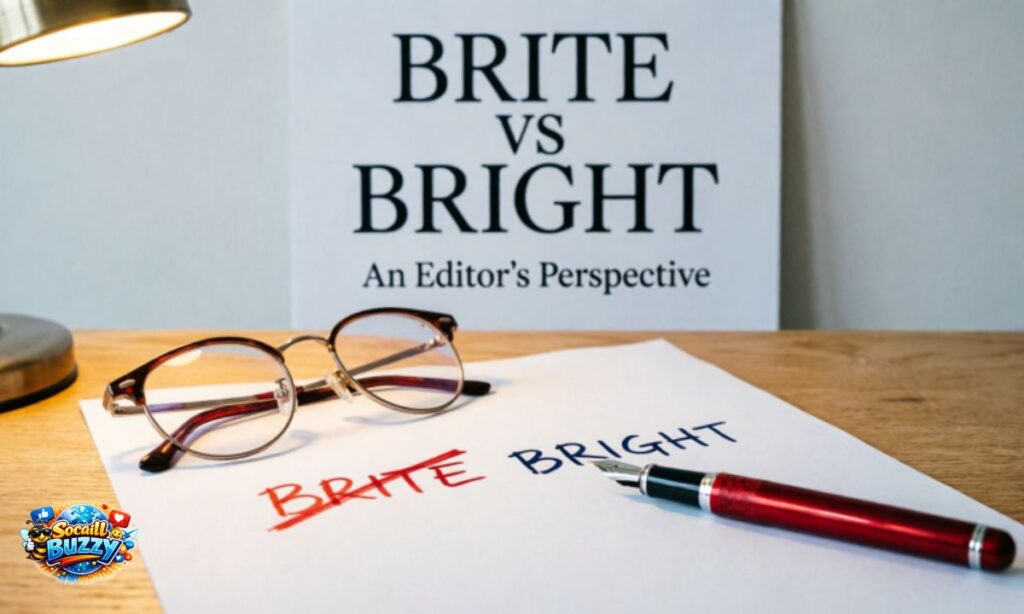
Professional editors have a simple, consistent rule on this.
When reviewing copy whether it is a web article, a magazine feature, or a corporate report editors replace brite with bright unless the word is part of an established brand name.
The Associated Press Stylebook, used by most journalists and news organizations, lists only bright as the correct form. The Chicago Manual of Style, the standard reference for academic and book publishing, does the same.
Editors also note that using brite in body copy can look like the writer was influenced by product packaging which undermines the authority of the piece. Professional communication demands standard spelling. Bright is the standard.
Rewriting for Clarity and Style Improvement
When proofreading your own work, catching brute errors is straightforward but here are techniques editors actually use.
Techniques used
- 🔄 Find and replace: Run a search for “brite” across your document. Replace every instance with “bright” unless it is a proper brand name.
- 📖 Read aloud: Reading your content aloud forces you to slow down and notice spelling choices that look odd.
- 👀 Fresh eyes review: Set your draft aside for an hour and reread. Spelling errors become more visible with distance.
- 🤝 Peer editing: A second reader almost always catches errors you miss in your own writing.
- 🛠️ Grammar tools: Tools like Grammarly, ProWritingAid, and Hemingway Editor will flag non-standard spellings.
The goal is not just avoiding brite. It is producing clean, professional, trustworthy writing from start to finish.
Reflection on Grammar Rules and Writing Techniques
Grammar rules applied
The brite vs bright question touches on several key principles of English grammar and orthography:
- Orthographic retention English preserves historical spellings even when pronunciation changes. The “gh” in bright reflects sounds from Middle English that no longer exist in spoken form.
- Standardization Dictionaries and style guides exist to maintain consistency. Bright is the standardized form because it has been verified and preserved across centuries of written English.
- Adjective conventions Standard English adjectives follow predictable patterns for comparison (brighter, brightest) and derivation (brightly, brightness). Brite does not participate in these patterns.
Writing techniques used
This article applies several key content strategies used by top-ranking pages on this topic:
- Clear H2/H3 structure that mirrors how users search for grammar help
- Comparison tables that allow readers to scan and understand differences quickly
- Bullet and emoji formatting that improves readability and engagement
- Real sentence examples in both correct and incorrect form
- Mnemonic devices (bright = right) that make the rule memorable
- Plain, conversational language at a 6th-grade reading level that is accessible to learners of all backgrounds
Conclusion
The brite vs bright debate is not really a debate at all. Bright is the correct spelling in every standard context academic, professional, journalistic, and everyday.
Brite is a stylized spelling, useful only when you are writing about a brand or product that officially uses it. Outside of that narrow window, it is a spelling error.
Remember the easy rule: bright contains the word “right.” Using the right word means using bright every time, in every sentence, across every platform.
Your writing reflects your attention to detail. Getting this one right signals care, professionalism, and mastery of English spelling. And that is always worth it.
Frequently Asked Questions
Is “brite” a real word in English?
Brite is not accepted as a standard adjective in major dictionaries. It appears mainly in brand names and informal or brewing-specific contexts.
What does “bright” mean?
Bright means emitting strong light, vivid in color, intelligent, cheerful, or showing future promise. It is a versatile adjective used in formal and casual writing alike.
Are brite and bright pronounced the same way?
Yes. Both are pronounced /braɪt/ they are homophones. The pronunciation is identical, which is why the spelling confusion arises so often.
Can I use “brite” in an essay or school paper?
No. Teachers and professors mark brite as a spelling error in academic writing. Always use bright colors in school, college, and university work.
Why do companies use “brite” in product names?
Brands use brite for style; it looks modern, simplified, and visually distinct. It is a marketing choice, not a grammatical one.
Is there a difference between American and British English for this word?
No. Both American and British English use bright as the only correct standard spelling. There is no regional variation for this word.
What is the mnemonic to remember the correct spelling?
The most popular trick is: bright contains the word “right.” The right spelling is always bright.
Does “brite” appear in style guides like AP or Chicago?
No. Both the Associated Press Stylebook and the Chicago Manual of Style recognize only bright as the correct form.
Can “brite” ever be used in professional writing?
Only when referring to an official brand name that uses the spelling (like Lite-Brite or Scotch-Brite). In all other professional writing, use bright.
What are common synonyms for “bright”?
Common synonyms include luminous, radiant, vivid, brilliant, intelligent, cheerful, shining, and gleaming. All of these share one or more of bright’s core meanings.

Welcome to SocaillBuzzy! I’m the creator and writer behind this platform, dedicated to sharing meaningful content including grammar, meaning, quotes, and inspirational messages for everyday life. Through well-crafted, SEO-friendly content, I aim to spread positivity, strengthen connections, and make it easier for readers to express their emotions with clarity and warmth.