
If you have ever paused mid-sentence wondering whether to type “comparable” or “comprable,” you are not alone. This is one of the most commonly searched spelling questions in English, and the confusion almost always comes down to how the word sounds when spoken quickly.
The good news is that the answer is simple, and by the end of this guide, you will never second-guess yourself again.
In short: comparable is the only correct spelling. Comprable is a misspelling with no dictionary backing, no regional variant, and no grammatical justification.
Below, we will break down why this mistake happens, where the word comes from, how to pronounce it correctly, and how to use it confidently in emails, reports, academic writing, and everyday conversation.
Comprable
Let’s start with the word that causes all the confusion: comprable.
“Comprable” is not a recognized English word. It does not appear in Merriam-Webster, Oxford, Cambridge, or any other major dictionary. It is simply what happens when the middle “a” sound in “comparable” gets dropped during fast speech or fast typing.
Here’s why it happens so often:
- When people say “comparable” quickly, the unstressed middle syllable becomes soft and easy to miss.
- Writers sometimes type based on how a word sounds rather than how it’s actually spelled.
- Autocorrect and predictive text can occasionally let typos slip through if a writer is typing fast or using a mobile keyboard.
If you’ve typed “comprable” into a document and seen a red squiggly underline, that’s your spell checker correctly flagging it as an error. There is no context academic, professional, casual, or technical where “comprable” is the right choice.
Comparable
Now let’s look at the correct word: comparable.
Definition: Comparable (adjective) means able to be compared with something else; similar in size, quality, value, or character.
For example:
- The two job offers were comparable in salary.
- Her writing style is comparable to that of a professional journalist.
- These laptops are comparable in performance, though one is more expensive.
The word is built from the root compare, plus the suffix -able, which means “capable of” or “able to be.” So comparable literally means “able to be compared.” This is also why the word keeps its full structure com + para + ble rather than losing a letter along the way.
Comparable is used constantly in business writing, journalism, science, education, and everyday speech, which is exactly why getting the spelling right matters so much.
Comparable or comprable pronunciation
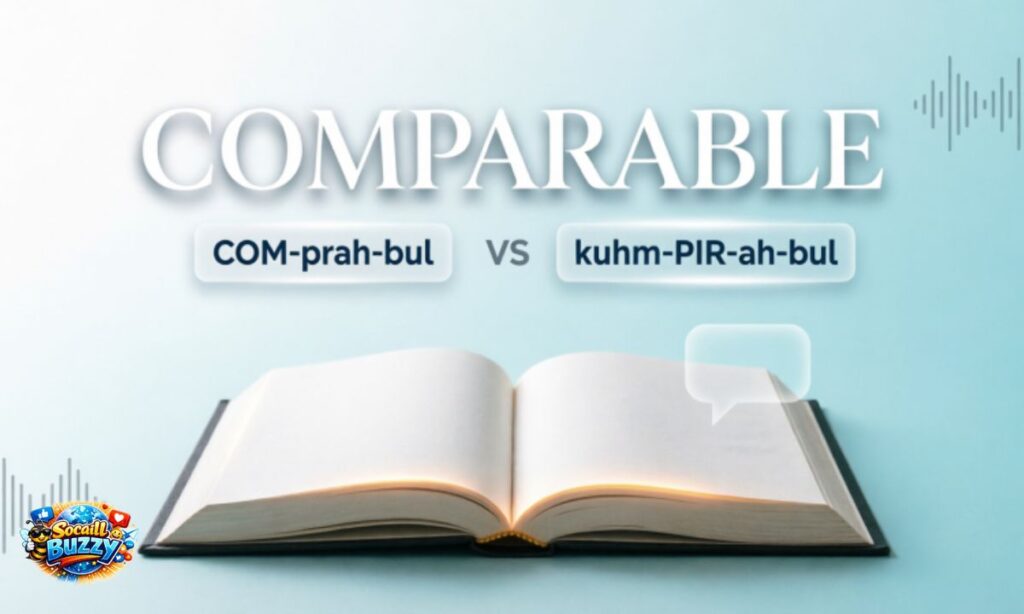
Mispronunciation is the number one reason people misspell this word, so let’s clear it up.
The correct pronunciation of “comparable” in American English is:
/ˈkɒm-pər-ə-bəl/ (KOM-pruh-buh-bul)
Broken down phonetically:
- COM like the beginning of “common”
- par a soft, almost swallowed syllable, like “per” said quickly
- a-ble rhymes with “table”
The stress falls on the first syllable, not the second. This is actually part of why “comprable” feels like it sounds right when native speakers talk quickly, that middle “a” gets reduced to almost nothing, making it sound like the syllable disappears entirely.
But disappearing in speech is not the same as disappearing in spelling. The letter is still there, even if you barely hear it.
There is no separate “correct” pronunciation for “comprable” because, again, it isn’t a real word. If you search for how to pronounce it, you’ll only find guidance on how to pronounce “comparable” correctly.
Click Here To Read More…
Comprable or Comparable – Quick Answer
For readers who just want the fast answer and nothing else:
✅ Correct: Comparable ❌ Incorrect: Comprable
There is no scenario, dialect, or writing style where “comprable” is acceptable. Whether you’re writing a school essay, a business proposal, a social media post, or a line of code documentation, the spelling never changes.
Examples:
- ✅ These two smartphones are comparable in price.
- ❌ These two smartphones are comprable in price.
- ✅ Her qualifications are comparable to those of a senior manager.
- ❌ Her qualifications are comprable to those of a senior manager.
- ✅ The research results were comparable across both studies.
- ❌ The research results were comprable across both studies.
If you remember nothing else from this guide, remember this: comparable always has the “a” in the middle, right after “comp.”
The Origin of Comparable
Understanding where a word comes from often makes it much easier to spell correctly, and “comparable” is no exception.
The word traces back to the Latin verb “comparare,” meaning “to pair, to match, or to liken one thing to another.” This Latin root passed into Old French as “comparable,” and from there it entered Middle English around the 14th to 15th century, keeping essentially the same spelling it has today.
Because the word has always retained its full Latin-derived structure compare (paired/equal) + able (capable of) there has never been a historically accepted shortened form.
Unlike spelling differences that genuinely evolved over centuries (such as “colour” versus “color”), “comprable” isn’t an older or alternate version of the word. It’s simply a modern typing and pronunciation slip, not a linguistic variant with its own history.
This is an important distinction: many spelling confusions in English exist because two forms genuinely developed in different regions. That is not the case here.
“Comparable” has one lineage, one accepted form, and one correct spelling worldwide.
British English vs American English Spelling
One of the most common follow-up questions is whether this is a British versus American spelling issue, similar to “colour/color” or “organise/organize.” It is not.
| Region | Accepted Spelling | Notes |
| United States | Comparable | Standard in all American dictionaries |
| United Kingdom | Comparable | Identical spelling to US English |
| Canada | Comparable | Follows standard English spelling |
| Australia | Comparable | No regional variation |
| Global/International English | Comparable | Universally accepted form |
Unlike many British-American spelling pairs, “comparable” does not change based on region. Whether you’re writing for an American business audience, a British academic journal, or an Australian news outlet, the spelling stays exactly the same. The only differences you might notice across regions are minor pronunciation shifts in emphasis or accent, not the actual letters used to spell the word.
So if you’ve ever assumed “comprable” might be a British spelling, an Australian variant, or some kind of regional shorthand, you can rule that out completely. It is incorrect everywhere, in every English-speaking country.
Which Spelling Should You Use?
Since there’s no regional variation to worry about, the real question isn’t which spelling to use, it’s how to make sure you use the correct one consistently. Here’s how that breaks down by audience.
If Your Audience is in the US:
Use comparable. American style guides, including AP Style and Chicago Manual of Style, recognize only this spelling. There is no American “shortcut” version, despite how the word sounds when spoken casually.
If Your Audience is in the UK or Commonwealth:
Use comparable. British English, Australian English, and Canadian English all follow the same standard spelling. If you’re writing for UK publications, academic journals, or business reports, “comparable” is the expected and only correct form.
If You Write for a Global Audience:
Use comparable. Because this word has no regional split, it’s one of the safest words in English to use across international audiences without needing to localize spelling for different markets. This makes it especially useful for global SEO content, multinational business communication, and academic writing intended for an international readership.
Common Mistakes with Comprable or Comparable
Even careful writers slip up sometimes. Here are the four most common mistakes people make, and how to avoid each one.
1. Dropping the “a”
This is the most frequent error by far. Writers type quickly, mirror how the word sounds when spoken, and accidentally skip the middle “a,” producing “comprable” instead of “comparable.”
Fix: Remember the root word “compare.” Since “compare” contains that “a,” “comparable” keeps it too. Think of the word in three chunks: com-PAR-able.
2. Confusing It with “Compareable”
Some writers overcorrect in the opposite direction, adding an extra “e” before “able” to make “compareable.” This is also incorrect. The word is not “compare” + “able” spelled literally together; it follows the established adjective form “comparable,” without the extra “e.”
Fix: There is no “e” before “able” in this word. It’s comp-a-r-a-b-l-e, eleven letters, no double vowels in that spot.
3. Wrong Pronunciation Leading to Wrong Spelling
Because the second syllable is unstressed and spoken softly, many people genuinely don’t hear the middle “a” when listening to others speak. This mishearing then becomes a spelling habit, especially for non-native English speakers learning primarily through listening.
Fix: Practice saying the word slowly and deliberately com-PAR-a-ble exaggerating each syllable until the spelling becomes automatic in your memory.
4. Using It Incorrectly in a Sentence
Even when the spelling is correct, some writers pair “comparable” with the wrong preposition. The most common version of this error is using “comparable than” instead of “comparable to.”
Wrong: These products are comparable to others. Correct: These products are comparable to others.
Fix: Always pair “comparable” with “to” (or sometimes “with”), never “than.” Since “comparable” isn’t a comparative adjective like “better” or “faster,” it doesn’t take a “than” construction.
Comparable in Everyday Examples
To really lock in correct usage, it helps to see the word in the kinds of writing you encounter daily.
In Emails:
“Thank you for your quote. We found a comparable offer from another vendor, but we’d like to give you the chance to match it before we decide.”
In News:
“Analysts say this quarter’s earnings are comparable to last year’s results, despite ongoing supply chain disruptions.”
On Social Media:
“Honestly didn’t expect this budget laptop to be comparable to my old $1,200 model, but here we are 👀”
In Academic Writing:
“The two datasets were statistically comparable, allowing researchers to draw meaningful conclusions across both sample groups.”
In Business Reports:
“Q3 revenue growth remains comparable to industry benchmarks, suggesting the company is maintaining its competitive position.”
Notice how naturally the word fits across formal and informal tones alike. That flexibility is exactly why it shows up so often and why getting the spelling wrong can quietly undercut otherwise polished writing.
Comprable or comparable synonym
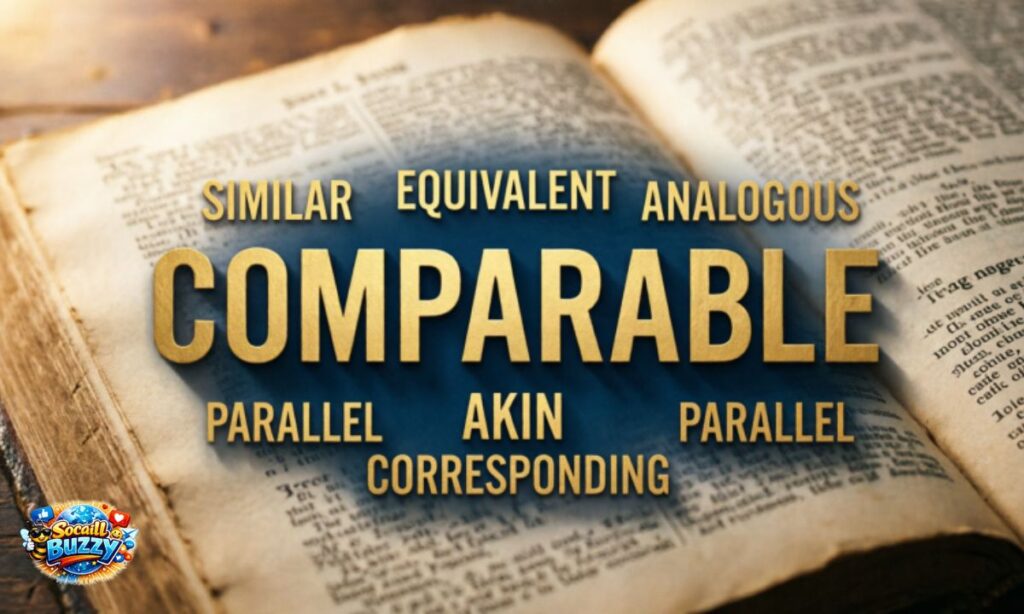
If you find yourself using “comparable” too often in the same piece of writing, it helps to have a few synonyms on hand. Some natural alternatives include:
- Similar The two reports were similar in structure.
- Equivalent Her experience is equivalent to a senior-level role.
- Analogous The situation is analogous to last year’s market downturn.
- On par with The new product is on par with industry leaders.
- Matching Both candidates had matching qualifications.
- Akin to His approach is akin to traditional teaching methods.
Using a mix of these alongside “comparable” not only avoids repetition but also improves the overall readability and flow of your writing, particularly in long-form content like reports, essays, or articles.
Comparable – Google Trends & Usage Data
Search interest in spelling clarification for this word has remained consistently high, and that’s not surprising given how often “comparable” is used across business, finance, science, and casual writing. Search patterns around “comprable or comparable” tend to spike around:
- Back-to-school and academic writing seasons
- Business reporting periods (quarterly earnings, year-end reviews)
- Content creation and blogging communities
- ESL and English-learning resources
This consistent search volume reflects just how widespread the word’s usage is and how common the spelling slip remains, even among experienced writers. It’s a strong reminder that spelling confusion isn’t a sign of poor English skills; it’s simply a quirk of how pronunciation and spelling don’t always perfectly align in this language.
Comparison Table: Comprable vs Comparable
| Feature | Comprable | Comparable |
| Dictionary Recognition | ❌ Not recognized | ✅ Recognized in all major dictionaries |
| Correct Spelling | ❌ No | ✅ Yes |
| US English | ❌ Incorrect | ✅ Correct |
| UK English | ❌ Incorrect | ✅ Correct |
| Academic Use | ❌ Never acceptable | ✅ Standard and widely used |
| Business Use | ❌ Reduces professionalism | ✅ Professional and clear |
| Root Word | N/A (not a real word) | Latin “comparare” via “compare” |
| Common Cause | Pronunciation/typing error | Correct full spelling |
| Pronunciation | N/A | /ˈkɒm-pər-ə-bəl/ |
| Noun Form | N/A | Comparability |
Frequently Asked Questions
Is it comparable or comprable?
It is always “comparable.” “Comprable” is a common misspelling and is not recognized in standard English.
What does comprable mean?
“Comprable” has no meaning because it isn’t a real word it’s simply a misspelling of “comparable.”
Are there two ways to say “comparable”?
No, there is only one correct spelling and pronunciation across all English-speaking regions.
How do I spell “comparable”?
C-O-M-P-A-R-A-B-L-E. Remember the root word “compare” to help you keep the middle “a.”
Final Thoughts
The debate between “comparable” and “comprable” really isn’t a debate at all it’s a simple case of one correct spelling and one common typing slip caused by how the word sounds in casual speech.
“Comparable” is the only form recognized by dictionaries, style guides, and English speakers worldwide, regardless of whether you’re writing for a US, UK, or international audience.
The easiest way to avoid the mistake going forward is to anchor the word to its root: compare. If you remember that “comparable” simply means “able to be compared,” the correct spelling with that essential middle “a” becomes second nature.
Whether you’re drafting a business report, writing an academic paper, or just sending a quick email, getting this small detail right helps keep your writing clear, polished, and professional.

Welcome to SocaillBuzzy! I’m the creator and writer behind this platform, dedicated to sharing meaningful content including grammar, meaning, quotes, and inspirational messages for everyday life. Through well-crafted, SEO-friendly content, I aim to spread positivity, strengthen connections, and make it easier for readers to express their emotions with clarity and warmth.