

Have you ever typed a sentence, stopped, and stared at the word “tryed”? Something about it looks off, but you cannot always explain why. You are not the only one who has felt this way, and the good news is that the answer is simple once you learn the rule behind it.
This guide breaks down the correct spelling, the grammar rule that controls it, real examples, common mistakes, and answers to every question people ask about tryed or tried. By the end, you will never second guess this word again.
Tryed
“Tryed” is not a real word in English. It shows up often in texts, social posts, and quick emails, but no dictionary lists it as correct.
People write it because adding “-ed” to a verb feels like the normal way to form the past tense, and in most cases, that instinct is right. The problem is that try does not follow the standard pattern because of how it ends.
When a verb ends in a consonant followed by the letter “y,” English spelling rules ask you to change that “y” to an “i” before adding “-ed.” Since “try” ends in “r” plus “y,” the same rule applies here.
Skipping that step and writing “tryed” breaks the rule and creates a spelling error, not an alternate form.
Tried
“Tried” is the correct past tense and past participle of the verb try. It follows the standard English spelling pattern for verbs that end in a consonant plus “y.” You will see it in books, news articles, emails, legal documents, and everyday conversation because it is the only accepted form.
The word carries the meaning of an attempt, an effort, or a test of something. Whether someone tried a new recipe, tried to solve a problem, or tried calling a friend, the spelling stays the same no matter the context. This consistency is one reason tried feels so natural once you get used to seeing it.
Tryed or Tried – Quick Answer
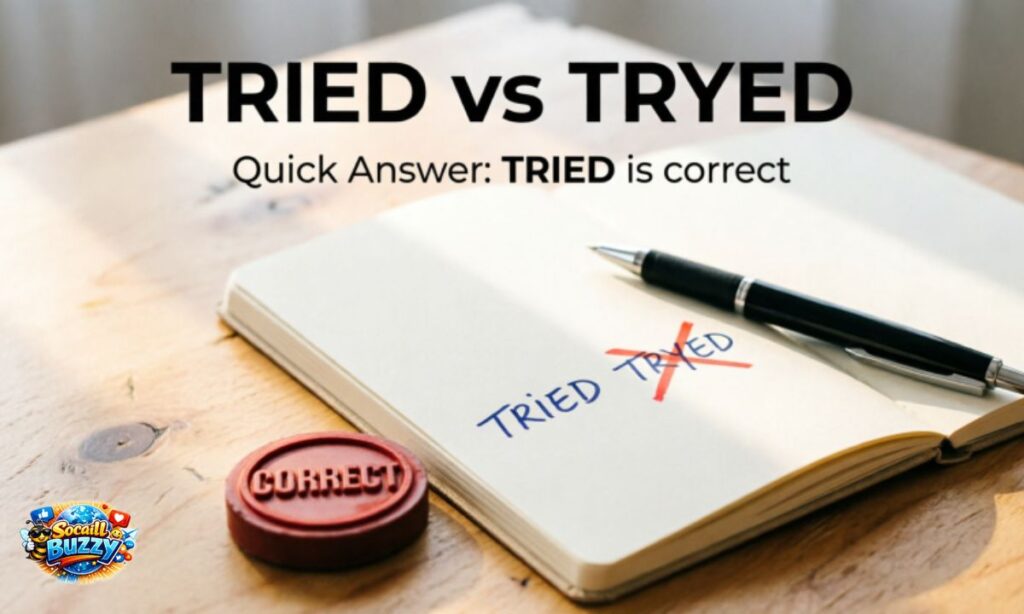
If you only need a fast answer, here it is: tried is correct, and tryed is always wrong.
- ✅ Correct: I tried to finish the report early.
- ❌ Incorrect: I tryed to finish the report early.
There is no situation, formal or informal, where “tryed” becomes acceptable. It does not appear in dictionaries, style guides, or grammar references. The rule behind this choice is short and easy to remember, and the next section explains exactly where it comes from.
Click Here To Read More…
The Origin and Spelling Rule
The verb try traces back to Old French trier, which meant to pick out, sort, or test something. Over centuries, English speakers shortened and adapted the word until it became the simple, everyday verb we use now.
As English developed consistent spelling patterns, verbs ending in a consonant plus “y” were given a specific past tense rule to keep pronunciation and spelling predictable.
The rule is this: when a verb ends in a consonant + y, you drop the “y,” add an “i,” and then attach “-ed.” This small change prevents awkward letter combinations and keeps the word easy to read and pronounce. Since “try” ends in the consonant “r” followed by “y,” it must follow this pattern, which is why “tried” is correct and “tryed” is not.
This same rule shapes many other common English verbs, which is why learning it once helps you spell dozens of words correctly. The logic behind the rule is mostly about pronunciation.
If English kept the “y” and simply added “-ed,” the resulting word would create an unusual letter combination that does not match how English speakers naturally read vowel sounds.
Changing the “y” to an “i” keeps the sound smooth and the spelling predictable, which is one reason this rule has stayed stable for centuries.
It also helps to understand what “consonant” and “vowel” mean in this context, since the whole rule depends on the letter right before the “y.” A consonant is any letter that is not a, e, i, o, or u. In the word “try,” the letter right before “y” is “r,” which is a consonant.
That single detail triggers the spelling change. If the letter before the “y” were a vowel instead, like in “play” or “stay,” the rule would not apply, and the word would simply add “-ed” without any change.
Examples of the Rule
Here are common verbs that follow the same consonant + y pattern:
- 🔤 Cry → Cried – She cried after hearing the good news.
- 🔤 Deny → Denied – He denied the accusation immediately.
- 🔤 Reply → Replied – They replied to the email within minutes.
- 🔤 Study → Studied – We studied for the exam all weekend.
- 🔤 Carry → Carried – The movers carried the boxes upstairs.
- 🔤 Fry → Fried – She fried the vegetables in olive oil.
Notice that each verb ends with a consonant right before the “y.” That single detail is the trigger for the spelling change, and it applies the same way to “try” becoming “tried.”
A few more examples that follow this exact pattern:
- 🔤 Apply → Applied – She applied for the job last week.
- 🔤 Copy → Copied – He copied the notes from the whiteboard.
- 🔤 Hurry → Hurried – They hurried to catch the train.
- 🔤 Marry → Married – The couple married in the spring.
Once you notice this pattern a few times, it becomes almost automatic. Your brain starts recognizing the consonant-plus-y ending and applies the spelling change without much conscious thought, which is exactly the goal when learning any grammar rule.
British English vs American English
One question people often ask is whether tried changes depending on the region. It does not. Both British English and American English use the exact same spelling for this word. There is no regional variant, no alternate British spelling, and no separate American form.
| Feature | British English | American English |
| Past tense of try | Tried | Tried |
| Pronunciation | /traɪd/ | /traɪd/ |
| Acceptable in formal writing | Yes | Yes |
| Alternate spelling | None | None |
This makes tried one of the more reliable words in English. Unlike words such as “colour” versus “color,” there is no split here. Whether you are writing for a UK audience, a US audience, or an international one, “tried” is always the safe and correct choice.
Which Spelling Should You Use?
The answer is simple: always use tried. There is no context, audience, or writing style where “tryed” is the better option. Whether you are writing a school essay, a business email, a social media caption, or a legal document, “tried” is the only form that dictionaries and grammar authorities recognize.
Some people wonder if “tryed” might work in casual texting or informal chats. Even in relaxed writing, using the wrong spelling can make a message look careless. Readers may pause or feel confused, which slows down communication instead of helping it. Sticking with tried keeps your writing clear, professional, and easy to trust, no matter who reads it.
A simple way to remember the rule is to connect it to similar words you already know. If you can spell “cried” or “studied” correctly, you already understand the pattern that makes “tried” correct too.
Content creators, students, and professionals all benefit from getting this right consistently. In SEO writing and blogging, spelling errors like “tryed” can lower reader trust and even affect how search engines evaluate the quality of a page. In academic settings, a misspelled past tense verb can distract a reader from the actual argument being made.
And in business communication, small errors like this one can shape how colleagues or clients perceive your attention to detail. None of this means one mistake will ruin your credibility, but building the habit of using tried correctly adds up over time and makes your writing stronger overall.
Common Mistakes with Tryed or Tried
Even careful writers slip up sometimes. Here are the three most common mistakes people make with this word, along with why they happen.
Mistake 1: Adding -ed directly
The most frequent error is treating try like a regular verb and simply adding “-ed” to the end. This produces “tryed,” which looks logical but breaks the spelling rule for verbs ending in consonant plus “y.” Regular verbs like “walk” or “jump” only need “-ed,” but “try” needs the extra step of changing the “y” to an “i” first.
Mistake 2: Forgetting the “y to i” rule
Some writers know the word should look different but forget exactly how. They might add extra letters or misplace the “i,” leading to spellings that still do not match the correct form. Practicing the rule with a few examples, like cry to cried or deny to deny, helps lock the pattern into memory.
Mistake 3: Confusing with words ending in vowel + y
Not every “y” verb follows the same rule. Words ending in a vowel plus y, such as “play” or “stay,” keep the “y” and simply add “-ed,” giving you “played” and “stayed.” Writers sometimes apply this vowel-plus-y pattern to “try” by mistake, which is another path that leads to the incorrect “tryed.” Remembering that “try” ends in consonant plus “y,” not vowel plus “y,” clears up this confusion.
Here is a quick way to test yourself before you hit publish or send on any piece of writing:
- 1️⃣ Look at the letter right before the final “y” in your verb.
- 2️⃣ Ask whether that letter is a consonant or a vowel.
- 3️⃣ If it is a consonant, change the “y” to “i” and add “-ed.”
- 4️⃣ If it is a vowel, keep the “y” and simply add “-ed.”
- 5️⃣ Read the sentence out loud to check that the word sounds and looks right.
This five-step check takes only a few seconds once it becomes a habit, and it works for far more verbs than just “try.”
Tried in Everyday Examples
Seeing a word used across different situations makes it easier to remember. Here is tried in a variety of everyday contexts:
- 🗣️ Spoken English: “Have you tried the new coffee shop downtown?”
- 📧 Professional Email: “I tried reaching you earlier but had no luck.”
- 📚 Academic Writing: “Researchers tried several methods before finding a solution.”
- 📱 Social Media: “We tried this recipe last night and loved it.”
- ⚖️ Legal Context: “The case was tried in front of a jury.”
- 🏠 Casual Conversation: “I tried calling my mom, but she didn’t pick up.”
Across all of these examples, the spelling never changes. Whether the tone is formal or casual, tried stays consistent, which is part of what makes it such a dependable word to learn once and use forever.
Here are a few more real-world scenarios where the word shows up naturally:
- 🍽️ Restaurant Review: “We tried the pasta special and it did not disappoint.”
- 💼 Job Interview: “In my last role, I tried a new onboarding process that improved retention.”
- 🏋️ Fitness Journal: “I tried a new workout routine this week and felt stronger by day three.”
- 🧳 Travel Blog: “We tried the local street food in every city we visited.”
- 🖥️ Tech Support: “I tried restarting the device before contacting support.”
Seeing the word in so many different settings shows just how flexible it is. No matter the subject, from food to fitness to technology, tried slots naturally into the sentence without ever changing form.
Google Trends & Usage Data
Search behavior around this topic tells an interesting story. People type “tryed or tried” into search engines far more often than you might expect, and most of these searches come from a genuine desire to confirm the correct spelling rather than curiosity about two valid options.
Here is what usage patterns generally show:
- 📈 Tried appears far more often across books, news sites, and everyday writing than “tryed.”
- 🔍 Searches for tryed are almost always spelling checks or grammar questions, not evidence of a real second form.
- 🌍 English speakers in the United States, United Kingdom, Canada, and Australia all search for and use the same correct spelling.
- 🧑🎓 Students, non-native speakers, and fast typists are the groups most likely to search this comparison.
- 💻 Spellcheckers and grammar tools in nearly every writing platform flag “tryed” as an error automatically.
This pattern confirms that “tried” is the dominant, dictionary-approved form, while “tryed” exists mainly as a common typing mistake rather than an accepted alternative.
Interestingly, many of the searches for “tryed” come from people who already suspect it is wrong but want confirmation before they publish or send something important.
This shows a growing awareness among writers, students, and professionals that small grammar details matter, especially in a world where so much communication happens through text, email, and online content.
Search engines themselves also play a role here. Modern search tools are quick to suggest the correct spelling when someone types “tryed,” which nudges even more users toward the correct form over time.
Comparison Table: Tryed vs Tried
A quick side-by-side view makes the difference easy to see at a glance.
| Category | Tryed | Tried |
| Correct spelling | ❌ No | ✅ Yes |
| Found in dictionaries | ❌ No | ✅ Yes |
| Follows spelling rule | ❌ No | ✅ Yes |
| Acceptable in formal writing | ❌ No | ✅ Yes |
| Acceptable in casual writing | ❌ No | ✅ Yes |
| Flagged by spellcheck | ✅ Yes (as an error) | ❌ No |
| Used in British English | ❌ No | ✅ Yes |
| Used in American English | ❌ No | ✅ Yes |
This table sums up the entire debate. There is truly only one correct answer, and every category confirms it.
Tried in Different Tenses
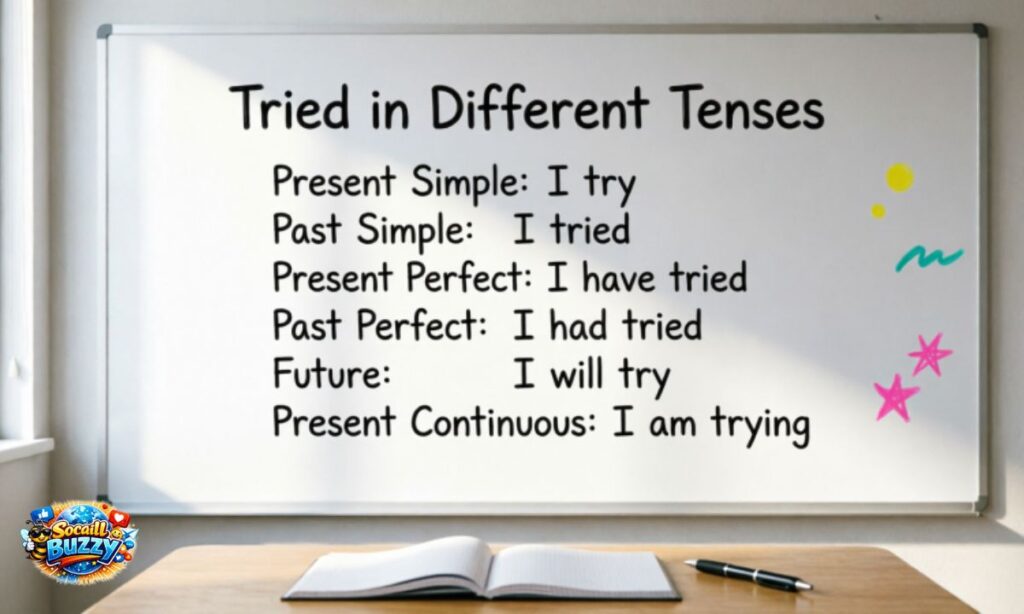
Understanding how to try changes across tenses helps you use it correctly in any sentence structure. Here is a full breakdown:
| Tense | Form | Example Sentence |
| Base form | Try | I try to eat healthy every day. |
| Present simple (he/she/it) | Tries | She tries her best in every project. |
| Past simple | Tried | He tried the new software yesterday. |
| Past participle | Tried | They have tried this method before. |
| Present participle | Trying | We are trying to fix the issue now. |
| Future | Will try | I will try again tomorrow. |
Notice that “tried” serves double duty. It works as both the simple past tense and the past participle, which means it pairs naturally with helping verbs like “have,” “has,” and “had” in perfect tense sentences.
Related Words and Forms
Learning the full family of words connected to try makes your vocabulary stronger and helps you avoid similar spelling slips in the future.
- 🔹 Try (base verb) – to attempt or make an effort
- 🔹 Tries (third person singular) – he tries, she tries, it tries
- 🔹 Trying (present participle/gerund) – an ongoing attempt
- 🔹 Tried (past tense/past participle) – a completed attempt
- 🔹 Trial (noun) – a test, experiment, or legal proceeding
- 🔹 Trier (noun) – a person who makes an effort
Synonyms that carry a similar meaning to tried include attempted, tested, examined, and sampled. These alternatives can add variety to your writing when you want to avoid repeating the same word too many times in one piece.
Pronunciation Guide
Pronunciation is another area where confusion sometimes creeps in, but the word itself is short and simple once broken down.
- 🔊 Tried is pronounced /traɪd/, rhyming with words like “pride,” “side,” and “guide.”
- 🗣️ It has one syllable, so there is no need to stress different parts of the word.
- 🌍 Pronunciation stays the same across British English, American English, Australian English, and Canadian English.
- 🎧 If you can say “cried” or “dried” correctly, you already know how to pronounce “tried.”
Since “tryed” is not a real word, it has no official pronunciation. If someone reads it aloud, it would still sound identical to “tried,” which is another reason the misspelling is easy to overlook until you see it written down.
This is actually one of the biggest reasons the mistake happens so often in the first place. Because “tryed” and “tried” sound exactly the same out loud, spoken English never exposes the error.
The mistake only becomes visible in writing, which is why proofreading and reading your work back silently, word by word, remains one of the best habits for catching it before you hit send or publish.
FAQs
1. Is tryed a correct word?
No. “Tryed” is a common misspelling and does not appear in any standard English dictionary.
2. What is the past tense of try?
The correct past tense of try is tried, formed by changing the y to i and adding ed.
3. Why does try become tried?
Verbs ending in a consonant plus y change the y to i before adding ed, and try follows this rule.
4. Is tried used in both British and American English?
Yes. Tried is spelled and used the same way in both British and American English.
5. When do we not change y to i?
When a verb ends in a vowel plus y, like play or stay, you keep the y and simply add ed.
6. Is tried formal or informal?
Tried works in both formal and informal writing, including emails, essays, and casual conversation.
7. Can using tryed affect professional writing?
Yes. Using tryed instead of tried can make writing look careless and less credible to readers.
Conclusion
The choice between tryed or tried comes down to one simple rule: verbs ending in a consonant plus “y” change that “y” to “i” before adding “-ed.” This is exactly why “tried” is correct and “tryed” will always be a spelling mistake, no matter the audience or writing style.
Once this pattern clicks, you will notice it applies to many other familiar words, from “cried” to “studied” to “carried.” Keep this guide handy, practice with a few example sentences, and you will never hesitate over this word again.

Welcome to SocaillBuzzy! I’m the creator and writer behind this platform, dedicated to sharing meaningful content including grammar, meaning, quotes, and inspirational messages for everyday life. Through well-crafted, SEO-friendly content, I aim to spread positivity, strengthen connections, and make it easier for readers to express their emotions with clarity and warmth.