
If you’ve ever typed a sentence and paused, did I just use the right word? you’re not alone. “Drove” and “driven” are two of the most commonly confused verb forms in the English language, even among native speakers. Both come from the same root verb, drive, but they work in very different ways inside a sentence.
Get this distinction wrong, and your writing can sound off. Get it right, and you’ll communicate clearly and confidently in emails, essays, conversations, and everything in between.
This guide breaks down the difference between drove vs driven, explains exactly when to use each one, and gives you dozens of real examples so the rule sticks for good.
What Is the Verb “Drive”? Understanding the Base Form
Before comparing drove and driven, it helps to understand the full verb family they belong to.
Drive is an irregular verb. Unlike regular verbs which simply add -ed to form past tenses (e.g., walk → walked) irregular verbs follow their own patterns. The verb drive changes its internal vowel rather than adding a suffix.
Here are the four core forms of drive:
| Form | Word | Example Sentence |
| Base (Infinitive) | drive | I drive to work every day. |
| Simple Past | drove | She drove to the airport yesterday. |
| Past Participle | driven | He has driven that route before. |
| Present Participle | driving | They are driving through the mountains. |
Quick note: “Drived” is never correct. It does not exist in standard English. Drive is irregular and always use drove or driven for past references.
Click Here To Read Hassle vs Hastle
What Does “Drove” Mean? (Simple Past Tense)
Drove is the simple past tense of drive. It describes an action that was completed at a specific point in the past. Crucially, drove works alone; it does not need any auxiliary (helper) verbs to form a grammatically complete sentence.
Rules for Using “Drove”
- Use it to describe a single, completed action in the past
- Use it without helper verbs like has, have, or had
- Use it when the time of the action is clear or implied (e.g., yesterday, last week, in 2020)
Examples of “Drove” in Sentences
- She d.rove home after the meeting.
- We d.rove across the country last summer.
- My brother drove us to the airport.
- He drove a truck for ten years before switching careers.
- I drove three hours just to see the concert.
- They drove through the night without stopping.
Notice how every sentence above stands on its own. There’s no has, have, or had anywhere. That’s the hallmark of d.rove.
What Does “Driven” Mean? (Past Participle)
Driven is the past participle of drive. Unlike d.rove, it cannot stand alone in a sentence. It always needs an auxiliary verb such as has, have, had, was, were, or been to function correctly.
Driven appears in three key grammatical situations:
- Perfect tenses (present perfect, past perfect, future perfect)
- Passive voice constructions
- As an adjective describing a person, product, or concept
Rules for Using “Driven”
- Always pair it with a helper verb (has, have, had, was, were, been)
- Use it to describe actions that have ongoing relevance or occurred before another event
- Use it in passive constructions where the subject receives the action
- Use it as an adjective to describe motivation or a quality
Drove vs Driven: Side-by-Side Comparison

| Feature | Drove | Driven |
| Grammatical role | Simple past tense | Past participle |
| Needs a helper verb? | ❌ No | ✅ Yes |
| Stands alone? | ✅ Yes | ❌ No |
| Used in perfect tenses? | ❌ No | ✅ Yes |
| Used in passive voice? | ❌ No | ✅ Yes |
| Can be used as adjective? | ❌ No | ✅ Yes |
| Example | She drove to work. | She has driven to work. |
How to Use “Driven” in Perfect Tenses
Perfect tenses describe actions connected across time either to the present, to another past moment, or to a future point. Driven is required in all of them.
1. Present Perfect Tense (have/has + driven)
This tense links a past action to the present. It’s often used for experiences or repeated actions.
- I have driven a Tesla before.
- She has driven that route many times.
- They have driven through the mountains on every road trip.
- He has driven since he was sixteen.
2. Past Perfect Tense (had + driven)
This tense describes an action completed before another past event.
- By the time I arrived, they had already driven to the airport.
- He had driven 300 miles before the engine failed.
- She had driven that road so often, she could do it blindfolded.
3. Future Perfect Tense (will have + driven)
This tense describes something that will be completed before a future moment.
- By this time next year, they will have driven across all 50 states.
- She will have driven over 100,000 miles by the time she retires.
How to Use “Driven” in Passive Voice
In passive voice sentences, the subject receives the action rather than performing it. Passive constructions always use a form of be (is, was, were, been) paired with driven.
Passive Voice Examples
- The car was driven by a professional driver.
- The truck is driven by remote control.
- The route was driven in record time.
- The vehicle had been driven extensively before the sale.
- The car was driven only once before being parked in the garage.
Grammar Tip: In passive voice, you can often omit the agent (the by… phrase) when it’s obvious or unimportant. “The car was driven carefully” is perfectly correct even without specifying who drove it.
“Driven” as an Adjective
One aspect of driven that often surprises learners is its role as an adjective. When used this way, driven describes a person’s character or a system’s operating nature with no helper verb needed.
“Driven” Describing a Person
When used as an adjective for a person, driven means motivated, ambitious, and determined to succeed.
- She is a driven professional who never misses a deadline.
- He is one of the most driven students in the program.
- You need to be driven to succeed in competitive industries.
“-Driven” in Compound Adjectives
Driven frequently appears in compound adjectives that describe what motivates or powers something:
| Compound Adjective | Meaning | Example |
| data-driven | guided by data | a data-driven business strategy |
| market-driven | shaped by market forces | a market-driven economy |
| goal-driven | motivated by goals | a goal-driven approach |
| results-driven | focused on outcomes | a results-driven team |
| wind-driven | powered by wind | wind-driven turbines |
| character-driven | centered on character | a character-driven story |
These compound forms are widely used in business, technology, journalism, and academia.
Common Mistakes People Make with Drove and Driven
Even fluent English speakers make errors with these two words. Here are the most frequent mistakes and how to fix them.
Mistake 1: Using “driven” without a helper verb
❌ I driven to work this morning. ✅ I d.rove to work this morning. ✅ I have driven to work this morning.
Mistake 2: Using “drove” with a helper verb
❌ She has drove that car for years. ✅ She has driven that car for years.
❌ We had drove all night. ✅ We had driven all night.
Mistake 3: Saying “drived”
❌ He drived to the store yesterday. ✅ He d.rove to the store yesterday.
Drived is not a real word. Drive is irregular and must use d.rove or driven.
Mistake 4: Confusing present perfect and simple past meaning
❌ I drove to the store and I am shopping now. (implies the driving and shopping are disconnected) ✅ I have driven to the store and I am shopping now. (shows the action connects to the present)
Quick Decision Guide: When to Use Drove or Driven
Not sure which word to use? Walk through these three questions:
Step 1: Is there a helper verb in the sentence (has, have, had, was, were, been)?
- If yes → use driven
- If no → continue to Step 2
Step 2: Is the action clearly completed in the past with no connection to now?
- If yes → use d.rove
- If no → consider whether a perfect tense (with driven) is more appropriate
Step 3: Are you describing someone’s personality or a system?
- If yes → use driven as an adjective (e.g., a driven person, data-driven decisions)
Memory Trick: “D.rove stands alone. Driven needs a companion.”
Real-World Examples: Drove vs Driven in Context
Sometimes the best way to internalize a grammar rule is to see it applied naturally. Here’s how a real conversation might use both words correctly:
“I drove to the trailhead at 6 AM,” said Maria. “By the time we got there, Jake had driven three hours from the other direction. He has driven that mountain road so many times, he practically knows every curve. Honestly, I think I have driven more miles this month than I did all of last year.”
Jake laughed. “You know, the car was driven hard today. I’m not surprised it’s making that noise.”
In this short passage, you can see:
- drove simple past, standalone, one completed action
- had driven past perfect, action completed before another
- has driven present perfect, experience/repeated action
- have driven present perfect, current relevance
- was driven passive voice
All correct. All natural.
The History Behind “Drive, Drove, Driven”
Understanding where these forms come from can make them easier to remember.
Drive traces its roots to Old English (drīfan), part of a class of verbs known as strong verbs. These verbs changed their internal vowel to indicate a system called ablaut rather than adding suffixes. This is why we say drive → drove → driven rather than drive → drived.
Many of the most common English verbs follow this same pattern. Compare:
| Base Form | Simple Past | Past Participle |
| drive | drove | driven |
| write | wrote | written |
| ride | rode | ridden |
| rise | rose | risen |
| bite | bit | bitten |
| hide | hid | hidden |
Seeing the pattern across similar verbs can make each individual form easier to remember.
Drove vs Driven in Formal vs Informal Writing
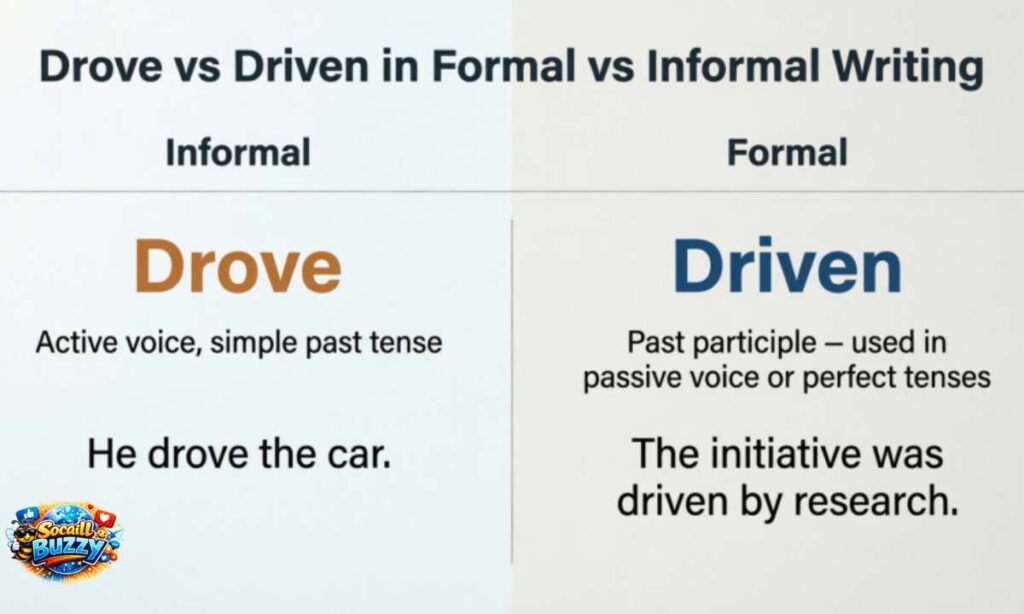
Both drove and driven are appropriate in any register, formal or informal. However, the grammatical structures they appear in may vary by context.
| Context | Likely Form | Example |
| Casual conversation | drove | “I drove here this morning.” |
| Storytelling | drove | “She drove through the desert alone.” |
| Resume / professional bio | driven (adjective) | “A driven leader with 10 years of experience.” |
| Academic writing | driven (perfect tense) | “The vehicle had been driven over 80,000 miles.” |
| News reporting (passive) | driven | “The car was driven into a barrier.” |
| Business strategy | driven (compound adj.) | “Our data-driven approach guides every decision.” |
Frequently Asked Questions About Drove vs Driven
Is “have drove” correct?
No. The correct form is “have driven.” D.rove never pairs with helper verbs.
Can I say “I driven to work”?
No. Without a helper verb, you must say “I drove to work.”
Is “drived” a real word?
No. Drived do not exist in English. Drive is irregular, so its past forms are drove and driven only.
Can “driven” be used without a helping verb?
Only when it functions as an adjective, for example, “She is a driven person” or “a data-driven strategy.”
What’s the difference between “I drove” and “I have driven”?
“I drove” refers to a specific completed past action. “I have driven” connects a past experience to the present moment, often implying relevance now.
Is “was driven” correct?
Yes. “Was driven” is a passive voice construction and is grammatically correct for example, “The car was driven carefully.”
Which form is used in passive voice?
Always driven. Passive voice requires a form of be + past participle: was driven, is driven, were driven, had been driven.
Can “driven” describe a person?
Yes. As an adjective, driven describes someone who is highly motivated and goal-oriented.
What about compound words like “data-driven”?
These use driven as an adjective suffix. They are correct and very common in business and technology writing.
How do I know if I need “drove” or “driven” quickly?
Look for a helper verb (has, have, had, was, were). If one is present, use driven. If not, use drove.
Conclusion: Mastering Drove vs Driven
The difference between drove and driven comes down to one clear rule: drove stands alone; driven needs support.
- Drove is the simple past tense. It describes a completed action in the past and doesn’t need any helping verbs. Use it when you’re stating a straightforward fact about something that happened.
- Driven is the past participle. It works alongside helper verbs (has, have, had, was, were) to form perfect tenses and passive constructions. It also functions independently as an adjective.
Once you train yourself to look for helper verbs in a sentence, the choice becomes automatic. If you spot has, have, or had, reach for drive. If the sentence stands alone with no helpers, drive is your word.
These aren’t just grammar rules, they’re tools for clearer communication. Whether you’re writing a business report, telling a story, or crafting a professional bio, using drove and driven correctly makes your language sharper, more natural, and more credible.
Practice the examples in this guide, use the decision flowchart when in doubt, and you’ll have this mastered in no time.

Welcome to SocaillBuzzy! I’m the creator and writer behind this platform, dedicated to sharing meaningful content including grammar, meaning, quotes, and inspirational messages for everyday life. Through well-crafted, SEO-friendly content, I aim to spread positivity, strengthen connections, and make it easier for readers to express their emotions with clarity and warmth.