Meating vs Meeting :
Have you typed “meating” in an email or a chat message and then paused, wondering if that’s even a real word? You’re not alone. Thousands of people search this exact question every month because “meating” and “meeting” look almost identical, sound nearly the same when spoken quickly, and are separated by just one letter.
Here’s the short answer: meeting is correct. It’s the word you use for a gathering of people, a discussion, or an appointment. “Meating,” in nearly every everyday context, is a spelling mistake not a recognized word in standard English.
But there’s more to this story than a simple typo. In this guide, you’ll learn where both words come from, how to pronounce and spell them correctly, why “meating” trips people up so often, and how to avoid the mistake for good.
We’ll also look at a close cousin of these words “meting” which actually is a real (but different) word. By the end, you’ll never second-guess yourself again.
Origins and Meanings of Meating vs Meeting

To understand why this confusion happens, it helps to look at where each word actually comes from. English is full of near-identical word pairs, and “meeting” vs. “meating” is a textbook example of how a single vowel sound can create two completely different meanings.
Meeting Meaning in English
“Meeting” is a noun formed from the verb meet, which traces back to the Old English word mētan, meaning “to come upon” or “to encounter.” Over hundreds of years, this evolved into the modern sense of people coming together for a shared purpose.
Today, a meeting refers to:
- A gathering of people for discussion, planning, or decision-making
- A scheduled business, academic, or social appointment
- An online or in-person session where ideas are exchanged
- A point where two things intersect (for example, “the meeting of two rivers”)
Because it describes something so common in daily life, work, school, family, and community, “meeting” is one of the most frequently used nouns in the English language.
Meating Meaning
“Meating” is formed by adding “-ing” to the word meat, which refers to the flesh of animals used as food. Grammatically, it could function as a present participle or gerund of a verb “to meat” but that verb barely exists in modern English.
In practice, “meating” shows up in only two situations:
- As a spelling mistake for “meeting” by far the most common reason you’ll ever see this word.
- In rare, specialized contexts related to meat processing, meat supply, or historical hunting terminology usage that has almost disappeared from everyday English.
Unless you work in the meat industry and are using it in a very specific technical sense, “meating” is not a word you should ever type on purpose.
Meting Meaning
There’s a third word worth knowing, because it’s often lumped into this same confusion: meting. This one comes from the verb mete, meaning “to distribute” or “to give out,” typically in the context of justice or punishment.
Example: “The judge was meting out sentences to each defendant.”
Notice that “meting” has only one “e” before the “t,” unlike “meeting,” which has a double “e.” Unlike “meating,” meting is a legitimate, dictionary-recognized word; it’s just used far less often and in a narrower context.
Click Here To See More…
Correct Spelling and Pronunciation (Meating vs Meeting)
Here’s a simple side-by-side comparison to settle the spelling question once and for all Meating vs Meeting.
| Word | Correct Spelling | Pronunciation | Real Words? | Meaning |
| Meeting | M-E-E-T-I-N-G | /ˈmiː.tɪŋ/ (MEE-ting) | Yes | A gathering of people for discussion |
| Meating | M-E-A-T-I-N-G | /ˈmiː.tɪŋ/ (MEE-ting, same sound) | Rarely/No | Almost always a typo; occasionally tied to meat processing |
| Meting | M-E-T-I-N-G | /ˈmiː.tɪŋ/ (MEE-ting) | Yes | Distributing or handing out (e.g., punishment) |
The tricky part is pronunciation: all three words often sound nearly identical when spoken at normal conversational speed. That’s exactly why so many people rely on how a word sounds instead of how it’s actually spelled and end up typing the wrong one.
Quick spelling rule: Meeting = meet + ing. If you can replace the word with “gathering,” “discussion,” or “appointment,” you need the double “e” spelling meeting, not meating.
How to Use ‘Meeting’ in Sentences
Since “meeting” is the word you’ll use 99% of the time, let’s look at how it fits naturally into everyday and professional writing.
- We scheduled a meeting for Monday morning to discuss the budget.
- The client meeting ran twenty minutes over schedule.
- Our weekly team meeting helps everyone stay aligned on goals.
- She was nervous before her first meeting with the new manager.
- The board meeting ended with a unanimous vote.
- Please join the meeting link five minutes before it starts.
- The parent-teacher meeting has been rescheduled to Friday.
- After the meeting, we all felt clearer about next steps.
Notice how “meeting” fits naturally into business writing, education, casual conversation, and even sports (“an athletics meeting”). It’s a versatile, essential word which is exactly why getting the spelling wrong stands out so much.
Why ‘Meating’ is Usually Incorrect
If “meating” isn’t a standard word, why do so many people type it? A few clear reasons explain the mistake:
- Identical pronunciation – “Meeting” and “meating” sound the same when spoken casually, so your brain doesn’t flag anything wrong.
- Fast typing and autocorrect – On mobile keyboards, a single mistyped vowel slips through easily, and autocorrect doesn’t always catch it.
- Visual similarity – The two words differ by only one letter, so a quick glance during proofreading can miss it.
- Unfamiliarity with “meat” as a root word – Many writers don’t consciously connect “meating” to “meat,” so it doesn’t register as odd.
- Contextual prediction – Readers’ brains automatically interpret “meating” as “meeting” based on context, which means the error often goes unnoticed by both writer and reader.
The result: this typo appears constantly in emails, chat messages, assignments, and even professional documents often without anyone catching it until it’s pointed out.
Bottom line: If your sentence is about people gathering, talking, planning, or discussing something, you need “meeting.” Save “meating” for the rare technical writing tied to meat production, and even then, double-check that it’s really the word you need.
Common Confusions and Mistakes (Meating vs Meeting)
Beyond meating vs meeting there’s a whole cluster of similar-sounding words that trip people up. Let’s break down each pairing.
Meet vs Meating vs Meeting
| Word | Part of Speech | Meaning | Example |
| Meet | Verb | To come together with someone | “Let’s meet at noon.” |
| Meat | Noun | Animal flesh used as food | “We bought fresh meat for dinner.” |
| Meeting | Noun | A gathering for discussion | “The meeting starts at 10 AM.” |
These three words are pronounced almost identically, but their meanings and grammatical roles are completely different. “Meet” is an action, “meat” is a food item, and “meeting” is the event created when people “meet.”
Meeting vs Meting
As covered earlier, “meeting” (double “e”) refers to a gathering, while “meting” (single “e”) refers to distributing or handing out something, usually in a formal or legal sense.
- Correct: “The committee held a meeting to review the case.”
- Correct: “The court is meting out penalties for the violation.”
Mixing these up is less common than the meating/meeting error, but it does happen, especially in formal or legal writing.
Spelling Mistakes in English (Meating vs Meeting)
English is notorious for near-homophone words that sound alike but are spelled differently and mean different things. A few well-known examples include:
- Their / There / They’re
- Affect / Effect
- Complement / Compliment
- Stationary / Stationery
- Meeting / Meating / Meting
These mistakes happen because English spelling doesn’t always match pronunciation consistently, unlike more phonetic languages. Understanding the pattern behind these errors makes it easier to catch them in your own writing.
Scenarios (Meating vs Meeting)
Here are real-world examples of where the meating/meeting mix-up commonly appears, and how to fix it:
| Incorrect | Correct |
| “We have a client meating tomorrow.” | “We have a client meeting tomorrow.” |
| “Join the meating link at 3 PM.” | “Join the meeting link at 3 PM.” |
| “The parent-teacher meating is scheduled.” | “The parent-teacher meeting is scheduled.” |
| “Let’s do a quick meating on Zoom.” | “Let’s do a quick meeting on Zoom.” |
| “The staff meating was postponed.” | “The staff meeting was postponed.” |
These mistakes might look small, but in professional emails, resumes, or reports, they can quietly damage your credibility and make your writing look careless.
Examples for Clarity (Meating vs Meeting
Let’s put both words side by side in complete sentences so the difference is unmistakable.
Correct use of “meeting”:
- The sales meeting helped the team close two new deals.
- Our book club meeting is happening this Sunday evening.
- The town hall meeting focused on community safety.
- I have back-to-back meetings all afternoon.
- The annual general meeting will be held in the main auditorium.
Rare, technical use of “meating”:
- The factory’s meating operations focus on packaging and distribution.
- Historical records mention meating practices tied to hunting seasons.
Correct use of “meting”:
- The referee was accused of meting out unfair penalties.
- Judges are responsible for meting justice according to the law.
Reading these examples side by side makes the pattern obvious: if people are involved in a discussion or gathering, it’s “meeting.” If something is being distributed or handed out, it’s “meting.” If it’s about food, it’s “meat” and “meating” almost never belong anywhere in ordinary writing.
Practice Session: Meating vs Meeting
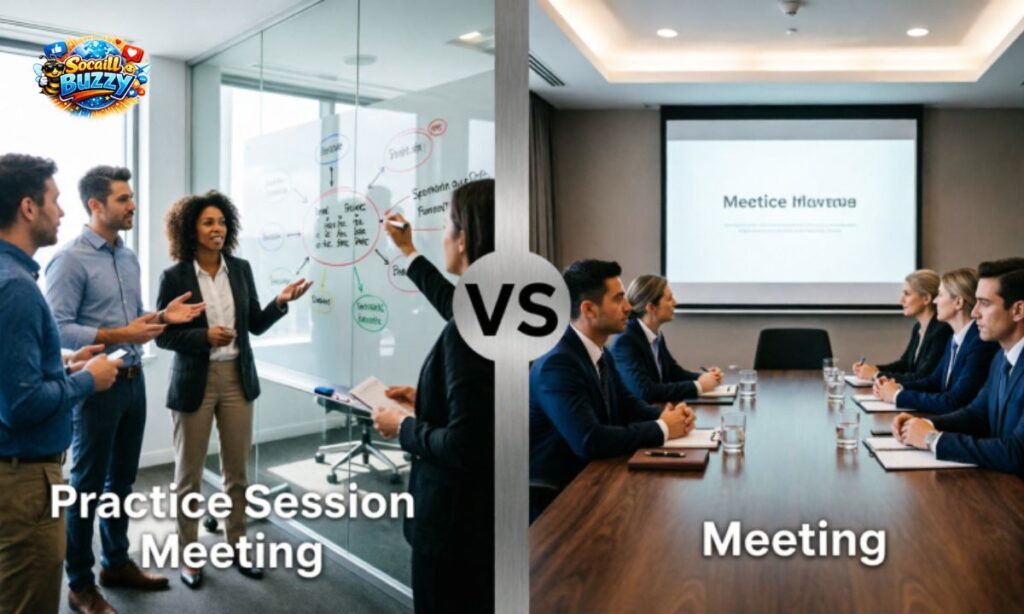
Ready to test what you’ve learned? This short practice section will help the correct spelling stick.
Fill in the Blank (Meating vs Meeting)
- We scheduled a ______ for Thursday afternoon. (meeting/meating)
- The judge is ______ out a fair punishment. (meeting/meting)
- I bought fresh ______ from the butcher. (meat/meet)
- Let’s ______ for coffee tomorrow. (meet/meat)
- The team ______ ran longer than expected. (meeting/meating)
Correct the Sentences (Meating vs Meeting)
- “We have a client meating at 2 PM.”
- “Join the meating link on time.”
- “The board meating was very productive.”
- “Our weekly meating helps us stay organized.”
- “She led the meating with confidence.”
Scenarios (Meating vs Meeting)
Imagine you’re proofreading a coworker’s email before it’s sent to a client. The draft reads: “Looking forward to our meating next week.” What would you correct, and why?
Or picture this: you’re writing a report about a courtroom case and need to describe how the judge assigned sentences. Which word fits meeting or meting?
Answer (Meating vs Meeting)
- Fill in the blank: (1) meeting, (2) meting, (3) meat, (4) meet, (5) meeting
- Corrected sentences: all five should replace “meating” with “meeting.”
- Scenario 1: Replace “meating” with “meeting” . The sentence is about a scheduled business gathering.
- Scenario 2: Use “meting” the sentence describes distributing punishment, not gathering people.
Tips to Avoid Mistakes (Meating vs Meeting
- Remember the root word: Meeting = meet + ing. If the sentence is about people, use meeting.
- Think “food vs. people”: Meat is something you eat; meeting is something you attend.
- Proofread out loud: Reading your sentence aloud can help you catch the visual typo your eyes might skip.
- Use spell-check, but don’t rely on it fully: Autocorrect doesn’t always catch “meating” because it can sometimes register as a valid variant.
- When in doubt, ask yourself: “Are people gathering, or are we talking about meat?” The answer almost always points you to the right word.
Frequently Asked Questions (Meating vs Meeting)
What is the difference between Meating vs Meeting?
“Meeting” refers to a gathering of people for discussion or a shared purpose. “Meating” is almost always a misspelling of “meeting,” with rare technical use tied to meat processing.
What is the meaning of meating?
“Meating” relates to the word “meat” and, outside of very rare industry usage, is not considered a standard English word.
What’s the difference between meet and meat?
“Meet” is a verb meaning to come together with someone, while “meat” is a noun referring to animal flesh used as food.
Is meating a real word in English?
Not in standard, everyday English. It appears in dictionaries only in narrow, specialized contexts related to meat production.
What is a posh word for meeting?
Formal alternatives include “conference,” “assembly,” “convocation,” “council,” or “session,” depending on the context.
Can meating be used in casual conversation?
Not using “meating” in casual conversation will almost always be read as a typo for “meeting” and can cause confusion.
How can I remember Meating vs Meeting?
Use this mnemonic: “Meeting” has people meeting together (meet + ing), while “meat” is something you eat to keep the two roots separate in your mind.
Conclusion (Meating vs Meeting)
The debate between “meating vs meeting” really comes down to one simple rule: if your sentence is about people coming together for work, school, or any kind of discussion the correct word is always meeting.
“Meating” belongs almost exclusively to rare, technical writing about meat processing, and using it anywhere else will read as a spelling mistake.
The confusion is understandable. Both words sound alike, they’re separated by a single letter, and fast typing or autocorrect can easily let the error slip through.
But now that you understand the origins, the correct spelling, and the small tricks to tell these words apart, you can write with confidence every time.
Next time you’re about to type “meating,” pause for a second and ask yourself: are people gathering, or are we talking about meat? Get that answer right, and your spelling will take care of itself.

Welcome to SocaillBuzzy! I’m the creator and writer behind this platform, dedicated to sharing meaningful content including grammar, meaning, quotes, and inspirational messages for everyday life. Through well-crafted, SEO-friendly content, I aim to spread positivity, strengthen connections, and make it easier for readers to express their emotions with clarity and warmth.